Author: Senthil Kumar, Technical Director | Updated: March 2026
On This Page
- What Is an Air Blast Oil Cooler?
- How It Works — The Cooling Process Step by Step
- Why Plants Choose Air Blast Oil Coolers
- Applications — Every Machine That Runs Hot Oil
- Design and Key Specifications
- Construction — What's Inside Every Unit
- Materials of Construction
- How to Select the Right Air Blast Oil Cooler
- Air Blast vs. Water-Cooled Oil Coolers — Which Is Right for You?
- Maintenance and Inspection
- Delivery and Project Support
- Why United Heat Exchangers
- Frequently Asked Questions
- Get a Free Quote
What Is an Air Blast Oil Cooler?
An air blast oil cooler — also called an air-cooled oil cooler or fin-fan cooler — is a heat exchanger that uses ambient air to dissipate excess heat from hydraulic, lubricating, or transmission oil. It maintains optimal oil viscosity and prevents system failures in applications where water cooling is impractical or unavailable.
💡 Why oil temperature control matters: Every 18°F (10°C) rise above the recommended operating temperature cuts lubricating oil service life roughly in half. A hydraulic system running at 180°F instead of the recommended 140°F will destroy oil twice as fast — and accelerate seal, pump, and valve wear proportionally. The air blast oil cooler is the last line of defense between a productive machine and a premature failure. Getting the sizing right is not optional.
How It Works — The Cooling Process Step by Step
The operating principle is straightforward, but the engineering behind consistent performance in a real industrial environment — with varying oil viscosity, fluctuating ambient temperatures, and variable heat loads — requires precise thermal design. Here is exactly what happens inside every air blast oil cooler from United Heat Exchangers.
Hot Oil Enters
Hot oil from the machine sump, gearbox, or hydraulic reservoir enters the oil cooler through the inlet header at maximum operating temperature.
Oil Flows Through Finned Tubes
Oil is distributed through multiple passes of finned tubes. Turbulence promoters or multi-pass arrangements maintain adequate velocity even with high-viscosity oils at low temperatures.
Fan Forces Air Across Fins
An electric motor drives an axial or centrifugal fan that moves ambient air perpendicular to the tube bundle. Fins on the tube outer surface extend the air-contact area by 10–20× versus bare tubes.
Heat Transfers to Air
Thermal energy conducts from the oil through the tube wall and into the fin material, then convects into the flowing air stream. The air exits warmer; the oil exits cooler.
Cooled Oil Returns
Oil exits at or below the target operating temperature — typically 120–160°F for hydraulic systems — and returns to the machine reservoir or lube oil system ready for reuse.
💡 The viscosity challenge: Unlike water or light hydrocarbons, heavy oils change viscosity dramatically with temperature. An ISO VG 320 gear oil at 40°F can be 50× more viscous than at 180°F — meaning a unit must be designed to handle very high oil-side resistance at cold startup while still achieving the target outlet temperature at full heat load under hot operating conditions. This is why proper thermal design software — not rule-of-thumb sizing — is non-negotiable.
Why Plants Choose Air Blast Oil Coolers
No Water — No Infrastructure
Air blast oil coolers run on ambient air alone. No cooling water circuit, no cooling tower, no make-up water system, no chemical treatment, no water permit required. Drop one in, wire the fan motor, connect the oil lines — done.
Ideal for Remote and Mobile Applications
Offshore platforms, mining excavators, mobile hydraulic equipment, and remote compressor stations share one thing: no reliable water supply. Air blast coolers solve the oil cooling problem wherever the machine is located.
Compact and Self-Contained
The entire cooling system — heat exchanger, fan, motor, and housing — is one unit. It mounts directly to the machine skid, reservoir, or structural frame. No separate pump skid, no water piping network, no remote cooling tower to find space for.
Protects Equipment and Extends Oil Life
Keeping oil within its rated temperature range prevents oxidation, varnish formation, and viscosity breakdown — extending oil change intervals, protecting seals and bearings, and dramatically reducing unexpected downtime and component replacement costs.
Low Maintenance Over a Long Service Life
The only moving part is the fan. No corrosion from cooling water, no waterside scale, no tube-side fouling from process chemistry. Properly maintained fan bearings and periodic fin cleaning are the only recurring maintenance items for 15–25 years.
Wide Range of Configurations
Horizontal or vertical airflow. Forced draft or induced draft. Single fan or multi-fan. Thermostatically controlled or fixed-speed. Skid-mounted or direct machine-mounted. Every configuration is available to match your specific installation requirements.
Applications — Every Machine That Runs Hot Oil
Wherever a machine generates heat through mechanical work and relies on oil to lubricate, actuate, or cool its critical components, an air blast oil cooler is the right answer when water is unavailable, undesirable, or unnecessarily complex. United Heat Exchangers has engineered and delivered air blast oil coolers across the full spectrum of heavy industry.
The most common air blast oil cooler application. Hydraulic systems generate heat through pump inefficiency, valve pressure drops, and actuator cycling — all of which must be removed to keep hydraulic oil within its recommended operating band of 100–160°F.
- Press and injection molding machines
- Offshore subsea HPUs
- Industrial lifting and clamping systems
- Mobile crane and excavator hydraulics
Rotary screw and reciprocating compressors generate significant heat in both the compressed gas and the oil that lubricates screws, bearings, and cylinders. Air blast coolers handle the lube oil circuit when water cooling is impractical.
- Natural gas compression trains
- Air compressor lube oil coolers
- Refrigeration compressor oil coolers
- Biogas and landfill gas compression
High-power gearboxes in mills, kilns, and conveyors generate gear mesh and bearing friction heat that must be removed to maintain oil film integrity and prevent bearing fatigue. Air blast coolers integrate into the forced lubrication circuit.
- Cement and raw mill gearboxes
- Rolling mill and steel plant drives
- Mining conveyor drive gearboxes
- Paper mill and pulper drives
Steam and gas turbines depend on pressurized lube oil to lubricate journal bearings. While large turbines typically use water-cooled lube oil coolers, smaller turbines and auxiliary lube oil systems frequently use air blast coolers as the primary or backup cooling device.
- Small steam turbine lube oil systems
- Gas turbine auxiliary oil coolers
- Turbo compressor bearing lube systems
- Emergency backup lube oil cooling
Large power transformers filled with insulating mineral oil use the OFAF (Oil Forced Air Forced) cooling method — oil is circulated through external air blast radiator banks by pumps, and fans force air across the radiator surfaces to remove heat from the insulating oil.
- OFAF cooling for utility power transformers
- ODAF transformer cooling banks
- Industrial substation transformers
- Traction transformer cooling systems
Wind turbine main gearboxes and generator bearings require precise oil temperature control. Air blast coolers mounted within the nacelle cool the gearbox oil loop — operating in a challenging environment of vibration, variable load, and extreme temperature swings.
- Main gearbox oil cooling — nacelle-mounted
- Pitch drive hydraulic oil cooling
- Generator bearing lube oil cooling
- Suitable for offshore wind turbine platforms
Shipboard machinery — propulsion gearboxes, bow thruster drives, and deck crane hydraulics — frequently uses air blast oil coolers when seawater quality makes direct seawater-cooled units impractical or when a self-contained, low-maintenance solution is preferred.
- Propulsion gearbox lube oil cooling
- Offshore deck crane hydraulic systems
- Subsea module topside equipment
- Platform auxiliary machinery lube systems
Steel mills, forges, and foundries operate hydraulic systems at high ambient temperatures — often above 100°F at the machine — and require robust oil coolers that can handle high heat loads, survive dusty environments, and run continuously without planned water supply.
- Rolling mill hydraulic AGC systems
- Continuous caster mold oscillation systems
- Forge press and hammer hydraulics
- Steel ladle car hydraulic drives
Surface mining trucks, shovels, and underground LHD vehicles carry large hydraulic systems that generate significant heat — and have no access to a permanent water supply. Air blast coolers are the only practical solution for mobile mining machinery.
- Haul truck hydraulic brake cooling
- Rope shovel crowd and hoist hydraulics
- Drill rig hydraulic power units
- Underground loader transmission oil cooling
Your Application, Your Specification — Air Blast Oil Cooler Engineered for Your Machine
Don't see your application above? If it runs on oil and needs cooling without water, United Heat Exchangers can engineer the right air blast oil cooler for it. Share your heat load, oil type, ambient conditions, and space constraints — and we will size and configure a unit that fits.
Request My Free Quote →Design and Key Specifications
Every air blast oil cooler from United Heat Exchangers is custom-engineered using thermal design software to your specific oil type, heat load, ambient temperature, installation constraints, and mounting requirements. The following specifications represent the full range of our manufacturing capability.
Standard Specification Range — Air Blast Oil Cooler
| Design Parameter | Options / Range | Engineering Note |
|---|---|---|
| Airflow Arrangement | Forced draft (fan pushes air in) or induced draft (fan pulls air through) | Forced draft is standard — easier fan access, lower first cost; induced draft preferred when hot air recirculation is a concern in enclosed machine rooms |
| Airflow Direction | Horizontal (air flows sideways across vertical bundle) or vertical (air flows upward or downward through horizontal bundle) | Horizontal airflow is most common for skid-mounted units; vertical upflow is used for reservoir-top mounting where horizontal clearance is limited |
| Oil Flow Arrangement | Single-pass or multi-pass (2, 4, 6, or 8 passes) | Multi-pass increases oil velocity and heat transfer coefficient for high-viscosity oils — essential for gear oils and heavy hydraulic fluids; single-pass suits light turbine and hydraulic oils at higher flow rates |
| Thermostat / Bypass Valve | Integrated thermostatically controlled bypass valve, fan speed control via thermostat, or VFD fan speed control | A bypass valve is strongly recommended — it routes hot oil around the cooler during cold startup (preventing oil congealing in the tubes) and re-engages cooling gradually as oil temperature rises; prevents over-cooling in cold ambient conditions |
| Fan Speed Control | Fixed speed (simple ON/OFF or star-delta start), two-speed motor, thermostat-switched fan, or variable frequency drive (VFD) | VFD control delivers the lowest energy consumption and most precise oil temperature regulation; two-speed motors are a cost-effective compromise for machines with clearly defined high-load and low-load operating modes |
| Housing and Frame | Carbon steel (epoxy painted or hot-dip galvanized), stainless steel, or aluminum alloy frame | Hot-dip galvanizing or marine-grade epoxy coating for offshore, coastal, and washdown environments; aluminum alloy for weight-sensitive mobile applications; stainless steel for food-grade or pharmaceutical washdown environments |
| Electrical Enclosure | TEFC (Totally Enclosed Fan-Cooled), TENV, or EX/ATEX-rated for hazardous area classification | ATEX/IECEx-rated motors required for Zone 1 and Zone 2 hazardous areas — common for hydraulic systems on offshore platforms, compressor buildings, and fuel oil systems; always specify hazardous area classification at time of enquiry |
Construction — What's Inside Every Unit
Quality of construction determines whether an air blast oil cooler delivers its rated performance for 5 years or 25 years. Here is exactly what you get inside every United Heat Exchangers air blast oil cooler.
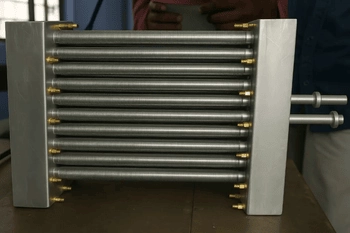
Seamless tubes with mechanically bonded or extruded aluminum fins — or welded steel fins for high-temperature oil service. Tube walls sized for the rated oil-side pressure plus a corrosion allowance. Fin density (7–12 fpi) selected during thermal design to balance heat transfer against air-side pressure drop.
Welded carbon steel or stainless steel header boxes at each end of the tube bundle — forming the oil-side pressure boundary and housing the pass partition plates that route oil through multiple tube passes. Plug-type or cover-plate headers available for tube-end access.
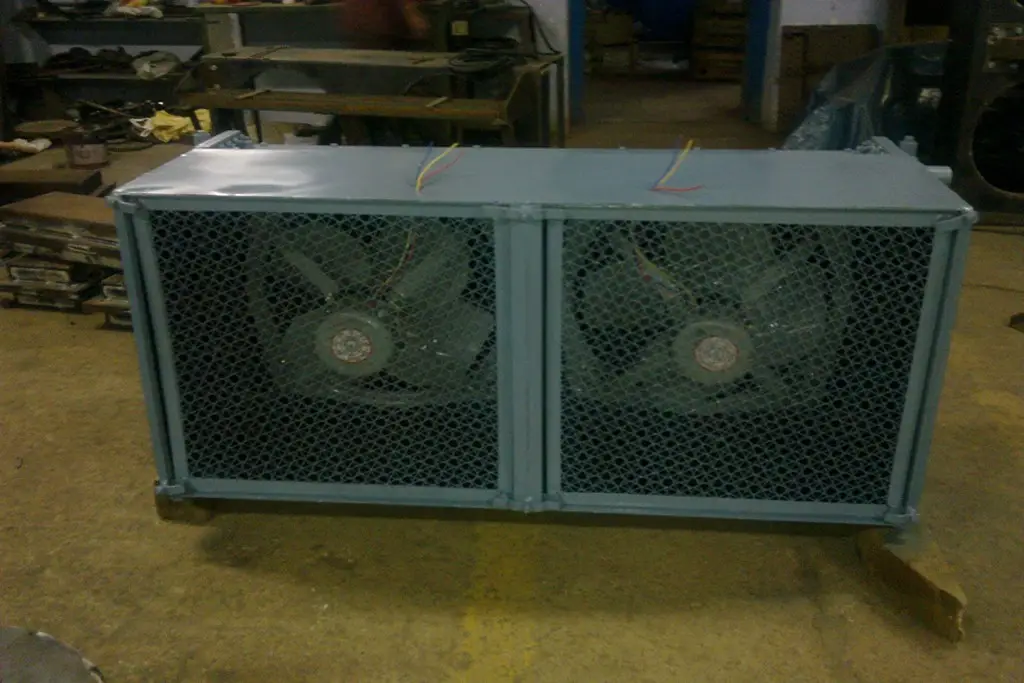
Axial-flow propeller fan on a direct-drive or V-belt motor shaft — sized to deliver the design airflow at the static pressure resistance of the fin bundle. Fan blades are aluminum alloy or FRP (fiberglass); motors are TEFC with IP55 minimum protection rating as standard.
Heavy-gauge wire fan guard on the air inlet and outlet — mandatory for personnel safety; wire mesh size per applicable safety standards. Sheet metal shroud directs airflow from the fan into the plenum and across the tube bundle uniformly.
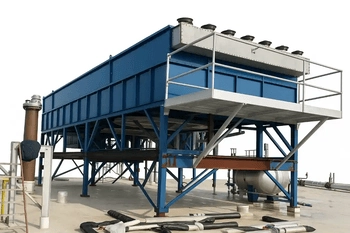
Hot-rolled steel or aluminum structural frame carries the combined weight of the tube bundle, fan assembly, and motor. Mounting feet or flange designed to match your machine baseplate, reservoir top, or structural steelwork interface — custom mounting patterns on request.
Oil inlet and outlet nozzles in NPT, BSP, SAE flanged, or ANSI flanged configurations as specified. Vent and drain connections standard. Optional thermostat pocket, pressure gauge connections, and thermometer wells available. Bypass valve body integrated into header when specified.
Materials of Construction
Material selection for an air blast oil cooler is governed by the oil chemistry, the installation environment (indoor, outdoor, marine, hazardous area), the operating pressure and temperature, and any specific regulatory or client material standards. United Heat Exchangers offers the full range of industrial materials — from standard carbon steel for inland industrial service to titanium and super duplex for aggressive offshore environments.
| Component | Standard Material | Alternative / Premium Options | Select When |
|---|---|---|---|
| Tubes (Oil Side) | Carbon steel seamless (ASTM A179) | 304/316L stainless steel; copper-nickel 90/10; admiralty brass; duplex 2205 | SS for ester or synthetic oil with corrosive additives; Cu-Ni for marine environments; duplex for offshore sour service |
| Fins (Air Side) | Aluminum alloy (1100 or 3003) — embedded or extruded; max 300°F | Galvanized steel fins; stainless steel fins for marine or chemical atmospheres; copper fins for specialty applications | Steel or SS fins when ambient atmosphere is corrosive (coastal, chemical plant) or when oil temperature exceeds 300°F |
| Header Boxes | Carbon steel plate (ASTM A516 Gr. 70) | 304/316L stainless steel; ductile iron (for compact cast units); carbon steel with SS or Alloy 625 weld overlay on oil-contact surfaces | SS headers for synthetic or ester-based oils; overlay for offshore sour oil service; ductile iron for compact low-pressure mobile units |
| Structural Frame | Carbon steel — epoxy-primer + polyurethane topcoat | Hot-dip galvanized steel; 304 stainless steel; aluminum alloy | Galvanized for outdoor industrial; SS for marine or washdown; aluminum for weight-sensitive mobile or nacelle-mounted applications |
| Fan Blades | Aluminum alloy — adjustable pitch | Fiberglass reinforced plastic (FRP); stainless steel for high-temperature induced draft; polymer for corrosive atmospheres | FRP for coastal/marine atmosphere; SS for induced draft with oil temperatures above 300°F (hot air at fan blade location) |
| Gaskets | Compressed fiber (non-asbestos) — standard oil service | PTFE; stainless spiral-wound; Viton rubber; EPDM | PTFE for synthetic esters; Viton for elevated-temperature oil above 250°F; spiral-wound for high-pressure header applications |
| Paint / Coating | Zinc-phosphate primer + industrial polyurethane topcoat (RAL 7035 light gray or as specified) | Two-pack epoxy primer + high-build topcoat for marine; hot-dip galvanize; thermal spray zinc | Multi-coat high-build epoxy for offshore and coastal; galvanize for long-term unattended outdoor installations |
How to Select the Right Air Blast Oil Cooler
Getting the size and configuration right on the first order saves time, money, and machine downtime. Answer these five questions — and provide the data behind them — and our engineering team will produce a fully sized, thermally guaranteed air blast oil cooler specification within 48 hours.
Question 1 — What Is Your Heat Load?
The heat load (in kW or BTU/hr) is the most critical sizing input. Calculate it as: Heat Load = Oil Flow Rate × Oil Specific Heat × (Oil Inlet Temperature − Oil Outlet Temperature). If you don't have all of these, provide the hydraulic system pump power in kW and the overall system efficiency — we can derive the heat load from those figures. For gearboxes, the heat load is typically 2–5% of the transmitted mechanical power at rated load.
Question 2 — What Is Your Oil Type and Viscosity Grade?
Oil type and viscosity grade directly determine the oil-side heat transfer coefficient and the pressure drop at operating conditions. A unit sized for ISO VG 32 hydraulic oil will be significantly undersized for ISO VG 320 gear oil at the same flow rate. Always provide the oil manufacturer's data sheet — or at minimum the ISO viscosity grade, pour point, and flash point. For synthetic or biodegradable oils, provide the full fluid specification; thermal properties of synthetic esters and polyalphaolefins (PAO) differ meaningfully from mineral oil.
Question 3 — What Is the Maximum Ambient Air Temperature?
⚠ Size for the hottest day, not the average day. An air blast oil cooler sized for an average ambient temperature of 85°F will consistently fail to maintain target oil temperature on summer peak days of 105°F or above — precisely when machines are running hardest and generating the most heat. Always specify the maximum ambient dry-bulb temperature that the site experiences during operation, not an annual average. For machines in enclosed buildings, add 10–20°F to the outdoor ambient to account for heat accumulated in the building.
Question 4 — What Are Your Installation Constraints?
- Available footprint and height: A horizontally oriented unit needs clearance on both sides for air inlet and outlet; a vertical upflow unit needs clearance above for hot air exhaust — confirm there is no obstruction within one fan diameter above the unit
- Mounting interface: Tell us whether you need reservoir-top mounting, skid-base mounting, wall mounting, or free-standing frame mounting — each requires a different structural design
- Vibration environment: Units mounted on compressors, gearboxes, or mobile equipment need fan blade and motor selections rated for the vibration levels present at the mounting point
- Electrical supply: Confirm supply voltage (415V/3Ph/50Hz, 480V/3Ph/60Hz, or 24VDC for small units), available amperage, and hazardous area electrical classification if applicable
Question 5 — Do You Need Temperature Control?
- Fixed speed, no bypass: Lowest cost — suitable only when the machine always generates the maximum heat load and ambient temperature is always near the design maximum; any over-cooling in winter is acceptable
- Bypass thermostat valve (recommended for most applications): Oil bypasses the cooler during cold startup and is gradually introduced as oil temperature rises — protects the machine from cold-start oil starvation and prevents over-cooling
- Thermostat-switched fan: Fan runs only when oil temperature exceeds the setpoint — simple control, but abrupt temperature swings between fan-on and fan-off; acceptable for light-duty or intermittent applications
- Variable frequency drive (VFD): Fan speed modulates continuously to maintain a precise oil temperature setpoint regardless of ambient temperature or heat load variation — best solution for continuous-duty critical machinery
Air Blast vs. Water-Cooled Oil Coolers — Which Is Right for Your Application?
This is the most common decision engineers face when specifying oil cooling for a new machine or replacing an existing cooler. The table below gives you the straight engineering comparison.
| Attribute | Air Blast Oil Cooler | Water-Cooled Oil Cooler (Shell-and-Tube or Plate) |
|---|---|---|
| Cooling Medium Required | Ambient air — no supply needed | Cooling water circuit required — cooling tower, pumps, treatment |
| Minimum Achievable Oil Outlet Temp | Limited to ~15–25°F above ambient air temperature at design conditions | Can achieve lower oil outlet temperatures — limited by cooling water inlet temperature, typically lower than ambient air in summer |
| Installation Simplicity | Maximum — one unit, oil inlet and outlet connections, power cable. Done. | Requires water supply piping, return piping, isolation valves, and connection to plant cooling water system |
| Remote / Mobile Suitability | Ideal — operates anywhere with electrical power | Not suitable without a water supply infrastructure |
| Risk of Water Contamination in Oil | Zero — no water in the cooling circuit | Present — a failed tube or plate in a water-cooled cooler allows water ingress into the oil, causing severe machine damage and hydraulic system contamination |
| Maintenance | Fan bearing lubrication and periodic fin cleaning only | Water-side tube cleaning, water treatment, and potential tube replacement; also requires winterization of water lines in cold climates |
| Performance in Hot Ambient Conditions | Performance degrades on very hot days — size for peak ambient | Stable performance — cooling water temperature varies less than ambient air temperature in summer |
| First Cost (Unit Only) | Moderate — finned tube bundle + fan/motor adds cost vs. bare S&T | Lower unit cost for comparable heat duty (no fan and motor) |
| Total Installed Cost (Including Infrastructure) | Lower total installed cost when no water circuit exists at the site | High total installed cost when water circuit must be built — pumps, tower, piping, treatment system |
| Specify Air Blast When: | No cooling water available; mobile or remote installation; highest priority is installation simplicity and zero water contamination risk; oil only needs to stay within a moderate temperature range above ambient | |
| Specify Water-Cooled When: | Cooling water is readily available at low cost; oil must be cooled to a temperature close to or below the ambient air temperature; very large heat load where an air blast unit would be impractically large; enclosed machine room with insufficient ambient air | |
Maintenance and Inspection
An air blast oil cooler is one of the lowest-maintenance heat exchangers in any industrial plant. Because there is no cooling water in contact with the tube surfaces, the primary fouling and corrosion risks associated with water-cooled heat exchangers simply do not exist. A disciplined but straightforward maintenance routine delivers a reliable service life of 15–25 years.
Routine Monitoring
- Oil outlet temperature vs. setpoint: The single most important performance indicator. If the oil outlet temperature rises above the normal operating range at the same load and ambient conditions, fin fouling or reduced airflow is the likely cause — investigate promptly before the oil temperature damages machine components.
- Fan motor current (amperage): Compare to the commissioned baseline value. Rising amperage indicates increased air-side resistance from fin fouling; falling amperage indicates reduced airflow from blade pitch loss or belt slip on belt-driven units.
- Fan vibration: Any step-change in vibration at the fan bearing housings warrants immediate inspection. Fan blade damage or pitch inequality between blades causes both vibration and reduced airflow — both degrade cooler performance and accelerate bearing fatigue.
- Oil pressure drop across cooler: A rise in oil-side pressure drop at constant flow rate indicates oil-side fouling — typically from carbon deposits, varnish, or sludge buildup inside the tubes from overheated or degraded oil. Schedule an oil-side chemical flush.
Scheduled Maintenance
- Monthly — Fin surface inspection: Visually inspect the fin surface for dust, debris, and oil aerosol contamination. A blocked fin surface is the most common cause of performance loss in air blast oil coolers. In dusty or greasy environments (steel mills, woodworking shops, food plants), monthly cleaning may be necessary.
- Monthly (belt drive only) — Belt tension check: Check V-belt tension and re-tension as needed. Loose belts slip and reduce fan speed, dramatically reducing airflow and oil cooling capacity. Replace belts at the first sign of glazing or cracking.
- Every 3 months — Fin cleaning: High-pressure air blowing (in the direction opposite to airflow to dislodge embedded debris) or low-pressure water wash. For greasy or oily fin deposits, a mild alkaline degreaser solution followed by a water rinse is effective. Never use high-pressure water jets directly on fin surfaces — fin damage is irreversible.
- Annually — Fan bearing lubrication: Re-grease fan bearings per the bearing manufacturer's schedule using the specified grease type and quantity. Over-greasing is as damaging as under-greasing — follow the procedure exactly. For sealed-for-life bearings, inspect for elevated operating temperature and replace on schedule.
- Annually — Oil-side inspection: During an oil change interval, inspect the oil-side surfaces of the header boxes for sludge, varnish, or carbon deposit buildup. If present, flush the oil side with a clean oil or chemical flush solution before refilling with fresh oil to prevent deposits from re-entering the machine lubrication circuit.
Major Inspection (Every 3–5 Years)
- Hydrostatic pressure test of the oil circuit at 1.5× design pressure to confirm tube-to-tubesheet joint integrity and header box weld condition — most important after any incident involving oil overpressure or overtemperature
- Visual and dye-penetrant inspection of header box welds and tube-to-tubesheet joints for fatigue cracking from pressure cycling and thermal expansion
- Fan blade inspection — check for fatigue cracks at blade root using dye penetrant (PT) on aluminum blades; confirm all blade pitch angles are equal within ±0.5°; replace blades exceeding allowable deflection from original geometry
- Structural frame inspection — check for corrosion breakthrough on painted surfaces; re-paint bare steel areas immediately to prevent accelerating corrosion
Delivery Timelines and What's Included
What's Included with Every Air Blast Oil Cooler
- Written thermal performance guarantee — oil inlet temperature, outlet temperature, heat duty, oil flow rate, and ambient design temperature all confirmed in writing with every unit supplied by United Heat Exchangers
- Complete fabrication documentation — material test reports (MTRs) for all pressure parts, weld records, dimensional inspection records, and hydrostatic test certificate
- ASME U-Stamp documentation (where ASME pressure vessel code is specified) — Manufacturer's Data Report, U-1 form, and ASME nameplate
- Fan performance data — airflow, static pressure, and motor power draw confirmed to match the HTRI thermal design airflow requirement
- Operation and maintenance manual — oil connection diagrams, bypass valve setting instructions, fan blade pitch adjustment procedure, lubrication schedule, cleaning procedures, and inspection interval recommendations
- Spare parts list — recommended spare parts for the first 5 years of operation including fan belt sets (if applicable), bearing replacements, and gasket sets
- Lifetime technical support — engineering assistance for thermal re-rating, fan upgrades, and troubleshooting throughout the service life of every unit
Why United Heat Exchangers — Air Blast Oil Cooler Manufacturer in India
When your machine depends on oil temperature control, the manufacturer of your air blast oil cooler matters. A unit that is 10% undersized in heat transfer area, or sized for the wrong oil viscosity, or built with inadequate fan power, will never perform to its rated capacity — and no amount of field adjustment will fix a thermal design error. United Heat Exchangers does not make those errors because we do not guess at the thermal design.
We use thermal design software for every air blast oil cooler — accounting for your specific oil viscosity-temperature curve, multi-pass flow arrangement, fin geometry, and site ambient conditions. You receive a written thermal performance guarantee, not a brochure specification.
Our engineering team has designed air blast oil coolers for hydraulic systems, steel mill gearboxes, gas compressors, power transformers, wind turbine gearboxes, and offshore machinery across India, the Middle East, Southeast Asia, and internationally.
All pressure-containing tube bundles and header boxes are fabricated under our ASME U-Stamp certified quality system. Material traceability, weld procedure qualification, non-destructive examination, and hydrostatic testing are standard — not optional extras.
We don't sell a catalog item and ask you to make it fit. We engineer the frame, connections, fan orientation, and mounting feet specifically to your machine interface. Reservoir-top, skid-base, wall-mount, or free-standing — all are engineered to your dimensional requirements.
Carbon steel, 304/316L stainless, duplex 2205, copper-nickel, admiralty brass, aluminum, and special alloys on request — with the full coating and surface treatment range for inland, coastal, marine, and offshore environments.
Standard units ship in 3–6 weeks. Complex custom configurations, alloy construction, and ATEX-rated units ship in 6–12 weeks. Emergency replacement units are prioritized — call us with your emergency and we will give you a realistic honest schedule, not one designed to win the order.
Get a Free Air Blast Oil Cooler Quote in 48 Hours
Tell us your heat load (kW), oil type and ISO viscosity grade, oil inlet and outlet temperatures, maximum ambient temperature, available mounting space, and any special requirements. Our engineering team will size the unit, specify the fan and motor, and deliver a fully itemized budgetary quote within 48 hours — with a written thermal performance guarantee.
Request My Free Quote →Frequently Asked Questions
1. How is an air blast oil cooler different from a water-cooled oil cooler?
An air blast oil cooler uses ambient air as the sole cooling medium — no water circuit, no plumbing, no water contamination risk. A water-cooled oil cooler (shell-and-tube or plate type) uses cooling water, which can achieve lower oil outlet temperatures but requires a water supply, return piping, and treatment infrastructure. The key practical difference: if a tube fails in a water-cooled cooler, water enters the oil — causing severe machine contamination and damage. In an air blast cooler, the only medium on the air side is air — there is no contamination risk from cooler failure.
2. Why is oil temperature control so important?
Every 18°F (10°C) rise above the recommended oil operating temperature approximately halves the service life of the lubricant through accelerated oxidation. Hot oil also causes viscosity breakdown — reducing the protective oil film on bearing surfaces, increasing wear rates, and elevating the risk of catastrophic bearing or pump failure. Hydraulic seals degrade rapidly above 160°F. Properly sized oil cooling maintains oil and machine reliability — making the air blast oil cooler one of the highest-return investments in a machine's maintenance budget.
3. What oil viscosity grades can an air blast oil cooler handle?
Air blast oil coolers are designed for the full range of industrial oil viscosity grades — from light turbine and hydraulic oils (ISO VG 32–68) to heavy gear oils and cylinder lubricants (ISO VG 680 and above). For high-viscosity oils, the thermal design uses multi-pass tube arrangements to maintain adequate oil-side velocity and heat transfer coefficient even at minimum operating temperature. Always provide the oil's viscosity-temperature data when requesting a quotation — the design is only as accurate as the viscosity data it is based on.
4. Can the air blast oil cooler be mounted directly on my machine?
Yes. United Heat Exchangers designs air blast oil coolers for direct machine mounting — on reservoir tops, machine baseplates, structural frames, and skid assemblies. We engineer the mounting feet, frame dimensions, oil connection locations, and fan orientation to match your machine's physical interface exactly. Provide dimensional drawings or CAD files of your machine's mounting interface and we will design a unit that drops into place without field modification.
5. What information do I need to provide to get a quote?
The essential inputs are:
- heat load in kW or BTU/hr — or system pump power and efficiency if heat load is unknown;
- oil type, ISO viscosity grade, and pour point;
- oil inlet temperature and required oil outlet temperature;
- oil flow rate in GPM or L/min;
- maximum ambient air temperature at the installation site;
- available space envelope and mounting type;
- electrical supply details (voltage, phase, frequency, hazardous area classification if applicable).
Optional but helpful: oil manufacturer data sheet, machine dimensional drawing or CAD file, and any applicable project specifications or codes.
Author: Senthil Kumar, Technical Director — United Heat Exchangers Pvt. Ltd. | Published: March 2026