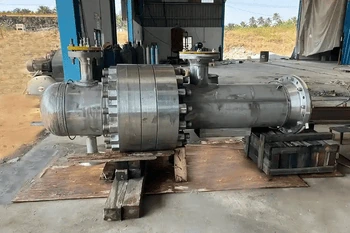
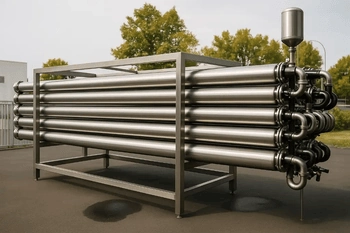
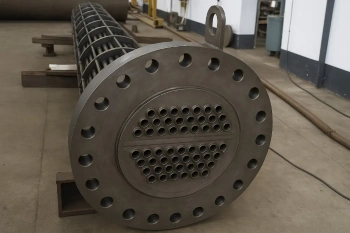
What Is a Marine Heat Exchanger?
Marine heat exchangers act as thermal bridges between engine coolant and raw seawater. By transferring excess heat without mixing the two fluids, they protect internal components from thermal stress and salt-water corrosion.
As a leading marine heat exchanger manufacturer in India, United Heat Exchangers designs and fabricates shell and tube, plate, keel cooler, charge air cooler, and exhaust gas recovery units for commercial shipping, offshore platforms, naval vessels, fishing fleets, tugboats, and workboats — built for the specific demands of continuous seawater exposure, high vibration, and the consequences of failure at sea.
35+Years manufacturing marine and industrial heat exchangers from Coimbatore, India
ASMEU-Stamp certified — required for vessels operating under international survey
10+Marine heat exchanger types — shell & tube to keel coolers to charge air units
ISO9001:2015 quality management — every unit inspected and tested before shipment
ASME U-StampPressure Vessel Certified
ISO 9001:2015Quality Management
Titanium / CuNiSeawater-Grade Materials
HTRI RatedWritten Thermal Guarantee
Custom EngineeredEvery Vessel Type and Duty
Why Marine Cooling Is a Different Problem Altogether

A marine engine does not have the luxury of a radiator fan pulling cool ambient air across a cooling circuit. It operates in a sealed engine room, often at continuous load for days or weeks at a stretch, surrounded by humid salt-laden air, with constant vibration from the propulsion system — and the ocean around the hull is the sole workable cooling medium.
That seawater brings its own challenges. It corrodes carbon steel and standard stainless steel. It carries biological growth, sediment, and minerals that foul tube surfaces. It varies in temperature — warm tropical shallows, frigid North Atlantic passages — and in salinity depending on whether the vessel is at sea, in an estuary, or operating in a port. A marine heat exchanger has to perform reliably across all of it.
💡 The stakes of a cooling failure at sea: Marine engines generating 2,000°F+ in combustion chambers depend entirely on their cooling systems. A heat exchanger that underperforms — through fouling, material failure, or inadequate design — does not just reduce efficiency. It can seize pistons, warp cylinder heads, or force an unscheduled shutdown in open water. The engineering behind every United Heat Exchangers marine unit accounts for this reality from the first line of thermal calculations.
How a Marine Heat Exchanger Works

The working principle is consistent across all types: two fluid streams exchange thermal energy across a conductive barrier — tube walls, plates, or coil surfaces — without ever contacting each other. Here is the sequence in a typical shell and tube marine engine cooler:
1
Hot Coolant Enters
The engine circulates hot glycol–water coolant from the engine jacket into the tube bundle of the heat exchanger.
2
Seawater Flows In
A raw water pump draws seawater from below the waterline and passes it through the shell side — across the outside of the tubes.
3
Heat Transfers Through Tube Walls
Thermal energy migrates from the hotter coolant through the tube wall into the cooler seawater — governed by the temperature differential and tube material conductivity.
4
Cooled Coolant Returns
The now-cooled coolant exits and re-enters the engine — ready to absorb heat through the next combustion cycle.
5
Warmed Seawater Overboard
The seawater, now carrying the transferred heat, is discharged back overboard — the two fluid circuits never mix.
The engineering challenge is not the concept — it is getting the tube material, tube count, baffle arrangement, flow velocities, and seawater inlet temperature right so that the heat exchanger delivers its rated duty at the worst-case operating condition the vessel will ever encounter.
Types of Marine Heat Exchangers

No single heat exchanger type suits every vessel or duty. United Heat Exchangers manufactures the full range of marine heat exchanger configurations — matched to the specific thermal duty, space constraints, material requirements, and maintenance philosophy of each application.
Engine coolant or lube oil flows through the tube side; seawater passes through the shell side across baffled tube bundles. The most rugged, pressure-capable design in the marine toolkit.
- Main engine jacket water cooling
- Lubricating oil cooling
- Auxiliary engine and generator cooling
- Freshwater generator systems
- Handles high pressure and continuous duty cycles
Corrugated metal plates stacked in alternating hot and cold flow channels, creating a large heat transfer surface in a very small footprint — increasingly the choice for modern vessel engine rooms where space is at a premium.
- Main engine jacket water cooling on modern ships
- HVAC and fresh water cooling circuits
- Higher heat transfer coefficient than shell and tube
- Fully disassemblable for inspection and cleaning
Copper-brazed or nickel-brazed plates fused into a single sealed unit — eliminating gaskets entirely. The result is a compact, leak-free exchanger suited for refrigeration and hydraulic oil cooling where contamination from gasket failure is unacceptable.
- Shipboard refrigeration systems
- Chiller circuits and HVAC
- Hydraulic oil cooling
- High thermal efficiency, minimal footprint
External tube grid mounted on the hull below the waterline. Engine coolant circulates through these tubes and sheds heat directly to the seawater outside the hull — seawater never enters the vessel at all.
- Tugs, fishing boats, and shallow-water workboats
- Vessels operating in muddy or debris-laden waters
- Eliminates internal seawater fouling and corrosion
- No raw water pump — simpler mechanical system
Turbocharged marine engines compress intake air, which raises its temperature and reduces its density. A charge air cooler drops that temperature before the air enters the cylinder — restoring air density and allowing more fuel to burn per stroke, directly increasing power output and fuel efficiency.
- All turbocharged main propulsion engines
- Air-to-water and air-to-air configurations
- Measurable improvement in engine power and fuel economy
One fluid flows through an inner tube; the second flows through the annular space between the inner and outer tube. A simple, reliable design for lower-capacity marine duties where high pressure and ease of maintenance matter.
- Small auxiliary marine engines
- Fuel oil preheating circuits
- Refrigeration condensers on smaller vessels
Mounted in the exhaust gas stream of the main engine, the EGB recovers heat that would otherwise be discharged to atmosphere and converts it into steam or hot water — reducing fuel consumption for shipboard services.
- Steam generation for fuel oil heating, galley, and accommodation
- Pre-heating feed water for auxiliary boilers
- Freshwater production via waste heat evaporation
- Measurable reduction in auxiliary fuel consumption
A helically coiled tube inside a cylindrical shell. The coiled geometry creates turbulence in both fluid streams, improving heat transfer rates and reducing the tendency for fouling — a practical advantage in seawater service.
- Steam generation and hot water systems
- Specialized oil cooling duties
- Self-cleaning flow pattern reduces scaling
Applications Across Marine Systems

A marine heat exchanger rarely does just one job on a vessel. In a modern ship's engine room, multiple heat exchanger units serve different systems simultaneously — each engineered for the specific fluid, pressure, temperature, and fouling conditions of that service.
| Marine System | Role of the Heat Exchanger | Typical Type |
|---|
| Main Engine Jacket Water Cooling | Removes heat from the engine's water jacket, preventing thermal overload of cylinder liners, pistons, and cylinder heads | Shell and tube or plate heat exchanger |
| Lubricating Oil Cooling | Keeps lube oil temperature within the viscosity range where it forms and maintains protective oil films on bearing surfaces | Shell and tube heat exchanger |
| Hydraulic Oil Cooling | Controls temperature in steering gear, cargo winch, and stabilizer hydraulic circuits — preventing oil degradation and seal failure | Brazed plate or shell and tube heat exchanger |
| Gearbox and Transmission Cooling | Removes heat generated by gear mesh friction and clutch engagement in the marine propulsion gearbox | Shell and tube heat exchanger |
| Freshwater Generator | Heats seawater under vacuum to flash-evaporate it into distilled freshwater for onboard consumption and machinery use | Shell and tube or plate evaporator |
| Air Conditioning and Refrigeration | Serves as the condenser in the ship's HVAC refrigeration cycle — rejecting the refrigerant's heat load to seawater | Shell and tube condenser or brazed plate heat exchanger |
| Charge Air Cooling | Cools compressed intake air after the turbocharger before it enters the cylinders — increasing air density and engine power | Charge air cooler (air-to-water) |
| Exhaust Heat Recovery | Captures waste heat from the main engine exhaust and converts it into steam for fuel oil heating, galley use, and freshwater production | Exhaust gas economizer (EGB) |
| Generator Set Cooling | Cools the auxiliary diesel engines driving onboard generators — providing reliable electrical supply independent of the main engine | Shell and tube or plate heat exchanger |
| Fuel Oil Heating | Heats heavy fuel oil to reduce its viscosity to the level required for efficient atomization in the fuel injectors | Shell and tube heater or double pipe heat exchanger |
| Cargo Oil Heating (Tankers) | Heats crude oil or refined products in cargo tanks to maintain pumpability for discharge operations | Shell and tube or coil heat exchanger |
| Desalination and Water Treatment | Provides controlled heating for RO pre-treatment and thermal desalination processes on vessels with onboard water production | Shell and tube or plate evaporator |
Marine Heat Exchangers for Every Vessel Type and Every Duty
Whether you are outfitting a new build or replacing a unit on an operating vessel — United Heat Exchangers delivers ASME-certified marine heat exchangers with full documentation. Free quote in 48 hours.
Request My Free Quote →
Benefits of Marine Heat Exchangers from United Heat Exchangers
01Reliable Thermal Performance in Extreme Conditions
Every unit is HTRI-rated for your specific seawater inlet temperature, flow rate, and process duty — not a catalogue approximation. Your heat exchanger performs on the hottest day in the tropics and the coldest night in northern waters.
02Designed for Seawater — Not Adapted from Land-Based Units
Marine heat exchangers require materials, tube wall thicknesses, and joint designs that account for seawater corrosion, biofouling, and vibration from propulsion and engine operation. We design for those conditions from the first calculation, not as an afterthought.
03Compact Footprint for Tight Engine Rooms
Engine room space on any vessel is at a premium. Our marine heat exchangers are configured — whether shell and tube or plate — to deliver maximum thermal performance per unit of floor space and connection layout.
04Long Service Life — Reduced Drydock Costs
Correct material selection, adequate corrosion allowance, and proven construction methods translate into heat exchangers that run full intervals between drydock inspections rather than requiring replacement before the vessel's scheduled maintenance period.
05Energy Recovery Reduces Fuel Consumption
Exhaust gas economizers and charge air coolers do more than cool — they recover usable energy from processes that would otherwise waste it. Every kilojoule recovered from exhaust gases is fuel not burned by auxiliary boilers.
06Drop-In Replacement Supply
When an operating vessel needs a heat exchanger replaced between drydock cycles, schedule matters. We manufacture to the existing nozzle layout, flange standard, and connection sizing — minimizing installation time and getting the vessel back in service faster.
Materials — Why Selection Matters at Sea

The single most common cause of premature marine heat exchanger failure is incorrect material selection. Carbon steel corrodes rapidly in seawater. Standard 304 stainless steel is susceptible to chloride pitting in seawater. Getting this right from the design stage is non-negotiable.
| Material | Key Properties | Typical Marine Use |
|---|
| Titanium | Outstanding seawater corrosion resistance, biofouling resistance, light weight, long service life | Seawater-side tubes in shell and tube coolers, plate heat exchangers in highly corrosive service |
| Copper-Nickel (Cu-Ni 90/10 and 70/30) | Proven seawater resistance, natural biofouling resistance, good thermal conductivity | Tube bundles in engine coolers, lube oil coolers, central coolers — the traditional marine standard |
| Super Duplex Stainless Steel (2507) | Very high chloride resistance, high strength, excellent fatigue performance | High-pressure seawater service, offshore platform coolers, high-velocity seawater circuits |
| Duplex Stainless Steel (2205) | Good chloride and pitting resistance, higher strength than 316L | Central coolers, jacket water coolers where cost and corrosion resistance need to balance |
| 316L Stainless Steel | Better corrosion resistance than 304, suitable for low-salinity or fresh water circuits | Fresh water loops, lube oil coolers (fresh water side), process side of closed circuits |
| Naval Brass / Admiralty Brass | Good corrosion resistance, moderate cost, compatible with shell materials in older vessel designs | Tube bundles in older fleet vessels, replacement units for existing brass-tube systems |
💡 Material recommendation is part of every proposal. When you submit your process data — seawater temperature, flow velocity, chloride concentration if known, operating hours per year — our engineering team recommends the tube material that delivers the required service life at the right cost. We do not default to the cheapest option and leave the corrosion risk with the buyer.
Maintenance and Cleaning Guide for Marine Heat Exchangers
Marine heat exchangers are in continuous contact with seawater — which means fouling is not a possibility, it is a certainty. The question is not whether marine growth, mineral scale, and sediment will accumulate on the seawater-side surfaces, but how quickly, and how the maintenance programmed addresses it. A well-maintained marine heat exchanger runs at close to its original thermal performance for its full design life. A neglected one causes rising engine temperatures, increased fuel consumption, and eventually emergency repairs.
Routine Maintenance — What to Monitor
M1Temperature Performance Tracking
Monitor coolant outlet temperature against baseline values. A rising outlet temperature for the same engine load and ambient seawater temperature is the earliest and most reliable indicator of fouling — before any visible symptom appears.
M2Pressure Drop Monitoring
An increasing pressure drop across the seawater side — measured at fixed flow rates — signals tube blockage or fouling buildup. Log and trend this value from commissioning to detect fouling before it impairs performance.
M3Coolant Quality Checks
Test the engine coolant's inhibitor concentration, pH, and glycol percentage at the intervals recommended by the coolant supplier. Degraded coolant accelerates corrosion on the tube inside surface and deposits scale that reduces heat transfer.
M4Visual Inspection of Connections and Seals
Check all inlet and outlet connections, gaskets, and end cover seals for weeping or discoloration. A minor coolant-seawater cross-leak detected early costs a gasket replacement. An undetected one can contaminate the cooling circuit and damage the engine.
M5Anode Condition (Sacrificial Anodes)
Many marine heat exchangers use zinc or aluminum sacrificial anodes to protect tube sheets and shells from galvanic corrosion. Inspect anodes at every scheduled maintenance and replace before they are fully consumed — a depleted anode protects nothing.
M6Tube Bundle or Plate Inspection
At intervals of 12–24 months depending on operating waters and fouling conditions, open the heat exchanger and inspect tube surfaces, plate surfaces, or coil condition for pitting, erosion at inlet edges, or biological colonization that brush cleaning alone will not remove.
Step-by-Step Cleaning Procedure
- Shut down and isolate — close all seawater and coolant isolation valves; allow the unit to cool to a safe handling temperature before opening any connection
- Drain both circuits — drain the shell side and tube side completely; capture coolant for testing or disposal according to local regulations
- Open the heat exchanger — remove end covers on a shell and tube unit or open the plate pack on a plate heat exchanger; inspect the internal surfaces before any cleaning begins
- Mechanical cleaning — seawater side — use a nylon tube brush or high-pressure fresh water flush to remove loose marine growth, mud, algae, and soft scale from tube bores or plate channels
- Chemical descaling (when required) — circulate a mild, marine-approved descaling solution through the fouled circuit for the time specified by the descaler manufacturer; the solution concentration and contact time are critical — follow manufacturer data to avoid damage to tube material or brazed joints
- Thorough fresh water rinse — flush all descaler residue from every circuit with clean fresh water before reassembly; descaler left in contact with copper-nickel or titanium beyond the recommended time causes damage
- Inspect and replace consumables — check all gaskets, O-rings, end cover seals, and sacrificial anodes; replace any that show compression set, cracking, or significant depletion
- Reassemble and torque connections — reassemble in the reverse of disassembly; apply correct torque values to all flange bolts and end cover fasteners per the maintenance manual
- Pressure test before restart — with valves closed, apply low-pressure test (fresh water or instrument air) to each circuit separately; check for leaks at all joints before returning the unit to service
- Return to service and verify performance — restart the cooling system; log coolant outlet temperature and pressure drop values and compare against pre-cleaning baseline to confirm restored performance
💡 Cleaning interval depends on the waters, not just the calendar. A vessel operating year-round in warm tropical coastal waters — high biological fouling rate, elevated mineral content — may require cleaning every 6 months. A vessel in cold deep-water ocean passages may operate 18 months between full cleanings. Design your maintenance interval around actual performance monitoring data, not a fixed calendar date.
Why United Heat Exchangers for Marine Applications
There are generic heat exchanger manufacturers and there are manufacturers who understand the specific demands of marine service. The difference shows in the detail — the tube wall thickness specified for the expected corrosion rate over the vessel's inspection interval, the sacrificial anode provision built into the design, the nozzle layout engineered to match existing vessel piping, and the documentation package that satisfies the vessel's class surveyor. United Heat Exchangers delivers all of it.
35+ Years of Focused ManufacturingEstablished in 1989 with an unbroken track record in thermal engineering. Marine heat exchangers are not a sideline product — they are a core part of what we build and have built for decades.
HTRI Thermal Design — Written Performance GuaranteeEvery marine heat exchanger we supply is thermally rated using HTRI Xchanger Suite — the industry-standard software for heat exchanger thermal design. We issue a written thermal performance guarantee with every unit. Not an estimate.
ASME U-Stamp CertifiedPressure components are manufactured and inspected to the ASME Boiler and Pressure Vessel Code — a requirement for vessels operating under international classification society survey. Our U-Stamp certification is independently audited and current.
Right Material for the ServiceWe recommend tube and shell materials based on your specific seawater conditions, operating temperatures, and required inspection interval. Titanium, copper-nickel, duplex, super duplex — the right call, not the default call.
Complete Package — One SourceTube bundle, shell, end covers, gaskets, sacrificial anodes, connection flanges to your standard, and all documentation — supplied as a single integrated package under one quality system and one supply contract.
Replacement Unit ExpertiseWhen an existing marine heat exchanger reaches end of life, we manufacture the replacement to the original nozzle layout, flange rating, and connection dimensions — minimizing installation time and vessel downtime.
48 hrsBudgetary proposal from your vessel data and duty requirements
4–8 wksStandard shell and tube and plate marine units
8–14 wksTitanium / super duplex, large EGB units, custom configurations
On requestEmergency replacement schedule for vessels in drydock
What's Included with Every Marine Heat Exchanger Order
- Written thermal performance guarantee — HTRI-rated for your specific duty, seawater temperature, and flow rate
- ASME U-Stamp documentation — Manufacturer's Data Report (MDR), material certifications (MTRs), weld records, and NDE inspection reports
- Hydrostatic test certificate — shell side and tube side tested to 1.5× design pressure; third-party witness available
- Material traceability — mill test reports for all pressure-containing components, traceable to heat and lot numbers
- Sacrificial anode provision — sized and positioned for the duty and material combination
- Operation and maintenance manual — cleaning procedures, inspection intervals, anode replacement schedule, torque values, and spare parts list
- Lifetime technical support — engineering assistance for re-rating, bundle replacement, and material upgrade throughout the vessel's service life
Get a Free Marine Heat Exchanger Quote in 48 Hours
Share your vessel type, cooling duty, process fluid, seawater conditions, design pressure, and applicable classification society — and our engineering team will size the right unit and deliver budgetary pricing within 48 hours.
Request My Free Quote →
Frequently Asked Questions
What is a marine heat exchanger?
A marine heat exchanger is a pressure vessel that transfers thermal energy between the engine's internal cooling circuit and raw seawater — keeping the two fluids isolated from each other at all times. The engine coolant loses heat to the seawater through the heat exchanger walls; the warmed seawater is discharged overboard. This allows the engine to operate continuously within safe temperature limits without seawater ever entering the engine's internal cooling passages.
What types of marine heat exchangers does United Heat Exchangers manufacture?
We manufacture shell and tube, plate, brazed plate, keel cooler, charge air cooler, double pipe, shell and coil, and exhaust gas economizer types. The right type for your application depends on the thermal duty, space available, operating pressure and temperature, seawater quality, and maintenance access on your vessel. Our engineering team makes the recommendation after reviewing your specific requirements.
What materials are used for marine heat exchangers?
The seawater-side surfaces — tubes or plates — are manufactured in titanium, copper-nickel (CuNi 90/10 or 70/30), duplex stainless steel, or super duplex stainless steel depending on the service conditions and required life. Carbon steel and standard 304 stainless steel are not suitable for direct seawater contact and are not used on the seawater side of our marine heat exchangers. Shell and structural components are typically carbon steel with appropriate corrosion allowance or stainless steel where atmospheric salt exposure is a concern.
How often should a marine heat exchanger be cleaned?
The honest answer is: based on performance monitoring, not a fixed calendar. A vessel operating in warm coastal waters with high biological activity may need cleaning every 6 months. A vessel in cold Deepwater passages may run 18 months between full cleanings. The correct trigger is rising coolant outlet temperature or increasing seawater-side pressure drop against your baseline — not a date on the maintenance schedule. Monitoring both values from commissioning gives you the data to clean at the right time, not too early and not too late.
Can chemical descaling damage a marine heat exchanger?
Strong acids will attack copper-nickel and titanium tube materials if concentration or contact time exceeds the manufacturer's recommendation. The correct approach is a mild, marine-approved descaling solution, mixed to the specified concentration, circulated for the specified time, and followed immediately by a thorough fresh water flush. Follow the descaler manufacturer's data sheet exactly — and always rinse completely before reassembly.
Can you manufacture a replacement marine heat exchanger to match existing connections?
Yes. For replacement units, provide us with the existing heat exchanger's nozzle layout drawing, flange standard and rating, connection sizes, overall dimensions, and the original thermal duty data if available. We manufacture the replacement to match — minimizing installation time and avoiding modification to existing shipboard piping.
Are United Heat Exchangers marine heat exchangers ASME certified?
Yes. Pressure-containing components are manufactured to ASME BPVC Section VIII Division 1 and U-Stamped. All pressure welds are performed to ASME Section IX qualified procedures. United Heat Exchangers holds a current ASME U-Stamp Certificate of Authorization, independently audited by the Authorized Inspection Agency.
Author: Senthil Kumar, Technical Director — United Heat Exchangers Pvt. Ltd. | Last Updated: May 2026