Brass Tube Bundle Heat Exchanger
Request a Quote
If you're looking for a heat exchanger or trying to understand what you already have, brass tube bundle heat exchangers are probably on your radar. They're common, reliable, and more affordable than you might think. Here's what actually matters.
You'll find these in air conditioners, boat engines, industrial cooling systems, and power plants. They work the same way everywhere—just at different scales.
The catch? Brass doesn't love acids or ammonia, and the zinc in brass can leach out if your water chemistry is off. But for standard applications, it'll outlast the equipment it's installed in.
Medium industrial systems usually handle capacities between 500 kW and 2 MW, making them suitable for manufacturing plants, process industries, and large-scale HVAC operations.
Large power plant systems operate in the range of 5–20 MW and are designed for high-capacity thermal management in power generation and heavy industrial environments.
Maintenance runs about 2-5% of purchase price per year. If you're in seawater, budget toward the higher end.
Stainless Steel: Handles acids better but conducts heat 30-40% worse than brass. You'll need a bigger unit to get the same performance. Costs 50% more upfront.
Titanium: Virtually indestructible, but costs 2.5 times what brass does. Only worth it for truly harsh environments or when you need 40+ years of service life.
For most applications under 250°C and 1,000 psi, brass gives you the best return on investment.
Retubing costs 40-60% of a new unit but extends life another 15-20 years. Most units get retubed once, then replaced.
If someone's trying to sell you titanium for a freshwater application or telling you brass won't work in seawater (it will with the right alloy), you're talking to the wrong person. At United Heat Exchangers, we give you honest guidance on what works for your application.
What Is It?
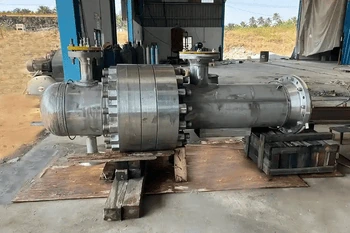
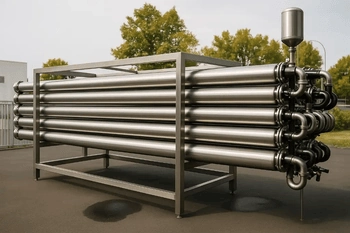
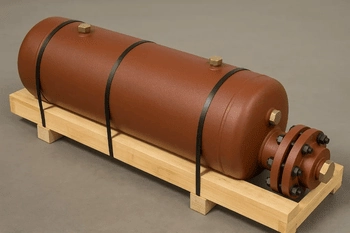
A brass tube bundle heat exchanger moves heat from one liquid to another without mixing them. Hot water flows through brass tubes while cold water flows around them. Heat passes through the tube walls, cooling one side and warming the other. That's it.You'll find these in air conditioners, boat engines, industrial cooling systems, and power plants. They work the same way everywhere—just at different scales.
Why Brass?
Brass doesn't rust like steel, conducts heat well (though not as well as copper), and costs about half what stainless steel does. For most water-based cooling systems, that's exactly what you need.The catch? Brass doesn't love acids or ammonia, and the zinc in brass can leach out if your water chemistry is off. But for standard applications, it'll outlast the equipment it's installed in.
Types You'll Actually See
- Fixed Tube Sheet: The simplest design. Tubes are welded in place permanently. Good for clean water, impossible to deep-clean inside. If you're not dealing with dirty water, this works fine and costs less.
- U-Tube: Tubes bent into a U-shape. One end floats freely, so thermal expansion doesn't crack anything. Common in HVAC and marine systems. Easier to maintain than fixed designs, but the U-bend itself is hard to clean.
- Floating Head: One end of the tube bundle can slide in and out. This is what you want if you're dealing with dirty water or need to physically remove the tubes for cleaning. Costs more, but pays off in maintenance savings.
- Shell and Coil: A spiral brass coil inside a shell. Compact and efficient, but harder to repair. Usually seen in smaller applications like residential boilers.
Which Brass Alloy Do You Need?
Different water conditions need different brass formulas:- Admiralty Brass — The standard for freshwater. Good up to 200°C. If you're running a freshwater cooling system, this is probably what you have.
- Arsenical Admiralty Brass — Freshwater with a hint of salt or contamination. The arsenic addition (tiny amount) prevents zinc from leaching. Power plants often use this.
- Naval Brass — More copper, less zinc. Handles seawater better than admiralty brass and works up to 230°C. Common in boats and coastal facilities.
- Aluminum Brass — The go-to for full seawater exposure. The aluminum forms a protective layer that resists corrosion and biological growth. If you're buying for marine use, this is what you want.
- Muntz Metal — High zinc content makes it easy to machine. Good for industrial processes where seawater isn't involved. Less corrosion resistant than naval brass.
How Long Will It Last?
Expect 20 to 30 years with regular maintenance. Freshwater systems can go longer, seawater systems trend toward the lower end. The tubes themselves rarely fail catastrophically—they gradually thin out or develop pinhole leaks you can monitor.What Kills Them?
- Dezincification: Zinc leaching out of the brass, leaving weak, porous copper. Happens when water pH drops below 6.5 or chloride levels get too high. You'll see pink or red deposits on the tubes.
- Solution: Use arsenical or aluminum brass, keep water pH between 6.5 and 8.5, and test your water chemistry quarterly.
- Biofouling: Algae, barnacles, and slime reduce heat transfer by up to 40% in marine systems. You'll notice reduced cooling performance before you see anything wrong.
- Solution: Aluminum brass naturally resists growth better. Mechanical cleaning every 6-12 months keeps things running. Some systems use automatic tube cleaning balls.
- Erosion-Corrosion: Water flowing too fast wears away the tube walls. Brass doesn't like velocities over 3 meters per second (about 10 feet per second).
- Solution: Proper system design. If you're buying, make sure the manufacturer knows your flow rates.
Certifications we have
Common certifications for heat exchanger manufacturers include:- ISO 9001 (Quality Management)
- ISO 14001 (Environmental Management)
- ASME U-Stamp (Pressure Vessel Certification)
- PED (Pressure Equipment Directive - for European markets)
- API (American Petroleum Institute)
Maintenance Reality
- Every Month: Check inlet and outlet temperatures. If they're drifting from normal, something's changing.
- Every 6-12 Months: Clean the tubes mechanically. Brushes or water jets. This isn't optional in seawater applications.
- Every Year: Have someone check tube wall thickness with an eddy current tester. Tubes that have lost 40% of their thickness should be replaced or plugged.
- Every 2-3 Years: Chemical cleaning if mechanical cleaning isn't cutting it. Citric acid or phosphoric acid solutions circulated for a few hours, then neutralized and flushed.
When to Clean
Watch your pressure drop. If it increases by 25% above normal, your tubes are fouling. Don't wait for temperatures to drift—pressure tells you earlier.Cost Breakdown
Small HVAC units typically operate within a capacity range of 50–200 kW and are commonly used in commercial buildings and localized cooling applications.Medium industrial systems usually handle capacities between 500 kW and 2 MW, making them suitable for manufacturing plants, process industries, and large-scale HVAC operations.
Large power plant systems operate in the range of 5–20 MW and are designed for high-capacity thermal management in power generation and heavy industrial environments.
Maintenance runs about 2-5% of purchase price per year. If you're in seawater, budget toward the higher end.
Brass vs Everything Else
Copper: Transfers heat 20% better but corrodes faster in some conditions and costs more. Unless you need that extra efficiency, brass makes more sense.Stainless Steel: Handles acids better but conducts heat 30-40% worse than brass. You'll need a bigger unit to get the same performance. Costs 50% more upfront.
Titanium: Virtually indestructible, but costs 2.5 times what brass does. Only worth it for truly harsh environments or when you need 40+ years of service life.
For most applications under 250°C and 1,000 psi, brass gives you the best return on investment.
Red Flags When Buying
- No mention of alloy type (you need to know if it's admiralty, naval, aluminum brass, etc.)
- Pressure rating below your system requirements
- No ASME or TEMA certification mentioned
- Tubes spaced too close together for your application (makes cleaning impossible)
- No consideration for fouling in the design (should be oversized by 15-25% if you have dirty water)
The Simple Decision Path
- Freshwater, clean conditions: Admiralty brass, fixed tube sheet design
- Freshwater with some contamination: Arsenical admiralty brass, U-tube or floating head
- Brackish water or light seawater: Naval brass, floating head
- Full seawater: Aluminum brass, floating head, plan for regular cleaning
- Industrial process, no seawater: Muntz metal or admiralty brass, choose design based on maintenance access
Can You Repair Them?
Individual tubes can be plugged if they leak—up to 10% of total tubes without major performance loss. Beyond that, you're looking at retubing (replacing all the tubes while keeping the shell) or replacement.Retubing costs 40-60% of a new unit but extends life another 15-20 years. Most units get retubed once, then replaced.
Final Thoughts
United Heat Exchangers brass tube bundle heat exchangers work. They're not exotic, they're not maintenance-free, but they're reliable and reasonably priced. Choose the right alloy for your water, keep up with cleaning, watch your water chemistry, and you'll get decades of service.If someone's trying to sell you titanium for a freshwater application or telling you brass won't work in seawater (it will with the right alloy), you're talking to the wrong person. At United Heat Exchangers, we give you honest guidance on what works for your application.
FAQ
- Do I need to drain it in winter? If it's installed where temperatures drop below freezing and it's not running, yes. Or use glycol.
- Can I use brass with treated city water? Usually fine. City water is typically pH 6.5-8.5, which brass handles well.
- What if I have hard water? You'll get scale buildup faster. Plan for more frequent cleaning and possibly chemical descaling.
- Should I worry about the arsenic in arsenical admiralty brass? No. It's alloyed into the metal structure at 0.04%, not leaching into your water. It's there to protect the zinc, not contaminate anything.
- How do I know when it's truly dead? When tubes are failing faster than you can plug them, or when wall thickness is down 40%+ across multiple tubes. At that point, repair costs exceed replacement value.
Related Products