Author:Senthil Kumar, Technical Director | Updated: March 2026
On This Page
- What Is a Kettle Reboiler Heat Exchanger?
- How It Works — The Boiling and Vaporization Process
- Types and Configurations
- Key Components and Their Functions
- Design Parameters and Engineering Specifications
- Kettle Reboiler vs. Thermosiphon vs. Forced Circulation
- Materials of Construction
- Industrial Applications
- How to Select the Right Kettle Reboiler
- Maintenance Best Practices
- Delivery and Project Support
- Why United Heat Exchangers
- Frequently Asked Questions
- Request a Quote
What Is a Kettle Reboiler Heat Exchanger?
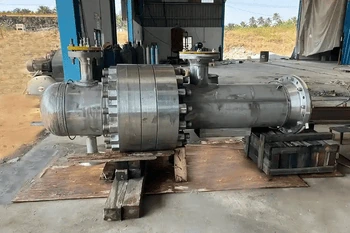
A kettle reboiler heat exchanger is a horizontal shell-and-tube heat exchanger with an oversized TEMA K-type shell that serves as both a boiling chamber and a vapor-liquid separator. Mounted at the base of a distillation column, it vaporizes a controlled fraction of the bottoms liquid — returning vapor to the column to drive separation while unvaporized liquid exits as bottoms product.
Its defining feature is the internal weir: a vertical overflow plate that maintains a constant liquid level over the submerged tube bundle, keeping the full heat transfer surface active regardless of feed rate or operating pressure.
💡 Why the kettle type dominates distillation service: Most reboiler types — thermosiphon, forced circulation, falling film — require precise hydraulic design to maintain stable two-phase circulation. A kettle reboiler bypasses that complexity entirely. The oversized shell is its own liquid inventory, the weir controls the boiling surface, and the vapor disengages directly above the bundle. No recirculation pump. No circulation hydraulics to get wrong. That simplicity is why process engineers have specified kettle reboilers as the default choice for distillation columns for over a century.
How a Kettle Reboiler Heat Exchanger Works
Understanding the operating principle of a kettle reboiler is the foundation for correct specification, troubleshooting, and performance optimization. The process unfolds in five distinct stages — each stage governed by both thermodynamics and the specific geometry of the kettle design.
Bottoms liquid from the distillation column flows by gravity into the shell-side liquid pool surrounding the tube bundle. The feed nozzle is positioned to introduce liquid below the weir, into the active boiling zone, without disrupting the vapor-liquid interface above the bundle.
Steam, hot oil, or a hot process fluid enters the tube-side channel head and flows through the tube bundle. Heat conducts from the heating medium through the tube wall and into the liquid pool surrounding the tubes on the shell side.
As the liquid adjacent to the hot tube outer surface reaches its local boiling point, nucleate boiling begins. Vapor bubbles form at preferred nucleation sites on the tube surface, grow, detach, and rise through the liquid pool — this is the primary heat transfer mechanism driving vaporization.
The internal weir maintains a fixed liquid level over the tube bundle — ensuring complete submergence and consistent nucleate boiling across the entire tube surface. Liquid overflows the weir into the subcooled bottoms sump and exits as the bottoms product drawoff stream.
The oversized vapor space above the boiling liquid allows vapor bubbles to disengage from the liquid surface, rise through the demister zone if fitted, and exit through the vapor outlet nozzle — returning to the distillation column as the reboiler vapor stream that drives the separation.
On the tube side, steam condenses after releasing its latent heat and exits through the condensate outlet nozzle — typically routed to a steam trap and condensate return system. Hot-oil heating media exits as a cooled fluid returned to its heater circuit.
Types and Configurations of Kettle Reboiler Heat Exchangers
Not every distillation service calls for the same reboiler configuration. The process fluid's fouling tendency, viscosity, required vaporization fraction, available heating medium, and column pressure all influence which configuration delivers the best combination of performance, reliability, and lifecycle cost.
▼ Natural Circulation (Pool Boiling)
Most common — standard kettle typeThe process liquid forms a pool around a submerged tube bundle inside the oversized kettle shell. Boiling occurs by natural convection — the density difference between the heated two-phase mixture at the tube surface and the bulk liquid creates gentle natural circulation within the shell. No external pump is required.
- Best for: Clean-to-moderate-fouling services, wide boiling range fluids, and any application where pump reliability is a concern
- Strength: Simplest arrangement — most reliable and lowest-maintenance reboiler configuration available
- Limitation: Not suited for very high viscosity fluids or services prone to severe tube fouling on the shell side
▼ Forced Circulation Kettle Reboiler
For high-viscosity or high-fouling process fluidsA dedicated recirculation pump forces the process liquid through the tube bundle or over the shell-side surface at a controlled, high velocity. The forced flow significantly increases the heat transfer coefficient for viscous fluids and reduces fouling by preventing stagnant zones near the heating surface.
- Best for: Heavy residue reboilers, viscous bottoms products (pitch, heavy fuel oil, polymer solutions), or severe fouling services
- Strength: Precise control over heat flux and residence time; maintains tube surface wetting at all operating conditions
- Limitation: Added capital and operating cost of the recirculation pump and associated piping
▼ Steam-Heated Kettle Reboiler
Most widely specified heating configurationSteam is the most common and most controllable heating medium for kettle reboilers. It enters the tube side as saturated steam and exits as condensate. The condensing steam-side coefficient is very high, the tube-side thermal resistance is minimal, and the reboiler duty is precisely regulated by the steam control valve.
- Best for: All refinery and chemical distillation columns with access to medium-pressure or high-pressure steam
- Strength: Precise temperature control via steam pressure regulation; constant wall temperature maintains stable nucleate boiling across the bundle
- Limitation: Maximum heating temperature limited by available steam pressure — if higher temperatures are needed, a hot-oil or fired heater system is required
▼ Hot-Oil Heated Kettle Reboiler
For high-temperature bottoms dutiesA circulating hot thermal oil (Therminol, Dowtherm, or equivalent) provides heating at temperatures achievable only with very high-pressure steam or fired heaters. The oil enters the tube side at its supply temperature, transfers heat to the process liquid, and returns to the heater at a lower temperature.
- Best for: High-temperature column bottoms duties above 400°F (200°C) where high-pressure steam is not available or is impractical
- Strength: Achieves high heating temperatures at low operating pressure — reduces shell design pressure vs. high-pressure steam
- Limitation: Requires a separate hot-oil heater and circulating pump system; hot oil is a fire hazard if it leaks at operating temperature
Key Components of a Kettle Reboiler Heat Exchanger
Every component in a kettle reboiler heat exchanger plays a specific role in maintaining stable, efficient vaporization. Understanding what each part does — and how it can fail — is essential for correct specification and effective maintenance planning.

Oversized pressure vessel
Heat transfer surface
Liquid level control
Pressure boundary
Heating medium distribution
Disengagement zone
Entrainment removal
Structural support
| Component | Function | Design Detail |
|---|---|---|
| Kettle Shell (Oversized) | Contains the liquid pool, tube bundle, vapor space, and weir plate — acts simultaneously as the pressure vessel and the vapor-liquid separator | Shell diameter is typically 1.5–2× the tube bundle diameter to provide sufficient vapor disengagement space above the liquid level; the oversized shell is the defining physical characteristic of the kettle type vs. all other reboiler types |
| Tube Bundle | Transfers heat from the heating medium inside the tubes to the process liquid pool surrounding them on the shell side; the submerged tube surface is where nucleate boiling originates | U-tube bundles are standard for kettle reboilers — the U-bend end is free to expand thermally without stressing the tube sheet; straight tube (fixed tube sheet or floating head) bundles are used when mechanical cleaning of the shell-side tube surface is required |
| Weir Plate | Controls the liquid level over the tube bundle; maintains constant submergence of the full tube heat transfer surface regardless of feed rate variations | Weir height is set during design to maintain liquid level at approximately the center or top of the tube bundle; the weir also creates the subcooled bottoms sump where the bottoms drawoff nozzle is located — preventing flashing of the bottoms product as it leaves the reboiler |
| Tube Sheets | The thick drilled plates that hold the tube bundle ends and form the primary pressure boundary between the tube-side heating medium and the shell-side process liquid | For U-tube bundles, only one fixed tube sheet is required at the channel head end — the U-bend end floats freely inside the shell; tube sheets are designed per ASME Section VIII Appendix UHX for combined pressure and thermal loading |
| Channel Head / Bonnet | Distributes the heating medium into the tube inlets and collects it from the tube outlets; houses the pass partition plates for multi-pass tube-side flow arrangements | Removable channel cover (TEMA type A) is standard for kettle reboiler service to allow tube-end inspection and cleaning access; bonnet type (TEMA type B) is used for lower-cost clean-service applications |
| Vapor Space (Disengagement Zone) | The open volume above the liquid surface inside the oversized shell where vapor bubbles detach from the liquid surface and travel to the vapor outlet nozzle; adequate vapor space prevents liquid entrainment in the vapor product | Vapor space height is calculated based on the vapor velocity and the required droplet settling distance; if the vapor velocity is too high, liquid droplets are entrained in the vapor product and contaminate the distillate — a demister pad is fitted when high entrainment risk is predicted |
| Demister Pad (when fitted) | A knitted wire mesh or structured packing element positioned in the vapor space to intercept and coalesce entrained liquid droplets before they exit with the vapor | Specified when the vapor loading is high relative to the shell cross-sectional area, or when the process requires a very high-quality vapor product (low entrainment); adds cost and requires periodic cleaning to prevent fouling that would restrict vapor flow |
| Weir Overflow / Bottoms Sump | The liquid that overflows the weir accumulates in a subcooled sump at the far end of the shell; this is the point from which the bottoms product is continuously drawn off | The sump depth and nozzle elevation are designed to maintain the bottoms liquid below its bubble point — preventing flashing in the bottoms control valve and ensuring stable level control; level measurement taps are located on the sump for the level controller |
| Saddle Supports | Structural supports positioned under the shell at the two standard saddle locations (typically 0.25L from each end for a horizontal vessel) | One saddle is fixed (anchor), one is sliding — the sliding saddle allows free axial thermal expansion of the shell as it heats up from ambient to operating temperature; both saddles are designed for dead weight plus the full weight of water during hydrostatic testing |
Design Parameters and Engineering Specifications
Every kettle reboiler heat exchanger from United Heat Exchangers is custom-designed using HTRI Xchanger Suite thermal design software — not estimated from standard catalog ranges. The following parameters define the complete design space for kettle reboiler specification and procurement.
| Parameter | Typical Range | Design Significance |
|---|---|---|
| Shell Diameter | 12 in to 120+ in (300 mm to 3,000+ mm) | Set by tube bundle diameter × oversizing factor (1.5–2×); larger shells provide more vapor disengagement space but increase vessel cost and weight |
| Shell Length | 4 ft to 40 ft (1.2 m to 12 m) | Set by required heat transfer area for the rated vaporization duty at the design ΔT between heating medium and boiling liquid |
| Design Pressure (Shell Side) | Full vacuum to 300 psi typical; higher on request | Column bottoms pressure plus system pressure drop; vacuum service requires external pressure (collapse) analysis per ASME Section VIII |
| Design Pressure (Tube Side) | Up to 1,500 psi+ (steam, hot oil, or process heating medium) | Set by heating medium supply pressure with appropriate overpressure margin; high-pressure steam tube sides require careful tube wall thickness and tube-sheet design |
| Design Temperature (Shell Side) | -50°F to 700°F (-46°C to 370°C) | Column bottoms operating temperature sets the shell material and code allowable stress; high temperatures may require alloy steel or austenitic stainless shell |
| Vaporization Fraction (Quality) | 5% to 35% of shell-side feed flow | Higher vaporization fractions increase the vapor velocity in the disengagement space and the risk of entrainment; above ~30% vaporization, a demister pad is usually required; very high vaporization fractions may require a forced-circulation arrangement |
| Critical Heat Flux Margin | Design heat flux at 60–70% of critical heat flux (CHF) | If the tube surface heat flux exceeds the critical heat flux for the boiling liquid, nucleate boiling transitions to film boiling — a vapor film blankets the tube surface, heat transfer collapses, and tube overheating and failure result; the design must maintain adequate CHF margin across all operating conditions |
| TEMA Class | R (Refinery) / B (Chemical) / C (Commercial) | Class R for petroleum refining and petrochemical service; Class B for chemical process; Class C for low-pressure utility and general industry applications |
| Tube Bundle Type | U-tube (standard), Fixed tube sheet (with weir), Floating head | U-tube is the standard for kettle reboilers — one tube sheet, free thermal expansion, no internal seals; floating head used when shell-side mechanical cleaning is required for fouling services |
| Weir Height | Set to maintain tube bundle submergence + 2–4 in freeboard | Too low: tubes dry out, heat transfer collapses, tube overheating occurs. Too high: vapor entrainment increases, vapor quality to column degrades. Weir height is a critical geometry parameter set during thermal and hydraulic design |
| Fouling Resistance | Shell side: 0.0002–0.001 hr·ft²·°F/BTU; Tube side: per heating medium type | TEMA and API 660 tabulate standard fouling factors by service; the fouled area is the design basis, not the clean area — always design on fouled conditions at the end of the cleaning interval |
Kettle Reboiler vs. Thermosiphon vs. Forced Circulation
Choosing the right reboiler type for a distillation column is one of the most consequential decisions in column design. Getting it wrong means poor separation performance, high maintenance, or — in the worst case — column flooding from uncontrolled reboiler behavior. This comparison cuts through the marketing language and gives you the engineering basis for the decision.
| Attribute | Kettle Reboiler | Vertical Thermosiphon | Forced Circulation |
|---|---|---|---|
| Circulation Mechanism | Pool boiling — no circulation required; liquid is static around tubes | Natural circulation driven by two-phase density difference; liquid and vapor travel up through tubes together | External recirculation pump forces liquid through the heat exchanger at controlled velocity |
| Pump Required? | No — simplest, most reliable arrangement | No — but requires careful hydraulic design of the recirculation piping | Yes — adds capital cost, operating cost, and a pump as a potential failure point |
| Shell-Side Fouling Service | Moderate — U-tube bundle is not removable without shell cutting; use floating head if fouling is high | Good — tube-side boiling means fouling in the tubes, which can be mechanically cleaned | Best — high forced velocity prevents fouling buildup; bundle is typically removable for cleaning |
| High Vaporization Fraction (>30%) | Handles well — oversized shell provides ample vapor disengagement at high vapor loads | Difficult — high vaporization fraction can cause unstable two-phase circulation or flooding in the riser piping | Handles well — forced velocity maintains stable flow regardless of vapor fraction |
| Viscous Bottoms (> 5 cP) | Acceptable for moderate viscosity; natural convection in the liquid pool decreases with increasing viscosity | Not recommended — viscous fluids reduce natural circulation driving force; circulation may stall | Preferred — forced velocity overcomes high viscosity resistance |
| Low Pressure Drop Requirement | Excellent — static pool boiling; essentially zero shell-side pressure drop | Moderate — two-phase riser creates pressure drop that must be balanced against the circulation driving force | High — pump provides the pressure needed to overcome circuit resistance |
| Wide Boiling Range Mixtures | Handles well — the liquid pool composition remains relatively stable as boiling proceeds | Challenging — composition changes along the tube length can cause unstable boiling patterns | Good — forced circulation maintains uniform composition at the tube inlet |
| Plot Area / Height | Larger footprint — oversized shell requires more space; mounted horizontally at grade | Compact — mounted vertically beside the column; requires only a small footprint | Moderate — requires exchanger plus pump skid plus recirculation piping run |
| Capital Cost | Moderate — oversized shell adds cost vs. thermosiphon, but no pump required | Lowest — compact design, no pump, minimal piping | Highest — heat exchanger plus pump plus piping plus controls |
| Best Specified When: | Wide operating range; clean-to-moderate fouling; high vaporization fraction; reliability is paramount; pump elimination is a design priority | Space is limited; moderate vaporization fraction; clean service; low-viscosity fluids; lowest capital cost is the priority | Viscous or severely fouling bottoms; precise heat flux control required; high pressure drop is acceptable in return for reliable operation |
Materials of Construction
Material selection for a kettle reboiler is driven by the chemical composition of the column bottoms liquid — which is often the most corrosive stream in the distillation system, having concentrated trace contaminants as lighter components are removed overhead. The heating medium on the tube side also imposes material requirements, particularly when hot oil or a corrosive process fluid is used for heating.
| Component | Standard Material | Alternative / Alloy Options | Select When |
|---|---|---|---|
| Shell (Kettle) | Carbon steel — SA-516 Gr. 70 | 304L / 316L stainless; 321 SS (high-temp); 2205 duplex; Alloy 625 clad | SS when bottoms liquid contains corrosive species (organic acids, chlorides, H₂S); duplex for high-chloride environments; clad for severe corrosion with cost constraint |
| Tubes | Carbon steel seamless — SA-179 | SA-213 TP304/316L; SA-213 TP321/347; Alloy 825; Hastelloy C-276; copper-nickel | Stainless for corrosive heating media (sour steam, organic acids); 321/347 for sensitization risk at high temperature; high alloy for highly corrosive or halide-containing tube-side fluids |
| Tube Sheets | Carbon steel — SA-516 / SA-266 | Stainless steel; carbon steel with SS weld overlay (Type 1 overlay cladding) | Weld overlay when tube material is stainless or alloy — provides compatible joint between tube and tube sheet without requiring full alloy tube sheet; more cost-effective for large-diameter tube sheets |
| Weir Plate | Same alloy as shell — carbon steel or SS | Alloy upgrade possible independently of shell material | The weir is in direct contact with the concentrated, hottest bottoms liquid — if localized corrosion is a concern, specify weir material one alloy grade above the shell; it is a low-cost upgrade relative to upgrading the full shell |
| Channel Head | Carbon steel — may differ from shell if tube-side fluid is more corrosive | Stainless steel; Alloy 825; carbon steel with alloy lining | Specify channel head material to match the tube-side fluid chemistry — common to have a carbon steel shell (shell-side hydrocarbon) with a stainless steel channel (tube-side steam with corrosive condensate) |
| Gaskets | Spiral-wound with 316L SS windings and flexible graphite filler — standard for refinery and chemical reboiler service | Ring-type joint (RTJ) for high-pressure service; PTFE for corrosive or cryogenic low-pressure service; Camprofile for high-temperature steam | RTJ for ASME Class 600 and above; spiral-wound graphite handles up to 1,200°F and is fire-safe; PTFE limited to below 400°F — do not specify for high-temperature reboiler service |
| Baffles (if used) | Carbon steel — same as shell | Stainless steel longitudinal baffles if shell-side corrosion is a concern | Note: traditional transverse segmental baffles are not used in kettle reboilers — the pool boiling mechanism requires an open, unobstructed shell-side space; baffles, if present, are longitudinal flow guides or impingement plates near the inlet nozzle |
Industrial Applications of Kettle Reboiler Heat Exchangers
The kettle reboiler heat exchanger is the thermal backbone of distillation-intensive industries worldwide. Wherever separation of liquid mixtures by boiling is required — and particularly where operating reliability matters more than compact design — the kettle reboiler is the preferred choice.
| Industry | Specific Application | Heating Medium | Key Requirement |
|---|---|---|---|
| Petroleum Refining | Atmospheric crude distillation column reboiler; vacuum distillation column reboiler; stabilizer and naphtha splitter reboilers | High-pressure steam or hot oil (for vacuum column high-temperature duty) | Wide operating range from startup to full throughput; resistance to chloride and sulfur corrosion; API 660 compliance |
| Chemical Processing | Methanol purification column; ethanol dehydration reboiler; acetic acid distillation reboiler; amine regenerator reboiler (DEA, MEA, MDEA) | Steam (medium or low pressure); hot water for amine regeneration | Amine reboilers require controlled heat flux to prevent amine degradation; acetic acid reboilers require alloy construction for corrosion resistance |
| Natural Gas Processing | Deethanizer column reboiler; depropanizer reboiler; debutanizer reboiler; glycol (TEG) regenerator reboiler | Steam or hot oil | Cryogenic service for demethanizer reboilers requires special low-temperature material qualifications; glycol reboilers must control heat flux to prevent glycol thermal degradation |
| Power Generation | Waste heat recovery boiler (WHRB) steam generation; steam stripping of condensate; deaerator heating system | Flue gas waste heat or extraction steam | Kettle-type waste heat boilers for steam generation use the same operating principle; steam quality requirement drives the vapor space and demister pad design |
| Pharmaceutical Manufacturing | Solvent recovery still reboilers (ethanol, acetone, IPA, DCM); API purification column reboilers; lyophilization support systems | Low-pressure steam; hot water | cGMP compliance; full traceability documentation; 316L stainless construction; electropolished internal surfaces; FDA-compliant gaskets |
| Food and Beverage | Ethanol distillation column reboiler (spirits, bioethanol); fruit juice concentration evaporator reboiler; sugar refinery evaporation train | Low-pressure steam | Food-grade stainless steel; CIP (clean-in-place) nozzle provisions; sanitary surface finish on wetted parts |
| Petrochemical | Ethylene / propylene fractionator reboilers; aromatics (BTX) distillation column reboilers; styrene monomer purification reboiler | High-pressure steam; hot oil for ethylene service cryogenic reboilers: propylene refrigerant | Styrene reboilers require careful heat flux control to prevent polymerization at the tube surface; ethylene service requires cryogenic-qualified materials (impact-tested at -150°F or lower) |
Kettle Reboiler Heat Exchanger Manufacturer in India — Ready for Your Project
United Heat Exchangers has designed and fabricated kettle reboilers for refineries, chemical plants, gas processing facilities, pharmaceutical manufacturers, and distilleries across India and internationally. Share your process data and we will deliver a fully engineered proposal in 48 hours.
Request My Free Engineering Quote →How to Select the Right Kettle Reboiler Heat Exchanger
Reboiler selection is not a single-variable decision. These five questions — answered honestly against your actual process data — will guide you to the right specification before you ever submit an enquiry.
1. What Is Your Vaporization Duty and Fraction?
The reboiler duty (in kW or MMBtu / hr) and the vaporization fraction (what percentage of the feed is vaporized) are your two primary sizing inputs. Calculate vaporization fraction as: V/F = reboiler vapor flow ÷ bottoms liquid feed flow. If the vaporization fraction exceeds 30–35%, the vapor disengagement space requirement becomes significant — size the shell diameter accordingly, specify a demister pad, and verify that the heat flux remains below the critical heat flux limit at the design condition.
2. Is the Bottoms Liquid Clean or Fouling?
This single question determines whether a U-tube bundle kettle reboiler is appropriate or whether you need a floating-head or forced-circulation design. If the bottoms liquid is clean (light hydrocarbons, alcohols, water-based), a U-tube bundle is the right first choice — simpler, less expensive, and more thermally efficient. If the bottoms liquid contains polymerizable monomers (styrene, butadiene), asphaltenes, heavy resins, or suspended solids, specify a removable bundle (floating head) or switch to a forced-circulation design that can be cleaned between column turnarounds.
3. What Heating Medium Is Available?
- Steam available at adequate pressure → Steam-heated kettle reboiler is the default first choice; simplest temperature control, highest tube-side heat transfer coefficient, lowest maintenance
- Column bottoms temperature exceeds available steam saturation temperature → Hot-oil heating system required; specify thermal oil and heater as part of the reboiler package
- Waste heat available from another process stream → Feed-effluent kettle reboiler; recovers heat from a hot process stream rather than consuming steam; reduces plant energy consumption but requires more careful hydraulic and thermal integration with the column
4. What Are the Column Pressure and Bottoms Temperature?
The column operating pressure sets the boiling point of the bottoms liquid at the reboiler, which in turn sets the minimum temperature the heating medium must achieve to drive vaporization. Confirm that your available heating medium temperature provides at least 20–40°F (10–20°C) of driving temperature difference above the boiling point at design operating pressure — less than this margin produces an unacceptably large heat transfer area and a unit that performs on the edge of specification.
5. What Is the Required Service Life and Maintenance Strategy?
A U-tube kettle reboiler in clean service with steam heating has essentially no maintenance requirements between column turnarounds — just periodic tube-side cleaning via the removable channel head and a visual inspection. If your column runs 3–5 years between turnarounds, the reboiler must be designed with fouling factors and corrosion allowances that sustain rated performance across that full interval without intermediate cleaning.
Maintenance Best Practices for Kettle Reboiler Heat Exchangers
A kettle reboiler operating in clean service with steam heating is one of the lowest-maintenance items in a distillation plant. Its only moving part is the heating medium control valve in the steam supply line. However, ignoring routine monitoring and turnaround inspection can result in fouling-induced performance loss that degrades column separation efficiency for months before anyone traces the root cause back to the reboiler.
Continuous Monitoring — Operating KPIs
- Reboiler duty vs. process requirement: Calculate actual heat transfer rate from column energy balance at regular intervals. A sustained drop in realized duty at constant steam supply conditions is the earliest indicator of tube-side fouling, shell-side fouling, or declining steam quality.
- Column bottoms temperature at reboiler outlet: If the bottoms temperature is drifting higher than normal at the same steam flow and column pressure, the overall heat transfer coefficient is declining — almost always from fouling on either the tube surface or the boiling-side shell surface.
- Steam consumption vs. reboiler duty: Rising steam consumption relative to the column operating load indicates declining heat transfer — more steam is needed to deliver the same duty as fouling accumulates on the tube surfaces.
- Liquid level in bottoms sump: The bottoms level controller should maintain steady operation. Erratic or difficult-to-control bottoms level may indicate partial tube-side blockage, flashing in the bottoms outlet line, or loss of vapor disengagement capacity from liquid entrainment.
Turnaround Inspection Checklist
- Tube-side inspection: Remove channel head or bonnet cover; visually inspect all tube inlets for scale, corrosion deposits, or particulate blockage; eddy current test of tube bundle for wall thinning, pitting, and erosion — detect remaining tube life before through-wall failures occur in service
- Shell-side inspection: Open shell inspection nozzle or manway; inspect tube outer surfaces for fouling deposits, scale, or coke buildup; inspect weir plate for corrosion, distortion, or deposits affecting weir height and liquid level control
- Weir inspection: Confirm weir height is at design dimension — corrosion or accidental mechanical damage can lower the weir and reduce tube submergence; even a 1-inch reduction in weir height can uncover the top tube rows and cause local dry-out
- Tube sheet inspection: Inspect tube-to-tubesheet joint faces for corrosion pitting and joint separation; hydraulically pressure-test the shell side and tube side independently at 1.5× design pressure to confirm all tube joints are leak-tight before returning to service
- Vapor nozzle and demister inspection: Inspect vapor outlet nozzle for corrosion and deposits that could restrict vapor flow; if a demister pad is installed, clean or replace at every turnaround — a fouled demister pad increases entrainment and can cause maldistribution in the column above
- Replace all flanged-joint gaskets at every opening — channel head gasket, channel cover gasket, and any inspection nozzle gaskets; never re-use compression gaskets regardless of apparent condition
Delivery Timelines and What Every Order Includes
As an experienced kettle reboiler heat exchanger manufacturer in India, United Heat Exchangers maintains a production schedule built around on-time delivery with zero surprises. We give you a realistic lead time at the quotation stage — not one engineered to win the order.
What's Included with Every Kettle Reboiler from United Heat Exchangers
- Written thermal performance guarantee — duty, vaporization fraction, bottoms temperature, steam consumption — all confirmed in writing, calculated by HTRI Xchanger Suite, issued with every unit
- ASME U-Stamp documentation package — Manufacturer's Data Report (U-1 form), material test reports (MTRs) for all pressure parts, weld procedure qualification records (WPSs and PQRs), NDE reports, and dimensional inspection records
- TEMA compliance certification — Class R, B, or C as specified; full dimensional inspection to TEMA tolerances documented at final QC
- API 660 vendor data package (when specified) — completed API 660 data sheet, vibration analysis report, nozzle load calculation, and all supplementary documentation required for petroleum and petrochemical project registration
- Hydrostatic test certificates — shell side and tube side tested independently at 1.5× design pressure; witnessed third-party inspection available on request at no additional charge with advance notice
- ASME UHX tube sheet analysis — full combined pressure and thermal loading analysis per ASME Section VIII Appendix UHX; included as standard in all fixed-tube-sheet kettle reboiler designs
- Operation and maintenance manual — weir height record, tube bundle orientation drawing, cleaning procedure, inspection interval recommendations, and spare parts list for first 5 years of operation
- Lifetime technical support — OEM engineering assistance for thermal re-rating, operating range changes, and troubleshooting available throughout the equipment service life
Why United Heat Exchangers — Your Kettle Reboiler Heat Exchanger Manufacturer in India
Choosing a kettle reboiler manufacturer is not just a price decision. A reboiler that is thermally undersized, built with incorrect material for the bottoms chemistry, or designed with an inadequate CHF margin will underperform from day one — and no amount of operational adjustment will recover the lost column throughput. United Heat Exchangers gets the engineering right before the first plate is cut.
35+ Years as a Reboiler Manufacturer in India
Our engineering team has designed and fabricated kettle reboilers for crude distillation units, amine regenerators, deethanizers, pharmaceutical stills, and glycol regenerators — across TEMA Class R, B, and C service and API 660 requirements. Real experience across real processes.
Every kettle reboiler is designed using HTRI Xchanger Suite — the industry-standard software for reboiler thermal design. We calculate the critical heat flux margin, the vaporization fraction, the vapor disengagement velocity, and the fouled heat transfer coefficient. A written thermal performance guarantee is issued with every unit.
Our ASME U-Stamp and R-Stamp certifications are current and maintained under continuous audit. Every kettle reboiler leaves our factory with the full ASME documentation package — MDR, U-1 form, MTRs, weld records, NDE reports, and hydrostatic test certificate. Nothing is missing at the project registration stage.
Column bottoms liquids concentrate the most corrosive species in the process. Our engineering team reviews your bottoms fluid chemistry — including H₂S content, chloride level, organic acid species, and pH — and selects the most cost-effective material that will survive the full design service life without premature failure.
TEMA Class R, B, and C — all fabricated in-house under our ISO 9001:2015 quality management system. API 660 vendor data packages are prepared and submitted as part of standard scope for petroleum and petrochemical projects. No subcontracted documentation, no missing data sheets.
We give you a manufacturing schedule at the quotation stage that we commit to. 8–12 weeks for standard units. 12–20 weeks for large-diameter or alloy construction. If your project has a hard turnaround deadline, tell us at the enquiry stage — we will tell you honestly whether we can meet it, and if we say yes, we mean it.
Request Your Kettle Reboiler Heat Exchanger Quote
Share these data points and our engineering team will return a full thermal design, material recommendation, and budgetary price within 48 hours — at no cost and no obligation.
- Process fluid name and composition (or fluid type)
- Required reboiler duty in kW or MMBtu/hr
- Bottoms boiling temperature and column operating pressure
- Heating medium type, inlet temperature, and supply pressure
- Vaporization fraction or vapor / bottoms split required
- Allowable pressure drop on both shell and tube sides
- Operating and design pressure and temperature (both sides)
- TEMA class required (R / B / C) and applicable design code
- Fouling tendency — clean, moderate, or high fouling service
- Site location and any special requirements (ATEX, NACE, PED)
Frequently Asked Questions About Kettle Reboiler Heat Exchangers
What is a kettle reboiler heat exchanger?
A horizontal shell-and-tube heat exchanger with an oversized TEMA K-type shell that acts as both a boiling chamber and vapor-liquid separator. A submerged U-tube bundle heats the process liquid via nucleate pool boiling; an internal weir maintains constant liquid level; vapor exits overhead to the distillation column. No recirculation pump required.
What is the difference between a kettle reboiler and a thermosiphon reboiler?
A kettle reboiler uses pool boiling in a fixed liquid pool — no circulation, no pump, stable across wide operating ranges. A thermosiphon uses two-phase natural circulation through vertical tubes and is more compact and cheaper, but sensitive to pressure variations and limited to vaporization fractions below ~30%. Choose a kettle when reliability matters more than footprint.
What is the function of the weir in a kettle reboiler?
The internal weir maintains a constant liquid level over the tube bundle, keeping the full heat transfer surface submerged at all operating conditions. Liquid overflows into a subcooled bottoms sump, preventing flashing at the control valve. If the weir is set too low, the top tube rows dry out — leading to overheating and tube failure.
What vaporization fraction can a kettle reboiler handle?
5% to ~35–40% of feed flow. Above 30%, a demister pad is typically required to prevent liquid entrainment in the vapor. Above 40%, a forced-circulation reboiler is usually the better choice.
What design codes govern kettle reboiler heat exchanger design?
ASME BPVC Section VIII (Div. 1 or 2), ASME Section IX (welding), TEMA Class R/B/C, API 660 (petroleum service), ASME UHX (tubesheet design), and NACE MR0175 / ISO 15156 for sour service.
Can a kettle reboiler handle corrosive bottoms liquids?
Yes — with correct material selection. Bottoms liquids concentrate corrosive species (organic acids, chlorides, H₂S) as lighter components are removed overhead. United Heat Exchangers conducts a full corrosion engineering review on every project to select the most cost-effective shell, tube, and weir materials for the service life required.
What information is needed to get a kettle reboiler quote?
Reboiler duty (kW or BTU/hr), process fluid and bottoms temperature, column operating pressure, heating medium type and conditions, required vaporization fraction, allowable pressure drop, design pressure and temperature (both sides), TEMA class, applicable code, and any special material requirements (NACE, PED, cGMP). We return a full thermal design and budgetary proposal within 48 hours.
Get Your Free Kettle Reboiler Heat Exchanger Quote in 48 Hours
United Heat Exchangers — trusted kettle reboiler heat exchanger manufacturer in India. ASME U-Stamp certified. TEMA Class R/B/C. API 660 ready. HTRI thermal design guaranteed. Share your process data and our engineering team will deliver a fully sized proposal within 48 hours.
Request My Free Quote Now →Author: Senthil Kumar, Technical Director — United Heat Exchangers Pvt. Ltd. | Published: March 2026