Author: Senthil Kumar, Technical Director | Updated: May 2026
Table of Contents
- What Is an Air Dryer and Why Is It Essential?
- Pressure Dew Point — The Number That Matters
- How Compressed Air Dryers Work
- Types of Air Dryers — Complete Guide
- Key Components Explained
- ISO 8573-1 Air Quality Classes
- Refrigerated vs Desiccant vs Membrane — Which to Choose
- Technical Specifications
- Industries and Applications
- How to Select the Right Air Dryer
- Maintenance Guide
- Why United Heat Exchangers
- Delivery and What's Included
- Frequently Asked Questions
What Is an Air Dryer and Why Is It Essential?
An air dryer removes moisture from compressed air before it reaches downstream equipment, tools, instruments, or end products. Every compressor draws in atmospheric air — and atmospheric air always contains water vapor. Compression concentrates that vapor. When the hot compressed air cools inside pipework, the vapor condenses into liquid water.
Liquid water in a compressed air system corrodes pipelines, damages pneumatic actuators, destroys instrument calibration, causes paint and coating failures, promotes bacterial growth in food processing lines, and freezes outdoor pipework in cold climates. A correctly sized air dryer eliminates every one of these failure modes at their source.
As a leading air dryer manufacturer in India, United Heat Exchangers supplies refrigerated, heatless desiccant, heated desiccant, and membrane air dryers for industrial compressed air systems — engineered to your flow rate, inlet conditions, and required dew point.
Pressure Dew Point — The Number That Matters Most
The pressure dew point (PDP) is the temperature at which moisture begins to condense from compressed air at operating pressure. It is the single most important performance specification for any air dryer — more important than flow rate, more important than brand.
If your compressed air operates at 7 bar and the pipework runs through a zone that reaches 10°C at night, you need a dryer delivering a PDP below 10°C — otherwise condensation occurs every night inside your pipework regardless of the dryer's rated capacity.
💡 The design rule: Your required pressure dew point should be at least 10°C lower than the lowest ambient temperature the compressed air pipework will ever encounter. If outdoor pipework reaches -5°C in winter, your dryer must deliver a PDP of -15°C or lower — which means a desiccant dryer, not a refrigerated dryer.
How Compressed Air Dryers Work
Different dryer types use fundamentally different moisture removal mechanisms. Understanding each mechanism explains why different applications need different dryer types.
Wet Air Enters
Hot, saturated compressed air from the compressor aftercooler enters the dryer inlet. Inlet air carries moisture as vapor — invisible but fully present at this stage.
Pre-Cooling (Refrigerated)
In refrigerated dryers, incoming hot wet air first passes through a pre-cooler — exchanging heat with outgoing cold dry air. This recovers cold energy and reduces refrigeration load.
Moisture Removal
Refrigerated: cooling condenses vapor into droplets. Desiccant: adsorbent material captures vapor chemically. Membrane: selective permeation allows vapor to escape through hollow fiber walls.
Condensate Drains
Collected liquid water is discharged through automatic drain valves at the moisture separator — continuously during refrigerated operation, and during the regeneration cycle in desiccant dryers.
Dry Air Exits
Clean, dry compressed air exits the dryer outlet at the specified pressure dew point — ready for tools, instruments, process lines, or end products without moisture risk.
Desiccant Regenerates
In desiccant dryers, the saturated tower switches offline while dry purge air or external heat drives captured moisture out — restoring the desiccant's capacity for the next drying cycle.
Types of Air Dryers — Complete Guide
Each air dryer type uses a different drying mechanism — suited to specific dew point targets, flow rates, energy budgets, and application environments. Selecting the wrong type means either over-spending on unnecessary dryness or under-specifying and getting moisture damage.
Refrigerated Air Dryer
Pressure dew point: +3°C to +7°C — general industrial standardCompressed air is cooled by a refrigerant circuit to 2–4°C — low enough for most atmospheric moisture to condense and drain. The dry air is then re-warmed by the incoming wet air in the pre-cooler before exiting. The most energy-efficient dryer for general industrial compressed air.
- Lowest capital cost and lowest energy consumption of all dryer types
- No consumables — no desiccant to replace, no membrane to change
- PDP of +3°C to +7°C — sufficient for most factory, workshop, and manufacturing air
- Cannot achieve sub-zero dew points — not suitable for outdoor sub-zero pipework
- Standard choice for general industrial, automotive, metalworking, and textile applications
Heatless Desiccant Air Dryer
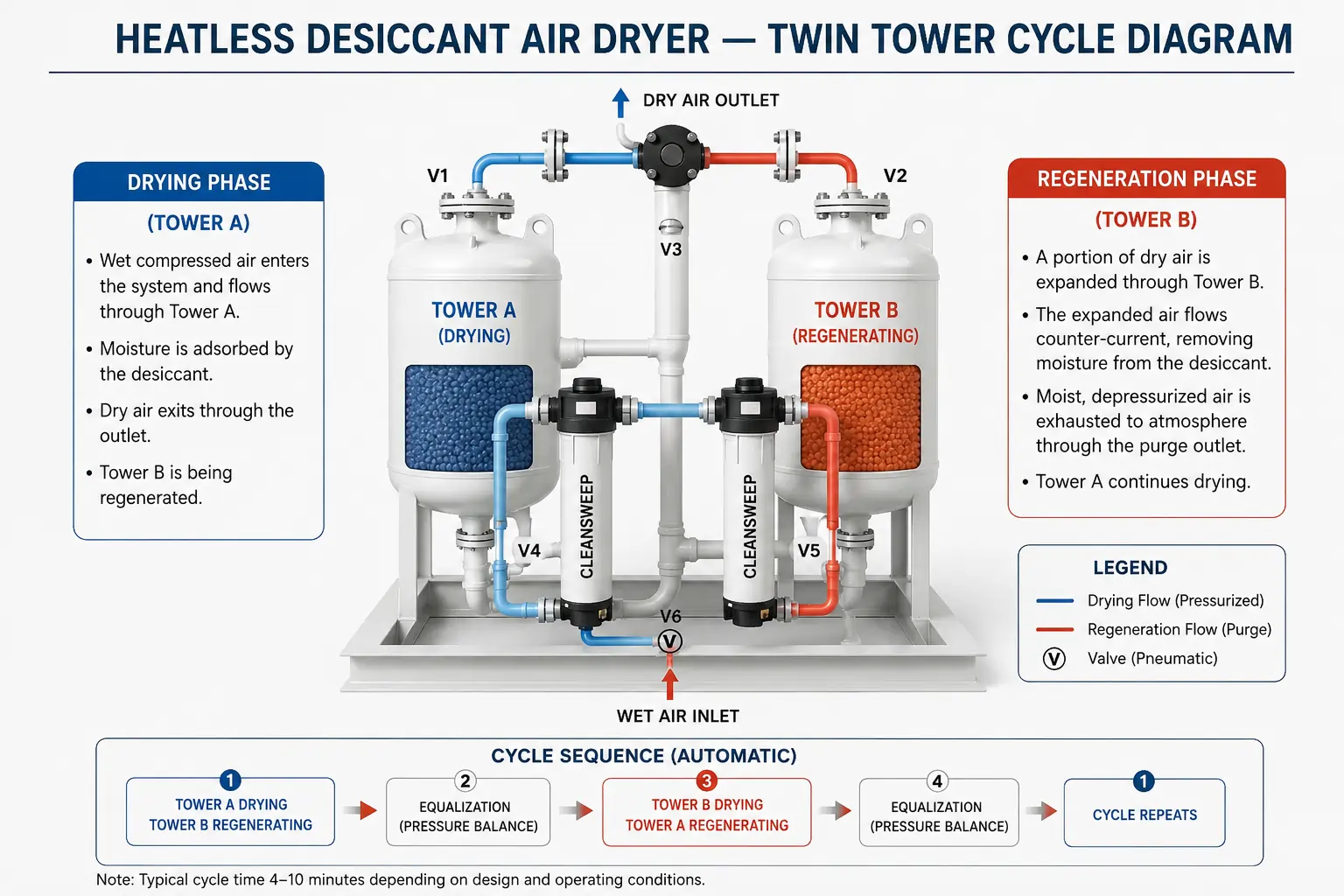
Pressure dew point: -40°C — instrumentation and outdoor linesTwo towers alternating between drying and regeneration — one tower dries the air while a fraction of already-dry air (the purge flow, 10–15% of total flow) passes through the other tower in reverse to strip out accumulated moisture. No external heat source. Simple, reliable, and low maintenance.
- Achieves -40°C PDP standard — suitable for instrumentation, outdoor cold climate lines
- No heaters, no moving parts other than switching valves — high reliability
- 15% purge air loss — energy cost at high flow rates
- Desiccant (activated alumina or molecular sieve) replaced every 3–5 years
- Specified for control panel air, instrument air, and outdoor compressed air lines
Heated Desiccant Air Dryer
Pressure dew point: -40°C to -70°C — pharmaceutical and critical processUses external electrical heating or heat-of-compression to regenerate the desiccant — eliminating or significantly reducing the purge air loss of heatless designs. Delivers the deepest dew points achievable in compressed air systems. Higher capital cost and complexity justified by energy savings on large systems.
- Achieves -70°C PDP — the deepest dew point of any compressed air dryer type
- Purge air loss reduced to 2–5% — energy saving vs heatless design at same flow
- Mandatory for pharmaceutical, laboratory, semiconductor, and laser cutting air
- Heated type: externally heated regeneration; HOC type: uses compressor discharge heat directly
- Higher installed cost — justified for large-flow systems where purge air saving pays back
Membrane Air Dryer
Pressure dew point: -20°C to -40°C — point-of-use, no power neededBundles of hollow polymer fiber membranes selectively allow water vapor to permeate through the fiber walls and escape to atmosphere — while dry air continues through the fiber interior. No refrigerant, no desiccant, no electrical power. Works silently at the point of use.
- No electricity required — works on compressed air pressure alone
- Silent, compact, suitable for hazardous areas and offshore installations
- PDP adjustable by controlling purge flow — deeper dew point needs more purge loss
- No desiccant to replace — membrane service life 5–10 years
- Limited to point-of-use or low-flow branch circuits with lower flow rates
Deliquescent Air Dryer
Simple passive drying — remote locations, no powerA vessel filled with hygroscopic salt tablets that dissolve slowly as they absorb moisture from the air stream — the dissolved brine drains from the vessel bottom. No power, no electronics, and no moving components. Used for basic moisture reduction in remote or hazardous locations where other dryer types are impractical.
- Simplest possible construction — vessel and drain valve only
- No power supply needed — purely passive operation
- PDP performance depends on ambient temperature — not suitable for critical dew point control
- Tablets require replenishment every 1–3 months depending on air volume
- Suitable for natural gas pipelines, remote compressor stations, and temporary installations
Combination Dryer (Refrigerated + Desiccant)
Two-stage drying — deepest dew point with energy efficiencyA refrigerated pre-dryer removes the bulk of the moisture load, reducing air to +3°C PDP before entering the desiccant stage. The desiccant stage then handles a far smaller moisture load — requiring less desiccant, shorter cycle times, and much lower purge losses to achieve -40°C or -70°C final dew point.
- Most energy-efficient route to very low dew points on large flow systems
- Extends desiccant bed life — less moisture load on the desiccant stage
- Higher capital cost — two dryer stages with controls
- Preferred for large pharmaceutical plants, laboratories, and semiconductor fabs
- Delivers ISO 8573-1 Class 1 air quality with appropriate downstream filtration
Key Components of an Air Dryer System
Heat Exchanger — Air-to-Air Pre-Cooler
In refrigerated dryers, the pre-cooler exchanges heat between hot incoming wet air and cold outgoing dry air. This recovers cold energy from the dry air — reducing the refrigeration load by 50–70% and improving overall system energy efficiency. The pre-cooler is the energy efficiency heart of every refrigerated dryer.
Refrigerant Evaporator — Air-to-Refrigerant
In refrigerated dryers, the evaporator cools the pre-cooled air from approximately 25°C down to 2–4°C using a refrigerant circuit. At this temperature, the dew point is suppressed to +3°C PDP. Refrigerant type: R134a or R407C for modern units — both phasing toward low-GWP alternatives.
Moisture Separator and Drain
A centrifugal or impingement-type separator at the refrigerant evaporator outlet captures liquid water droplets that form as the air cools. The automatic drain valve discharges collected water continuously — a failed or blocked drain valve is the most common cause of downstream moisture problems in a refrigerated air dryer system.
Desiccant Bed — Activated Alumina or Molecular Sieve
In desiccant dryers, the active drying medium. Activated alumina adsorbs moisture at -40°C PDP. Molecular sieve 4A achieves -70°C PDP — the difference is pore size, which determines how tightly water vapor molecules are held. Bed height and diameter are sized for the design flow rate and required cycle time.
Switching Valves — Inlet, Outlet, Purge
Desiccant dryers use pneumatically or electrically operated valves to switch the air path between drying and regenerating towers on a timed cycle. Valve reliability determines overall dryer reliability — failed switching valves are the primary cause of desiccant dryer moisture breakthrough and downstream equipment damage.
After-Filter
A 0.01-micron after-filter downstream of the desiccant bed captures desiccant dust and any residual aerosol — preventing desiccant particle carryover into the compressed air system. Essential for instrument air, pharmaceutical air, and any application where particulate limits are specified by ISO 8573-1.
Dew Point Sensor and Controller
A capacitive dew point sensor measures outlet air moisture content continuously. Modern controllers use dew point demand switching — extending each drying cycle until the actual dew point approaches the setpoint, rather than switching on a fixed timer. Dew point demand control reduces purge air consumption by 30–50% on variable-load compressor systems.
Pre-Filter
A coalescing pre-filter upstream of any air dryer removes liquid water droplets, compressor oil aerosol, and large particles before they enter the dryer. Oil on desiccant beads immediately reduces adsorption capacity — unfiltered oil from a lubricated compressor can halve desiccant service life within weeks.
ISO 8573-1 Compressed Air Quality Classes
ISO 8573-1 defines the quality of compressed air by three parameters: solid particulate, water content (dew point), and oil content. Specifying the correct ISO class for your application determines which air dryer type and filtration train you need.
| ISO Class | Pressure Dew Point | Particle Size | Oil Content | Typical Application |
|---|---|---|---|---|
| Class 1 | ≤ -70°C PDP | ≤ 0.1 micron | ≤ 0.01 mg/m³ | Pharmaceutical, semiconductor, medical breathing air, food direct contact |
| Class 2 | ≤ -40°C PDP | ≤ 1 micron | ≤ 0.1 mg/m³ | Instrument air, laboratory, electronics assembly, outdoor sub-zero lines |
| Class 3 | ≤ -20°C PDP | ≤ 5 micron | ≤ 1 mg/m³ | General process air, automation, pneumatic controls, food non-contact |
| Class 4 | ≤ +3°C PDP | ≤ 15 micron | ≤ 5 mg/m³ | General industrial — compressed air tools, workshop air, spray painting |
| Class 5 | ≤ +7°C PDP | ≤ 40 micron | ≤ 25 mg/m³ | Basic industrial — pneumatic machinery, non-critical general use |
| Class 6 | ≤ +10°C PDP | ≤ 40 micron | ≤ 25 mg/m³ | Very basic utility — construction tools, outdoor pneumatic applications |
💡 A refrigerated dryer achieves ISO Class 4 or 5. A heatless desiccant dryer achieves Class 2 with a 0.01-micron after-filter. A heated desiccant dryer achieves Class 1. Specify your ISO class first — then select the dryer type that achieves it. United Heat Exchangers confirms the correct dryer and filtration train for your ISO class requirement in every proposal.
Refrigerated vs Desiccant vs Membrane — Selection Comparison
| Criterion | Refrigerated | Heatless Desiccant | Heated Desiccant | Membrane |
|---|---|---|---|---|
| Pressure Dew Point | +3°C to +7°C | -40°C | -40°C to -70°C | -20°C to -40°C |
| ISO 8573-1 Class | Class 4–5 | Class 2 (with filter) | Class 1 (with filter) | Class 2–3 |
| Energy Consumption | Lowest — refrigeration only | Moderate — 15% purge air loss | Lower than heatless at large flows | 10–30% purge air loss |
| Consumables | None — no desiccant, no membrane | Desiccant every 3–5 years | Desiccant every 5+ years | Membrane every 5–10 years |
| Capital Cost | Lowest | Moderate | Highest | Low (small units) |
| Outdoor / Sub-Zero | Not suitable — PDP above -5°C | Suitable — PDP of -40°C | Most suitable — PDP to -70°C | Suitable for small flows |
| Pharmaceutical / Lab | Insufficient dew point | Acceptable for Class 2 | Required for Class 1 | Point-of-use only |
| Maintenance Complexity | Lowest — drain, refrigerant check | Valve servicing, desiccant change | Heater, valves, desiccant | Low — membrane replacement only |
| Power Required | Yes — refrigerant compressor | Yes — valve solenoids | Yes — heater + solenoids | None — pressure-driven only |
Technical Specifications
| Specification | Range / Options |
|---|---|
| Type | Refrigerated, heatless desiccant, heated desiccant (externally heated or HOC), membrane, deliquescent, combination |
| Flow Rate Capacity | 5 CFM to 10,000+ CFM (8 m³/h to 17,000+ m³/h) at rated pressure |
| Inlet Pressure | 5 to 16 bar standard; high-pressure variants to 40 bar on request |
| Inlet Temperature | Up to 50°C for refrigerated; up to 60°C for desiccant — aftercooler strongly recommended above 40°C |
| Pressure Dew Point | +7°C (refrigerated) to -70°C (heated desiccant) — full range available |
| ISO 8573-1 Air Quality | Class 1 through Class 6 achievable with the appropriate dryer and filtration combination |
| Desiccant Type | Activated alumina (-40°C PDP), molecular sieve 4A (-70°C PDP), silica gel (economy, -30°C PDP) |
| Refrigerant | R134a, R407C — transitioning to R1234ze and R32 in new designs |
| Purge Loss — Heatless | 12–15% of rated inlet flow — energy cost to consider on large systems |
| Power Supply | Single phase 220V / Three phase 415V — per local supply and dryer size |
| Control System | Timed cycle controller standard; dew point demand controller for energy optimization on variable-load systems |
| Connection Size | 1/2 inch BSP (small) to DN150 flanged (large industrial) — matched to compressor outlet piping |
Industries and Applications
Pharmaceutical Manufacturing
ISO Class 1 — Heated desiccant, -70°C PDPFood and Beverage Processing
ISO Class 1–2 — Desiccant, oil-free compressor mandatoryElectronics and Semiconductor
ISO Class 1 — Heated desiccant, cleanroom compatibleAutomotive Manufacturing
ISO Class 4 — Refrigerated standard; Class 2 for paintingOil and Gas — Instrument Air
ISO Class 2 — Desiccant, outdoor sub-zero dutyTextile Industry
ISO Class 4–5 — Refrigerated, high flowPower Generation
ISO Class 2–3 — Desiccant for instrument air, refrigerated for generalLaser Cutting and CNC
ISO Class 1 — Heated desiccant, -70°C PDPAir Dryers for Every Industry and Every Dew Point
From +3°C refrigerated to -70°C heated desiccant — engineered to your flow rate, inlet conditions, and ISO 8573-1 class. Free quote in 48 hours.
Request My Free Quote →How to Select the Right Air Dryer
Determine Required Pressure Dew Point
Identify the minimum ambient temperature the compressed air pipework will ever reach — then subtract 10°C for safety margin. That figure is your required PDP. Above 0°C → refrigerated. Below 0°C → desiccant. Below -40°C → heated desiccant.
Identify the Required ISO 8573-1 Class
Consult the downstream application's air quality requirement. Pharmaceutical and food contact → Class 1. Instrumentation → Class 2. General manufacturing → Class 4. Match the dryer type and filtration train to the required class — not to a lower standard that will fail compliance audits.
Size the Flow Rate Correctly
Use the compressor's rated delivery (CFM or m³/h) at the operating pressure as the dryer inlet flow. Size the dryer 10–20% larger than rated compressor output to handle flow peaks and ensure the dryer is never at maximum duty continuously — which shortens service life.
Check Inlet Temperature
Compressor aftercoolers should reduce inlet temperature to 40°C or below before the air reaches the dryer. Every 3°C above 40°C reduces refrigerated dryer capacity by 4–6%. Desiccant dryers above 50°C inlet temperature require pre-coolers. Confirm inlet temperature before ordering — it affects the dryer size directly.
Assess Inlet Oil Content
Oil-lubricated compressors produce oil aerosol — 3–5 ppm typically at discharge. This oil must be removed by a coalescing pre-filter before reaching a desiccant dryer. Oil-contaminated desiccant loses capacity rapidly and cannot be regenerated by purge air alone. Specify a coalescing pre-filter rated for 0.01 mg/m³ oil carryover with every desiccant dryer.
Consider Energy at Large Flow Rates
At flows above 500 CFM, heatless desiccant purge losses (15% of flow) become a significant energy cost. At these flows, evaluate a heated desiccant dryer — its higher capital cost is often recovered within 18–30 months through reduced purge air loss. United Heat Exchangers provides this payback calculation in every large-flow proposal.
Maintenance Guide — Protecting Air Dryer Service Life
| Task | Dryer Type | Frequency | Action |
|---|---|---|---|
| Pre-filter element replacement | All types | Every 1,000–2,000 hours or when ΔP exceeds 0.5 bar | Replace coalescing pre-filter element — clogged pre-filter restricts flow and increases pressure drop upstream, causing compressor backpressure |
| Automatic drain valve function test | Refrigerated, desiccant | Weekly | Manually trigger the drain valve and confirm condensate discharges freely. A stuck drain valve allows water to accumulate and pass downstream — the leading cause of moisture breakthrough in refrigerated dryers |
| Refrigerant charge check | Refrigerated only | Annual | Verify evaporator refrigerant suction pressure against design. Low suction pressure indicates refrigerant loss. Low refrigerant reduces cooling capacity — raises outlet dew point above spec without any visible alarm |
| Dew point verification | All types | Monthly — continuous sensor preferred | Measure outlet dew point with a calibrated portable dew point meter or confirm continuous sensor reading is within specification. A rising dew point at steady inlet conditions signals desiccant saturation, refrigerant loss, or membrane degradation |
| Switching valve servicing | Desiccant | Every 12–18 months | Inspect inlet, outlet, and purge valve seats for wear and verify fast, clean switching. Slow or incomplete valve switching allows wet air to bypass the active drying tower — causing dew point excursions without alerting the controller |
| Desiccant inspection | Desiccant | Every 3 years or after oil contamination event | Sample desiccant beads from the bottom of both towers. Discard beads that are crushed, oil-stained, or darker than fresh material — degraded desiccant does not regenerate fully and progressively worsens outlet dew point |
| After-filter element replacement | Desiccant | Every 2,000 hours or when ΔP exceeds 0.3 bar | Replace 0.01-micron after-filter element — captures desiccant dust that abrades from beads during cycle switching. Carryover of desiccant dust into instrument air or pharmaceutical air is a contamination failure |
| Condenser coil cleaning | Refrigerated | Every 6 months — monthly in dusty environments | Clean refrigerant condenser coil fins with compressed air or soft brush. Blocked condenser fins raise condensing temperature, reduce cooling capacity, and cause high-pressure shutdown — dusty factory environments clog condenser coils much faster than clean rooms |
💡 The drain valve is the most neglected component in any compressed air dryer. It is also the most critical. A blocked or failed automatic drain valve on a refrigerated dryer lets accumulated condensate pass directly into the compressed air system downstream — causing moisture damage that looks exactly like dryer failure. Test drain valves manually every week. Replace drain valves every 2–3 years as preventive maintenance regardless of apparent condition.
Why United Heat Exchangers
An air dryer sized incorrectly — too small for the actual flow, too shallow a dew point for the application, or specified with the wrong type for the inlet conditions — will fail to protect downstream equipment from day one. United Heat Exchangers sizes and specifies every air dryer from first principles, not from a catalogue lookup.
35+ Years Thermal Equipment Manufacturing
Established 1989. Air dryers, heat exchangers, and compressed air treatment equipment are our core manufacturing base. Deep thermal and fluid handling expertise applied to every unit.
Correctly Sized for Your Actual Flow
We size dryers at your actual operating pressure and maximum ambient temperature — not at standard conditions that understate the real duty. A dryer sized at standard conditions often delivers 70% of its rated capacity at actual site conditions.
ISO 8573-1 Class Guarantee
We specify the complete dryer and filtration train — pre-filter, dryer, and after-filter — required to meet your stated ISO class. The system is guaranteed to deliver the specified air quality class at rated inlet conditions.
All Dryer Types — One Manufacturer
Refrigerated, heatless desiccant, heated desiccant, membrane, and combination systems — all under one quality system and supply contract. One supplier, one warranty, one contact for any post-installation technical support.
Complete Documentation Package
Dryer sizing calculation, ISO 8573-1 class confirmation, test certificates, operation and maintenance manual, spare parts list, and desiccant or filter replacement schedule — issued before delivery.
Lifetime Spares and Support
Desiccant, filter elements, drain valves, switching valve kits, and membrane replacement bundles are held in stock or manufactured to order. Technical support for troubleshooting and system re-rating available throughout the dryer's service life.
Delivery and What's Included
What's Included with Every Air Dryer Order
- ISO 8573-1 air quality class confirmation — written confirmation of the ISO class the dryer and filtration train will deliver at your rated inlet conditions
- Dryer sizing calculation — correction factors for your actual operating pressure, inlet temperature, and ambient temperature applied to the rated capacity
- Pre-filter and after-filter specification — complete filtration train sized and specified for your ISO class and oil content requirement
- Factory test report — outlet dew point measured at rated flow before shipment; test record included in the documentation package
- Electrical and control wiring diagram — for connection to site power supply and integration with compressor control panel
- Operation and maintenance manual — startup procedure, drain valve testing schedule, filter replacement intervals, desiccant inspection guide, and troubleshooting chart
- First-year spare parts kit — pre-filter element, after-filter element (desiccant units), drain valve service kit, and recommended desiccant inspection quantity
- Desiccant replacement schedule — projected desiccant service life based on your inlet conditions and cycle frequency, with replacement specification
- Lifetime technical support — dew point troubleshooting, system re-rating for changed compressor output, and spare parts supply throughout service life
Get a Free Air Dryer Quote in 48 Hours
Share your compressor flow rate, operating pressure, inlet temperature, required pressure dew point or ISO 8573-1 class, ambient temperature, and application. Our engineering team selects the correct dryer type, sizes the unit, and delivers a technical proposal within 48 hours.
Request My Free Quote →Frequently Asked Questions — Air Dryers
What is an air dryer and why is it needed?
An air dryer removes moisture from compressed air before it reaches downstream equipment. Every compressor draws in humid atmospheric air — compression concentrates the water vapor. When the air cools inside pipework, the vapor condenses into liquid water that corrodes pipelines, damages instruments, contaminates products, and freezes outdoor lines. An air dryer prevents all of these by reducing the moisture content to a safe pressure dew point.
What is the difference between a refrigerated and desiccant air dryer?
In order to achieve a pressure dew point of +3°C to +7°C, a refrigerated air dryer cools compressed air to 2–4°C so that moisture condenses and drains away. Suitable for general indoor industrial use above freezing. A desiccant air dryer passes air through adsorbent material that captures moisture chemically — achieving -40°C to -70°C PDP. Required for instrumentation, pharmaceutical, outdoor cold climate, and sub-zero applications.
What is a heatless desiccant air dryer?
A heatless desiccant dryer uses two towers filled with activated alumina or molecular sieve. While one tower dries the air stream, a fraction of already-dry air — approximately 15% — passes back through the other tower to strip out accumulated moisture without any external heat. The towers provide continuous -40°C PDP output by switching every five to ten minutes on a timed or dew point-controlled cycle.
What pressure dew point do I need for instrument air?
Instrument air for control valves, positioners, and field instruments in process plants requires a minimum -40°C pressure dew point — ISO 8573-1 Class 2. In cold-climate or outdoor installations, -60°C PDP is often specified for additional margin against freezing in outdoor instrument lines. A heatless or heated desiccant dryer is mandatory for instrument air — a refrigerated dryer does not deliver adequate dew point.
Which air dryer is required for pharmaceutical compressed air?
Pharmaceutical compressed air must meet ISO 8573-1 Class 1 — requiring ≤ -70°C PDP, ≤ 0.1 micron particulate, and ≤ 0.01 mg/m³ oil. This demands a heated desiccant dryer with molecular sieve 4A desiccant, a 0.01-micron coalescing pre-filter, and a 0.01-micron sterile after-filter. An oil-free compressor is also mandatory — oil-lubricated compressors cannot reliably achieve Class 1 oil content even with downstream filtration.
How much does the purge loss from a desiccant dryer cost?
A heatless desiccant dryer consuming 15% purge air on a 500 CFM compressed air system wastes 75 CFM continuously — equivalent to running a 15 kW compressor solely to produce purge air. At ₹8 per kWh and 8,000 operating hours per year, that is approximately ₹9.6 lakh per year in purge air energy cost. At large flows, switching to a heated desiccant dryer that reduces purge loss to 3–5% pays back the additional capital cost within 18–30 months.
Can I use a refrigerated dryer for outdoor compressed air lines in winter?
Only if the outdoor temperature never falls below the dryer's outlet dew point. A refrigerated dryer delivering +3°C PDP will allow condensation in any outdoor pipework that reaches below 3°C — which in most of India's northern regions happens regularly in winter. For outdoor lines in cold regions, a heatless desiccant dryer delivering -40°C PDP is the correct specification.
What is the delivery time for an air dryer from United Heat Exchangers?
Standard refrigerated dryers from 5 to 500 CFM deliver in 2–4 weeks from order confirmation. Heatless and heated desiccant dryers at all flow rates deliver in 4–8 weeks. Large-flow custom units and combination dryer systems deliver in 8–12 weeks. Expedited schedules for plant shutdown replacement are available on request.
Author: Senthil Kumar, Technical Director — United Heat Exchangers Pvt. Ltd. | Last Updated: May 2026