Author: Senthil Kumar, Technical Director | Updated: June 2026
Table of Contents
- What Is a Dynamic Scraped Surface Heat Exchanger?
- How a Scraped Surface Heat Exchanger Works
- Why Scraping Is Necessary — The Fouling Problem
- Key Components of a Scraped Surface Heat Exchanger
- Types and Configurations
- Scraped Surface vs Conventional Heat Exchangers
- Material Selection — Barrel, Rotor, and Scraper Blades
- Design Specifications and Operating Parameters
- Industries and Applications
- How to Select a Scraped Surface Heat Exchanger
- Maintenance and Cleaning Guide
- Why United Heat Exchangers
- Delivery and What's Included
- Frequently Asked Questions
What Is a Dynamic Scraped Surface Heat Exchanger?
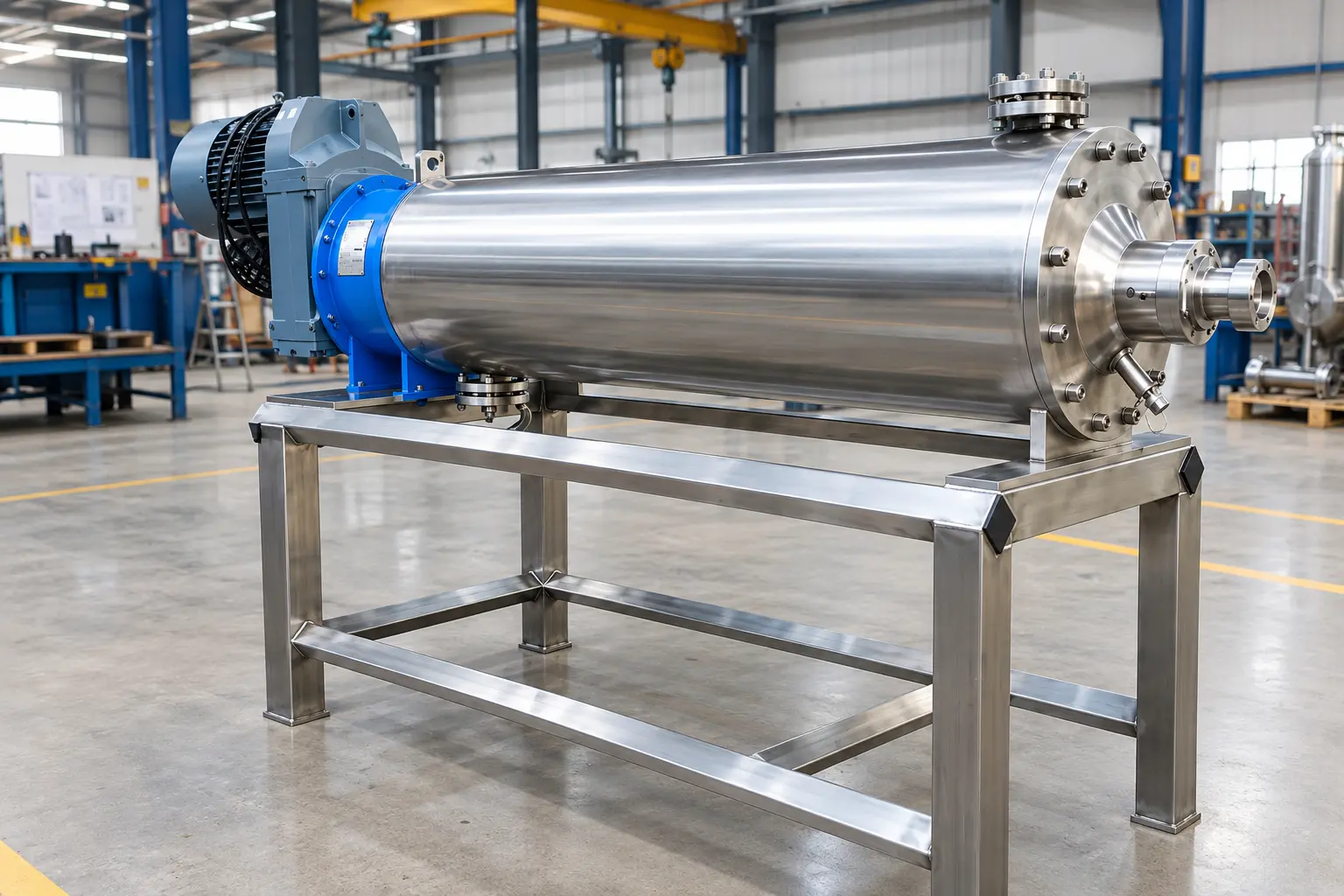
A dynamic scraped surface heat exchanger (SSHE) is a specialised heat exchanger purpose-built for one specific engineering problem that no conventional shell-and-tube, plate, or finned heat exchanger can solve well: transferring heat efficiently to or from a fluid that fouls, crystallises, burns, or builds an insulating film on a static heated or cooled surface. Instead of relying on bulk fluid flow alone to expose fresh fluid to the heat transfer surface, an SSHE uses a rotating shaft fitted with spring-loaded scraper blades that at each rotation, a clean metal surface is exposed to the process fluid by continually and mechanically removing the product film as it forms.
The scraped surface heat exchanger differs from all other types of heat exchangers due to this constant mechanical activity. In a conventional exchanger, fouling builds a thermally insulating layer over time, progressively reducing the overall heat transfer coefficient until the unit must be shut down and cleaned. The rotating scraper in an SSHE keeps this layer from ever forming; even when processing fluids with viscosities thousands of times greater than water or fluids that would set, crystallize, or carbonize on a static wall in a matter of seconds, the heat transfer coefficient essentially stays constant from start-up to shutdown.
As a trusted scraped surface heat exchanger manufacturer in India, United Heat Exchangers designs and fabricates dynamic SSHE units for food processing, chemical, polymer, pharmaceutical, and industrial crystallisation applications — in 316L stainless steel, duplex, and Hastelloy construction, with custom rotor speed, scraper blade material, and jacket design engineered around your specific product's rheology and thermal sensitivity.
How a Scraped Surface Heat Exchanger Works
The process fluid is pumped through the narrow annular gap between the inner wall of a cylindrical, jacketed barrel and a central rotating shaft. A heating or cooling medium — steam, hot water, chilled water, glycol, or refrigerant — circulates in the jacket surrounding the barrel, and heat passes through the barrel wall to or from the product exactly as in any jacketed vessel. The difference is what happens at that wall: spring-loaded scraper blades, mounted along the length of the rotating shaft, sweep continuously across the inner barrel surface, shearing off the thin layer of product that has absorbed or released heat and is beginning to form an insulating film.
Product Enters Annular Gap
The small gap between the rotating central shaft and the jacketed barrel wall is filled with process fluid.
Heat Transfers Through Barrel Wall
Heating or cooling medium in the jacket exchanges heat through the barrel wall with the thin product film against it.
Scraper Blades Remove the Film
Spring-loaded blades on the rotating shaft continuously sweep the barrel wall, removing the heated or cooled film before it can foul or insulate.
Scraped Film Mixes Into Bulk
The removed film mixes back into the bulk product stream, promoting uniform temperature and texture throughout the product.
Product Exits at Target Temperature
Conditioned product exits the barrel outlet — heated, cooled, partially crystallised, or aerated as required by the process.
Engineering Insight — Why the Scraping Action Improves Heat Transfer: The boundary layer of fluid immediately against any heated or cooled wall is, by definition, the layer with the steepest temperature gradient and the highest local viscosity (in a fluid that thickens as it cools, like margarine or chocolate). This boundary layer dominates the overall thermal resistance. By mechanically removing it at every shaft revolution and replacing it with fresh bulk fluid, an SSHE keeps the effective film thickness extremely thin and constantly renewed — delivering a tube-side film heat transfer coefficient many times higher than the same fluid would achieve under natural convection or even forced laminar flow in a static tube. The trade-off is mechanical complexity and rotor power consumption, which is the price paid for processing fluids that would otherwise be impossible to handle efficiently.
Why Scraping Is Necessary — The Fouling Problem
Conventional heat exchangers rely entirely on fluid velocity and turbulence to keep the heat transfer surface clean. This works well for water, light oils, and most gases — but fails for an entire category of industrially important fluids whose physical behaviour actively works against this principle.
High and Variable Viscosity
Fluids such as molten chocolate, margarine emulsion, and polymer melts have viscosities thousands of times higher than water, and that viscosity often increases sharply as the fluid cools near the wall — creating a self-reinforcing stagnant boundary layer that a static heat exchanger cannot disrupt by flow alone.
Crystallisation on Cooling
Products like margarine, shortening, and paraffin wax are designed to crystallise as they cool. In a static cooler, this crystallisation happens preferentially at the cold wall, building a solid insulating crust that can completely block flow within minutes.
Heat-Sensitive Burning or Scorching
Dairy products, fruit purees, and protein-rich foods scorch or caramelise if held too long against a hot wall. A static exchanger's slowest-moving boundary layer fluid is exposed to the wall the longest — precisely the fluid most likely to burn and discolour the product.
Particulate and Solids Content
Products containing fruit pieces, nuts, or other particulates can bridge and pack against tube walls or plate channels in conventional exchangers, causing blockage. The open annular geometry and active scraping of an SSHE handle particulate-laden products that would plug a plate heat exchanger.
Sticky, Adhesive Products
Adhesives, certain polymer intermediates, and sugar-rich confectionery products physically adhere to metal surfaces. Without active mechanical removal, these products build up layer upon layer until the flow passage is fully obstructed.
Progressive Fouling Decay
Even moderately fouling fluids in a conventional exchanger show a fouling resistance that grows continuously between cleanings — heat transfer performance at the end of a production run can be a fraction of the clean-surface value. SSHE units maintain near-constant performance throughout the run.
Key Components of a Scraped Surface Heat Exchanger
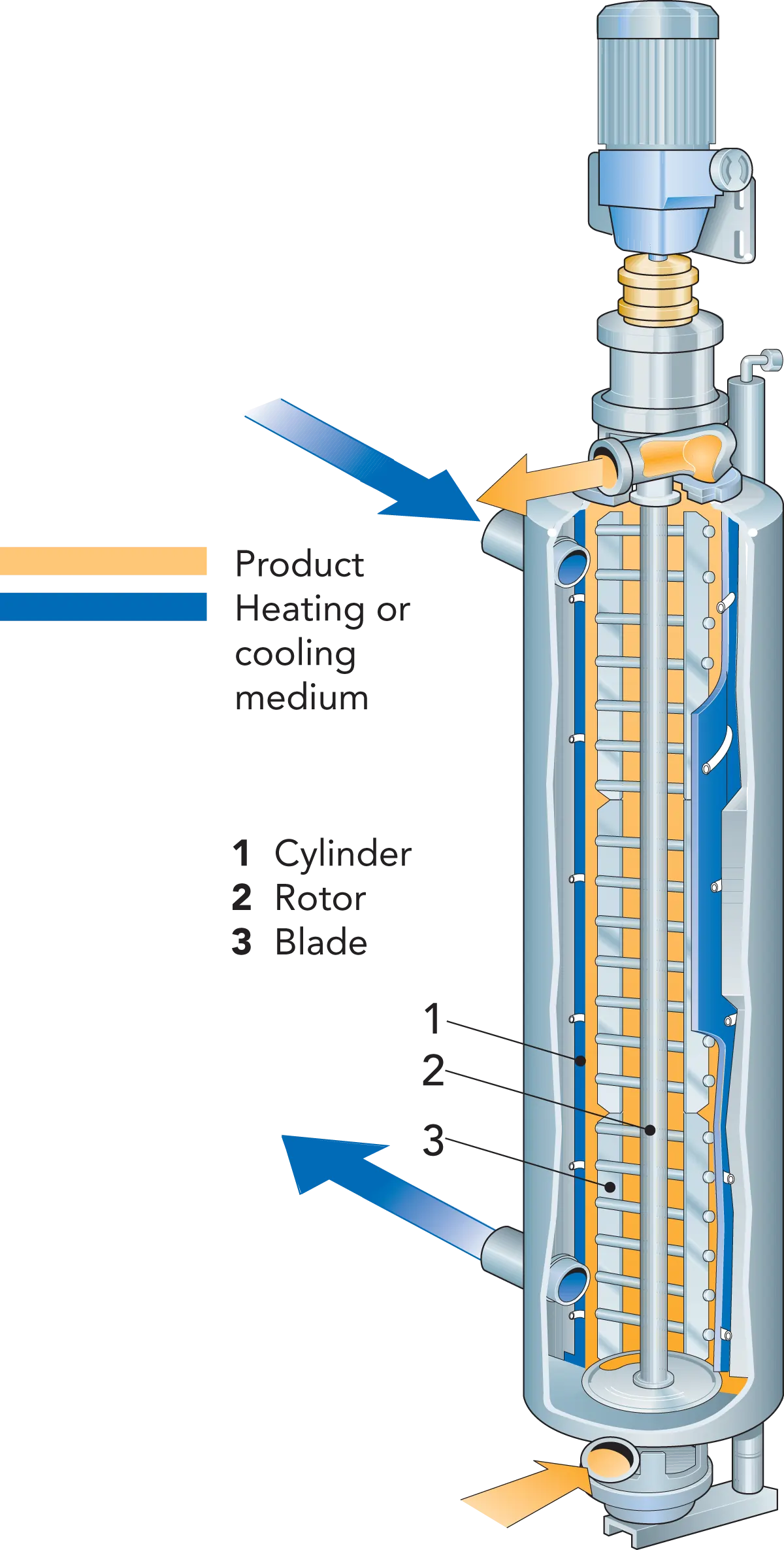
Dynamic Scraped Surface Heat Exchanger — Single Barrel Cross-Section
Barrel (Cylinder)
In the inner heat transfer surface, which is a pressure-containing cylindrical tube, the product flows through the annular space between the wall and the rotor, while the heating/cooling medium circulates in the jacket to the outside. Bore finish is critical: hygienic services specify mirror-polished or electropolished 316L stainless to Ra ≤ 0.4 µm.
Jacket
The outer shell surrounding the barrel, forming a sealed annular space through which the heating or cooling medium — steam, hot water, chilled glycol, or ammonia refrigerant — circulates. Jacket design follows ASME Section VIII pressure vessel rules independently from the product-side pressure rating.
Rotor Shaft
The central rotating shaft running the length of the barrel, carrying the scraper blade mounts. Shaft speed is a key process variable — typically 100 to 800 rpm depending on product viscosity, residence time requirement, and desired shear input — driven by a variable speed motor and gearbox.
Scraper Blades
Spring-loaded or hinged blades mounted along the rotor that maintain continuous contact with the barrel inner wall, sweeping away the product film as the shaft rotates. Blade material — PTFE, UHMW-PE, or stainless steel — is selected for product abrasiveness, temperature, and hygienic requirements.
Mechanical Seal
A rotating shaft seal at each end of the barrel that prevents product leakage or jacket medium ingress where the rotor shaft penetrates the pressure boundary. Single or double mechanical seals are specified based on product hygiene requirements and the pressure differential across the seal.
Drive Assembly
An electric motor coupled through a gearbox (and frequently a variable frequency drive) to the rotor shaft, providing the torque needed to drive the scraper blades through viscous product at the specified rotational speed — power demand can range from a few kW to over 100 kW depending on barrel size and product viscosity.
Types and Configurations
Horizontal Single-Barrel SSHE
Most common configuration — continuous in-line processingA single jacketed barrel mounted horizontally with the rotor driven from one end. The standard configuration for continuous, in-line product heating, cooling, or crystallisation duties across food and chemical processing.
- Continuous flow-through design for high-volume production lines
- Single or multiple barrels in series for staged temperature profiles
- Standard for margarine, shortening, and ice cream mix processing
Vertical SSHE
Gravity-assisted flow — viscous and crystallising productsA vertically mounted barrel where gravity assists product movement through the annular gap — used where very high viscosity or partial crystallisation would otherwise resist horizontal pumping through the unit.
- Gravity assist reduces pumping energy for extremely viscous products
- Compact footprint for limited floor-space installations
- Common in wax, sulphur, and polymer crystallisation service
Multi-Barrel SSHE Bank
Series-connected barrels for large duty or staged processingMultiple SSHE barrels connected in series, each with independent jacket temperature control, allowing a defined heating, cooling, or crystallisation temperature profile to be applied stage by stage as the product progresses through the bank.
- Independent jacket temperature zones for controlled crystallisation curves
- Scales heat transfer capacity for large continuous production volumes
- Standard configuration for margarine and shortening votator lines
SSHE Crystalliser
Designed specifically for controlled crystal formationA scraped surface unit optimised for controlled crystallisation rather than simple heating or cooling — rotor speed, jacket temperature, and residence time are tuned to produce a target crystal size and polymorphic form in fats, waxes, and certain chemical products.
- Precise crystal nucleation and growth control through scraping intensity
- Used in fat tempering, wax dewaxing, and chemical crystallisation
- Often paired with a resting/working section downstream for crystal maturation
Scraped Surface vs Conventional Heat Exchangers
| Parameter | Dynamic Scraped Surface Heat Exchanger | Shell-and-Tube / Plate Heat Exchanger |
|---|---|---|
| Fouling Resistance | Excellent — continuous mechanical removal prevents film buildup | Poor for viscous/crystallising fluids — fouling layer builds progressively |
| Maximum Practical Viscosity | Very high — thousands of centipoise, including semi-solid pastes | Low to moderate — performance degrades sharply above a few hundred cP |
| Heat Transfer Coefficient Stability | Stable throughout the run — minimal decay between cleanings | Declines progressively as fouling resistance accumulates |
| Mechanical Complexity | Higher — rotating shaft, seals, drive, and scraper maintenance | Lower — no moving parts in the heat transfer section |
| Capital and Operating Cost | Higher per unit of surface area — justified only when fouling demands it | Lower — the default choice whenever fouling is not a limiting factor |
| Crystallisation Capability | Purpose-built — scraping promotes controlled nucleation and prevents crust | Not suitable — crystals build on the wall and block flow |
Material Selection — Barrel, Rotor, and Scraper Blades
316L Stainless Steel — Barrel and Wetted Parts
The standard barrel material for food, pharmaceutical, and most chemical applications. Electropolished to Ra ≤ 0.4 µm for hygienic service. Excellent corrosion resistance and full CIP (clean-in-place) compatibility.
Duplex 2205 — Aggressive Chemical Service
Specified for higher-strength, higher-corrosion-resistance applications such as concentrated salt solutions or chloride-bearing chemical process streams beyond 316L's reliable service envelope.
Hastelloy C-276 — Extreme Corrosion Resistance
Used for the most aggressive chemical and polymer processing fluids — mixed acids, chlorinated organics, and other streams that would attack stainless or duplex barrels over the unit's service life.
PTFE Scraper Blades
Low-friction, chemically inert, FDA-compliant scraper material for food and pharmaceutical service — minimises barrel wall wear while maintaining effective film removal at moderate product abrasiveness.
UHMW-PE Scraper Blades
Ultra-high molecular weight polyethylene blades offer excellent wear resistance and impact toughness — preferred for products with higher particulate content or abrasiveness than PTFE can reliably handle.
Stainless Steel Scraper Blades
Hardened stainless steel blades for high-temperature service beyond polymer blade limits, or for products requiring the most aggressive mechanical scraping action against a tenacious fouling layer.
Design Specifications and Operating Parameters
Dynamic Scraped Surface Heat Exchanger — Standard Design Parameters
Industries and Applications
| Industry | Typical Product | SSHE Function |
|---|---|---|
| Food & Beverage | Margarine, shortening, ice cream mix, processed cheese | Rapid cooling with controlled crystallisation and aeration |
| Confectionery | Chocolate, fondant, caramel, fruit fillings | Tempering and cooling without burning or crystal defects |
| Chemical Processing | Polymer melts, resins, adhesives | Controlled cooling and crystallisation without wall buildup |
| Pharmaceutical & Cosmetics | Creams, ointments, lotions, waxes | Uniform heating/cooling of viscous hygienic formulations |
| Oil & Wax Processing | Paraffin wax, lard, tallow, sulphur | Controlled solidification and flaking ahead of packaging |
How to Select a Scraped Surface Heat Exchanger
Define Product Rheology
Provide viscosity at process temperature, shear sensitivity, particulate content, and crystallisation behaviour — these properties drive barrel diameter, rotor speed, and scraper blade selection.
Specify Inlet/Outlet Temperatures
Define the required temperature change and target outlet condition (fully liquid, partially crystallised, or fully solidified) to size barrel length and number of stages.
Confirm Hygienic Requirements
Food and pharmaceutical applications require electropolished bores, 3-A/EHEDG fittings, and CIP compatibility — specify these requirements upfront as they affect material and finish selection.
Select Jacket Medium
Steam, hot water, chilled water, glycol, or direct refrigerant expansion — chosen based on the temperature range required and available utilities at your site.
Determine Throughput
Production rate (kg/hr or L/hr) determines barrel diameter, number of barrels in series, and motor sizing for the rotor drive.
Review Cleaning Regime
Specify CIP or manual disassembly cleaning requirements — this affects seal type, blade mounting design, and barrel access provisions.
Maintenance and Cleaning Guide
Scraper Blade Inspection and Replacement
Inspect blade wear and spring tension at scheduled intervals — worn blades lose contact pressure against the barrel wall, allowing fouling film to re-establish and heat transfer to decline. Replace blades on a preventive schedule based on product abrasiveness.
Mechanical Seal Monitoring
Check seal leakage and flush flow regularly. A degrading mechanical seal is the most common cause of unplanned SSHE downtime — early detection through routine inspection avoids contamination incidents and emergency shutdowns.
CIP (Clean-in-Place) Cycle
For food and pharmaceutical units, run scheduled CIP cycles with appropriate alkaline and acid wash steps to maintain hygienic bore condition without full disassembly between production runs.
Barrel Bore Condition Check
Periodically inspect the barrel inner surface for scoring or wear from scraper contact — a scored bore reduces scraping effectiveness and can become a fouling initiation site even with new blades fitted.
Why United Heat Exchangers
Custom Rotor Engineering
Scraper geometry, blade count, and rotor speed are engineered specifically around your product's rheology — not selected from a fixed catalogue range.
ASME Certified Pressure Parts
Completely documented pressure-containing jacket and barrel components designed and manufactured to ASME Section VIII Division 1.
Hygienic Design Expertise
Electropolished bores, 3-A and EHEDG-compliant fittings, and full CIP compatibility for food and pharmaceutical applications.
All Alloys In-House
316L stainless, duplex 2205, and Hastelloy C-276 barrel fabrication — matched to your product's corrosivity and hygienic requirements.
35+ Years Manufacturing Experience
Decades of process heat exchanger fabrication for food, chemical, and pharmaceutical clients across India and export markets.
Full Documentation Package
Material certifications, hydrostatic test records, and complete drawings issued with every unit for regulatory and quality compliance.
Get a Free Scraped Surface Heat Exchanger Quote in 48 Hours
Share your product's viscosity, inlet/outlet temperatures, throughput, and hygienic requirements. Our team will recommend the optimum barrel size, rotor speed, and scraper configuration and deliver a complete proposal within 48 hours.
Request My Free Quote →Delivery and What's Included
What's Included with Every Order
- Process engineering review — rotor speed, barrel sizing, and scraper configuration matched to your product rheology
- ASME Section VIII documentation — jacket and barrel pressure part design calculations and certification
- Material certifications (MTRs) — traceable mill test reports for all wetted and pressure-containing components
- Hydrostatic test certificate — jacket and product-side pressure circuits tested and witnessed
- Hygienic compliance documentation — 3-A/EHEDG conformance records for food and pharmaceutical units
- General arrangement drawing — overall dimensions, nozzle schedule, and drive specification
- Operations and maintenance manual — CIP procedure, blade replacement guide, seal maintenance schedule, and spare parts list
- Lifetime technical support — rotor upgrade and re-rating assistance as your product or capacity requirements evolve
Frequently Asked Questions — Dynamic Scraped Surface Heat Exchangers
What is a dynamic scraped surface heat exchanger?
A dynamic scraped surface heat exchanger (SSHE) is a specialised heat exchanger in which a rotating shaft fitted with spring-loaded scraper blades continuously removes the boundary layer of product film from the inner wall of a jacketed cylindrical barrel. This continuous mechanical scraping prevents fouling, burning, or crystal buildup on the heat transfer surface, maintaining a consistently high heat transfer coefficient even with highly viscous, sticky, or crystallising fluids that would otherwise foul a conventional shell-and-tube or plate heat exchanger within minutes.
How does a scraped surface heat exchanger work?
A scraped surface heat exchanger works by pumping the process fluid through the annular space between a jacketed cylindrical barrel and a central rotating shaft. A heating or cooling medium circulates in the outer jacket, transferring heat through the barrel wall to the product. As the product film forms on the inner barrel wall, spring-loaded scraper blades mounted on the rotor continuously remove it, exposing fresh barrel surface to the product and preventing the insulating fouling layer from building up. The scraped film mixes back into the bulk product, improving both heat transfer and product uniformity.
What products are processed in scraped surface heat exchangers?
Scraped surface heat exchangers process highly viscous, sticky, crystallising, or heat-sensitive products including margarine and shortening, chocolate and confectionery, ice cream mix, processed cheese, fruit purees and jams, peanut butter, mayonnaise, polymer melts and resins, paraffin wax, sulphur, lard and tallow, and pharmaceutical creams and ointments. Common to all these applications is a tendency to foul, crystallise, or burn on a static heated or cooled surface — the continuous scraping action is what makes efficient processing possible.
What is the difference between a scraped surface heat exchanger and a votator?
Votator is a registered trademark originally used for a specific brand of scraped surface heat exchanger developed for the margarine industry, and the name became so closely associated with the technology that it is still used informally as a generic term for any scraped surface heat exchanger. Functionally, a votator and a dynamic scraped surface heat exchanger are the same equipment type — a jacketed barrel with an internal rotating scraper shaft.
What materials are used to construct scraped surface heat exchangers?
Scraped surface heat exchanger barrels are most commonly constructed from 316L stainless steel for food, pharmaceutical, and general chemical service, with electropolished or mirror-finish bores for hygienic applications. Duplex stainless steel and Hastelloy C-276 are used for aggressive chemical or polymer processing services. Scraper blades are manufactured from PTFE, UHMW-PE (ultra-high molecular weight polyethylene), or hardened stainless steel, selected based on product abrasiveness, operating temperature, and hygienic requirements.
What industries use scraped surface heat exchangers?
Scraped surface heat exchangers are used extensively in the food and beverage industry (margarine, ice cream, chocolate, processed cheese, fruit preparations), the chemical and petrochemical industry (polymer crystallisation, paraffin wax processing, sulphur cooling), the pharmaceutical industry (creams, ointments, and viscous formulations), and the cosmetics industry (lotions and creams). These industries all share the need for dependable heat transfer with viscous, fouling, or crystallizing products that are difficult for traditional static heat exchangers to effectively handle.
Author: Senthil Kumar, Technical Director — United Heat Exchangers Pvt. Ltd. | Last Updated: June 2026