Author: Senthil Kumar, Technical Director | Updated: June 2026
Table of Contents
- What Is a Copper Heat Exchanger?
- Why Copper? — Thermal and Material Properties
- How a Copper Heat Exchanger Works
- Types of Copper Heat Exchangers
- Copper Heat Exchanger Anatomy — Shell and Tube Design
- Copper Alloys for Heat Exchangers — Full Guide
- Engineering Advantages of Copper Heat Exchangers
- Design Specifications and Operating Limits
- Fluid Compatibility — What Copper Can and Cannot Handle
- Copper vs Stainless Steel vs Titanium Heat Exchangers
- Industries and Applications
- How to Select a Copper Heat Exchanger
- Maintenance and Cleaning Guide
- Why United Heat Exchangers
- Delivery and What's Included
- Frequently Asked Questions
What Is a Copper Heat Exchanger?
A copper heat exchanger is a heat transfer device in which copper — or a copper alloy — is the primary heat transfer material, forming the tubes, coils, fins, or brazed plates through which heat flows between two fluid streams. Copper has been the material of choice for heat exchangers in water heating, HVAC, refrigeration, oil cooling, and many industrial applications for over a century, and it remains the dominant metal in these sectors today because no common engineering material combines its specific combination of thermal conductivity, corrosion resistance, formability, and antimicrobial properties in a single package.
A copper heat exchanger can take many structural forms — a shell-and-tube exchanger with copper tubes inside a steel or brass shell, a coiled copper tube immersed in a tank or enclosed in a cylindrical shell, a brazed plate unit where copper brazing permanently bonds stainless steel corrugated plates, a finned-tube air coil where aluminium fins are bonded to copper tubes, or a simple steam coil distributing heating steam inside a vessel or ductwork. What all these configurations share is the copper heat transfer surface — and the specific engineering advantages that copper brings to each application.
As a leading copper heat exchanger manufacturer in India, United Heat Exchangers designs and fabricates copper tube shell-and-tube heat exchangers, copper coil heat exchangers, copper brazed plate designs, copper finned tube coils, and copper steam coils — in phosphorus-deoxidised copper, admiralty metal, aluminium brass, and copper-nickel alloys — for HVAC, refrigeration, water heating, oil cooling, marine, and industrial process applications, with ASME certification and full documentation on every unit.
Why Copper? — Thermal and Material Properties
The case for copper in heat exchanger design begins with a single number: thermal conductivity of 385–401 W/m·K for pure copper, falling to 340–380 W/m·K for common copper alloys. To understand what that means in practice, compare it to the materials it competes with: carbon steel sits at around 50 W/m·K, 316L stainless steel at approximately 16 W/m·K, and titanium at about 22 W/m·K. Copper conducts heat five to eight times better than steel and more than twenty times better than stainless steel — with direct consequences for heat exchanger design at every scale.
A high thermal conductivity material reduces the resistance the tube wall itself contributes to the overall heat transfer from fluid to fluid. In a typical heat exchanger, the overall heat transfer coefficient (U) is the reciprocal of the sum of all individual resistances — tube-side film, tube wall, and shell-side film. For a thin stainless steel tube in clean fluid service, the tube-wall resistance is already small relative to the film resistances, so switching to copper gives a modest U improvement. But for thicker tube walls, higher wall resistances (as in fouling or viscous service), or designs where the tube wall resistance is significant, copper's conductivity advantage directly translates into a higher U, a smaller required heat transfer area, and therefore a smaller, lighter, less expensive heat exchanger for the same duty.
Engineering Insight — Thermal Conductivity in Context: In most clean-fluid HVAC and refrigeration applications, the overall heat transfer coefficient is determined primarily by the fluid film coefficients on each side of the tube, and the tube-wall resistance is minor. Copper's main advantage in these services is not the marginal improvement in U — it is the ability to draw copper into very thin-wall (<0.5 mm) seamless tube without sacrificing structural integrity, keeping the tube-wall resistance negligible even when the tube is extremely thin, while still meeting pressure and mechanical requirements. Stainless steel, with its lower conductivity and higher strength (allowing thinner walls), partially closes the gap — but copper's combination of conductivity and formability into thin, precise tube dimensions remains unmatched for HVAC, refrigeration, and water heating coil applications.
Beyond thermal conductivity, copper brings a cluster of additional properties that explain its persistent dominance in specific heat exchanger markets:
Outstanding Corrosion Resistance in Water
Copper forms a stable, adherent Cu₂O and CuO oxide layer in clean water that acts as a protective film, sharply slowing further corrosion. In properly treated fresh water systems, copper tube heat exchangers routinely operate for 20–30 years without significant wall loss.
Natural Antimicrobial Properties
Copper's oligodynamic antimicrobial action — toxic to bacteria, viruses, and fungi on contact — is a significant benefit in potable water heat exchangers, domestic hot water systems, and food and beverage process applications where biological fouling and contamination must be minimised.
Excellent Formability and Drawability
Copper is easily drawn into thin-wall seamless tube in a wide range of diameters, bent into complex coil geometries without wall thinning or cracking, and connected by soldering or brazing to fittings — making it the most fabrication-friendly metal for compact coil and finned-tube heat exchangers.
Full Refrigerant Compatibility
Copper is compatible with every commercial refrigerant — CFC, HCFC, HFC, and HFO — with the sole exception of ammonia (which attacks copper and its alloys). This makes copper the default tube material for refrigeration condensers, evaporators, and oil separators across the commercial and industrial refrigeration industry.
Brazeable and Solderable
Copper can be joined by silver brazing, copper brazing, or soft soldering — enabling the manufacture of leak-free brazed plate heat exchangers and the assembly of complex tube-and-fin coil structures without welding, which is a significant manufacturing cost advantage for high-volume HVAC coil production.
High Fatigue Resistance
Copper has good resistance to thermal and mechanical fatigue cycling — important in applications where the heat exchanger sees repeated heating-cooling cycles, pressure fluctuations in refrigeration circuits, or vibration from compressor pulsations in refrigeration or gas compression service.
How a Copper Heat Exchanger Works
The operating principle of a copper heat exchanger is identical to any recuperative heat exchanger — two fluid streams at different temperatures are separated by the copper heat transfer surface, and heat flows by conduction from the hotter to the cooler fluid through the copper tube wall or plate. What distinguishes the copper heat exchanger is the high thermal conductivity of that separating wall, which minimises the wall's contribution to the overall thermal resistance and allows the same heat duty to be achieved with less surface area — or the same surface area to achieve a higher heat transfer rate — compared with equivalent stainless steel or titanium designs.
Hot Fluid Enters Copper Tubes
The hotter process stream enters the copper tube side from the inlet header or manifold at its design inlet temperature and pressure.
Convection to Tube Inner Wall
Turbulent or laminar flow in the copper tube creates a film heat transfer coefficient — heat flows from the hot fluid to the inner copper tube wall by convection.
Conduction Through Copper Wall
Heat conducts through the copper tube wall. Copper's high thermal conductivity (385 W/m·K) makes the wall resistance minimal — far less than with steel or stainless tube.
Convection to Shell or Air Side
Heat transfers from the outer copper tube wall to the cooling fluid — water, air, refrigerant, or oil — by convection on the shell or fin side.
Cooled Fluid Exits
The tube-side fluid exits at the required outlet temperature. The shell-side fluid exits warmer, having absorbed the transferred heat.
Types of Copper Heat Exchangers
United Heat Exchangers manufactures all principal copper heat exchanger configurations. Type selection is governed by the process duty, fluid properties, operating pressure, fouling tendency, and installation environment.
Copper Tube Shell-and-Tube Heat Exchanger
Copper tubes inside a steel or brass shell — the workhorse of industrial copper heat exchangeThe most widely used copper heat exchanger configuration in industrial and HVAC applications — copper tubes (seamless, to ASTM B111 or B68) are rolled or expanded into tube sheets at each end and enclosed within a cylindrical steel, admiralty, or copper shell. The tube-side fluid flows through the copper tubes; the shell-side fluid flows across the outside of the tubes guided by baffles.
- Copper tubes to ASTM B111 — seamless copper and copper-alloy condenser and heat exchanger tubes, standard for water cooling, steam condensing, and refrigeration service
- Shell in carbon steel, stainless steel, or brass depending on shell-side fluid requirements
- Tube sheet material — naval brass (C46400), admiralty, Muntz metal, or carbon steel with copper-tube expansion
- Fixed tube sheet, U-tube, or floating head designs — U-tube most common for copper to accommodate thermal expansion without stress
- Standard applications: water-to-water heat exchangers, refrigerant condensers, lube oil coolers, transformer oil coolers, steam condensers
- TEMA-R, B, or C classification; ASME Section VIII pressure parts; IBR for steam service
Copper Coil Heat Exchanger
Helical or serpentine copper coil — immersion or coil-in-shell configurationsA copper coil heat exchanger uses copper tubing formed into a helical (cylindrical spiral) or serpentine coil — either immersed in a tank or vessel at atmospheric pressure (immersion coil), or enclosed within a pressure shell (coil-in-shell heat exchanger). Copper coils transfer heat through the tube wall exactly as shell-and-tube designs but in a more compact, easily installed package.
- Helical copper coil — cylindrical spiral, compact, maximum surface area in minimum volume
- The serpentine copper coil is ideal for rectangular tanks or ducts because of its flat or multi-plane bent design.
- Immersion coil — open coil submerged directly in tank, bath, or vessel; no external shell required; simple to install and replace
- Coil-in-shell — helical copper coil enclosed in a pressure shell for fluid-to-fluid exchange at elevated pressure
- Applications: tank heating with steam or hot water, solar water heating, wort cooling in brewing, swimming pool heating, chemical reactor temperature control, and oil bath heating
- Dean vortex secondary flow in helical copper coil increases tube-side heat transfer coefficient 20–50% above straight tube values
Copper Brazed Plate Heat Exchanger
Permanently brazed — no gaskets, no frame, high pressure ratingA copper brazed heat exchanger consists of a stack of corrugated stainless steel plates brazed together at every contact point with copper brazing alloy in a high-temperature vacuum furnace. The copper fills the plate-to-plate contact zones, creating a single rigid, leak-free, all-metal unit with no gaskets and no bolted frame — the most compact, highest-pressure-rated form of plate heat exchanger available.
- No gaskets, no frame, no bolts — permanently bonded all-metal construction
- High design pressure capability — typically 30–45 bar depending on plate pattern and brazing specification
- Design temperature up to approximately 225°C — copper brazing alloy temperature limit
- Compact and lightweight — ideal for space-constrained installations in HVAC, refrigeration, and heat pump systems
- Standard applications: refrigerant condensers and evaporators, domestic hot water plate heat exchangers, hydraulic oil coolers, district heating substations
- Not suitable for ammonia refrigerant, aggressive acids, or high-fouling fluids where internal cleaning is required
Copper Finned Tube Heat Exchanger (Air Coil)
Copper tubes with aluminium or copper fins — HVAC evaporator, condenser, heating coilA copper finned tube heat exchanger — also called a fin-and-tube coil or air coil — uses copper tubes fitted with external aluminium or copper fins to multiply the air-side heat transfer surface area. This is the standard heat exchanger configuration in virtually every air conditioning, heat pump, refrigeration, and air heating system installed worldwide.
- Copper tube (C12200 DHP, ASTM B68) — inner fluid is refrigerant (evaporator/condenser) or hot/chilled water (heating/cooling coil)
- Aluminium fins — lightweight, economical, good conductivity; or copper fins for coastal and marine environments where aluminium corrosion is a concern
- Fins bonded to copper tubes by mechanical expansion — tube is expanded inside the fin collar to create a tight interference fit
- Standard fin pitch: 4 to 16 fins per inch (FPI) — selected to balance air-side pressure drop and surface area
- Applications: split system and packaged AC evaporator and condenser coils; fan coil units; heat pump coils; air handling unit heating and cooling coils; dehumidifier coils
- Hydrophilic or anti-corrosion fin coatings available for coastal, marine, and industrial air environments
Copper Steam Coil
Helical or serpentine copper coil for steam heating in tanks, vessels, and ductsA copper steam coil is a copper tube coil — helical, serpentine, or panel form — used to distribute low to medium pressure steam inside tanks, vessels, process reactors, storage tanks, and air duct systems for direct heating of the surrounding medium (liquid, gas, or airstream).
- Steam supply and condensate return connections — copper tube or brass fittings with threaded or flanged ends
- Materials: C12200 DHP copper tube for steam service up to approximately 250°C; copper-nickel for higher temperature or corrosive environments
- IBR-approved design for steam service in India — copper steam coils in boiler feed systems and steam-heated process vessels comply with Indian Boiler Regulations
- Applications: tank heating for fuel oil, heavy liquids, and process chemicals; drying oven steam coils; air pre-heating in duct systems; swimming pool water heating; food process vessel heating; electroplating bath heating
- Available in single or double-stack coil arrangement for large heating duty in tall vessels
- Drain connection at lowest coil point ensures complete condensate removal and eliminates water hammer
Copper-Nickel Heat Exchanger
90/10 or 70/30 Cu-Ni — marine, seawater, and offshore serviceA copper-nickel heat exchanger uses copper-nickel alloy tubes — either 90/10 (C70600, 90% Cu, 10% Ni) or 70/30 (C71500, 70% Cu, 30% Ni) — in place of pure copper or admiralty metal tubes, specifically for seawater cooling, marine central cooling, and brackish water service where dezincification risk excludes brass alloys and where titanium is not justified on cost grounds.
- 90/10 Cu-Ni (C70600) — most widely specified copper-nickel alloy for seawater heat exchangers; resists biofouling and marine organism attachment better than any other common tube material
- 70/30 Cu-Ni (C71500) — higher nickel content gives greater corrosion resistance in more aggressive seawater conditions; standard for naval ships and offshore platforms
- Immune to dezincification — unlike admiralty brass and Muntz metal, copper-nickel alloys contain no zinc and are not subject to this failure mode
- Excellent biofouling resistance — the slow release of copper ions suppresses marine organism settlement on the outer tube surface in seawater service
- Applications: marine central cooling systems, seawater desalination, offshore platform utility cooling, naval vessel heat exchangers, coastal industrial plant cooling
- Designed to BS 2871, ASTM B111, or ASTM B359 tube standards; ASME Section VIII pressure parts
Copper Heat Exchanger Anatomy — Shell and Tube Design
Copper Tube Shell-and-Tube Heat Exchanger — U-Tube Configuration (TEMA — ASTM B111 Copper Tubes)
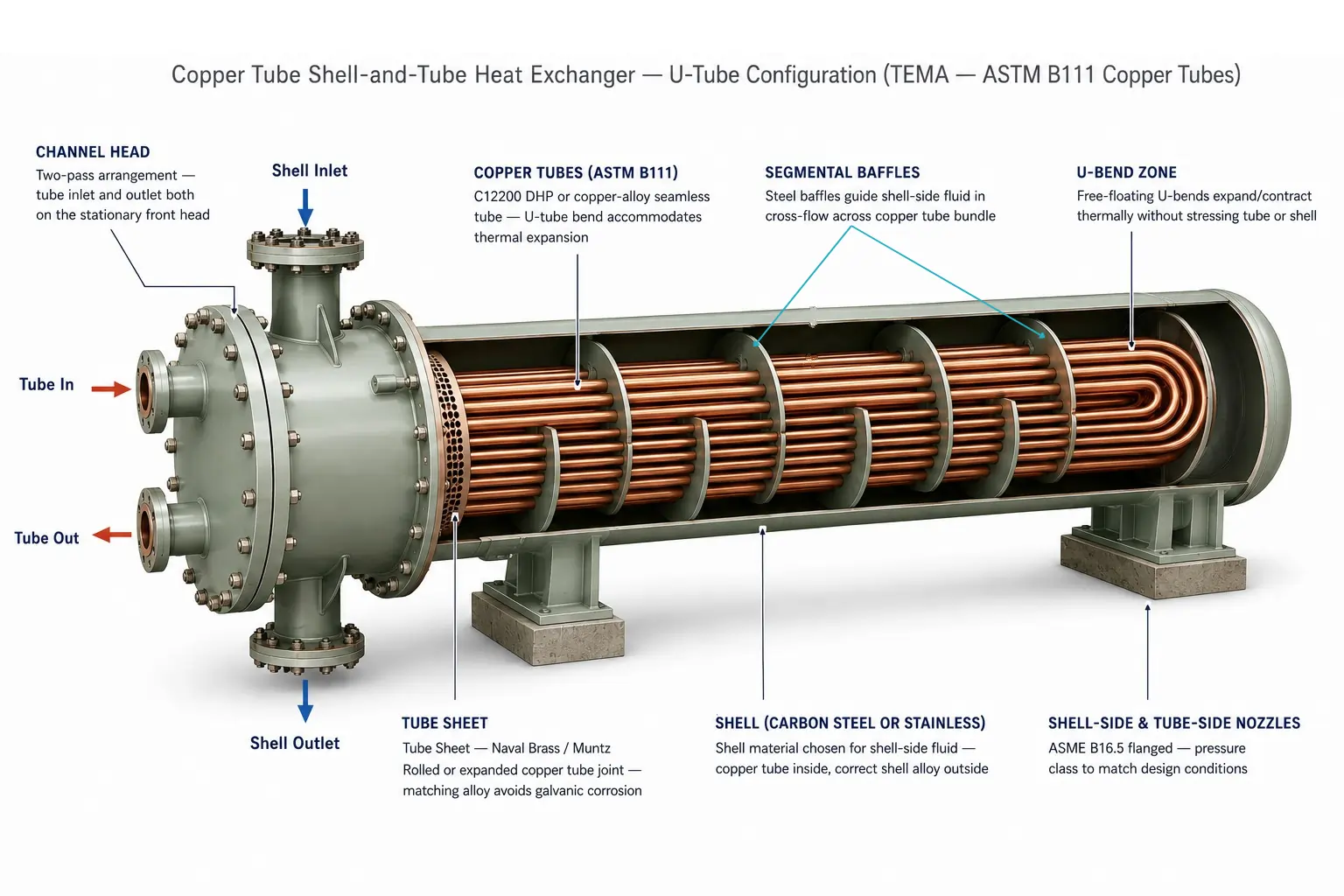
Copper Tubes (ASTM B111 / B68 / B359)
The heat transfer core. Copper tubes drawn to exacting specifications for outer diameter, wall thickness, and temper are prepared in accordance with ASTM B111 (for condenser and heat exchanger tubes), B68 (for bright annealed tubes), or B359 (for U-bend tubes). Standard OD from 12.7 mm (½ inch) to 50.8 mm (2 inch) in wall thicknesses from 0.7 mm to 3.0 mm depending on pressure duty. Tube pitch typically 1.25× to 1.5× OD on triangular or square layout.
Tube Sheet
The main barrier for the pressure differential between the fluids in the tubes and those in the shell—a thick plate that is bored into each tube and then mated to the flanges of the shell and tubes. Material selection for the tube sheet is critical when copper tubes are used: naval brass (C46400), Muntz metal (C28000), or silicon bronze are typical choices to avoid galvanic corrosion between the tube and tube sheet material in water service. Carbon steel tube sheets with copper-tube rolling are also used where the shell-side fluid permits.
Shell
The outer pressure-containing cylinder — typically carbon steel (most common), stainless steel (for corrosive shell-side fluids), or brass/bronze (for full copper-alloy construction in marine or potable water service). Shell material is selected for the shell-side fluid chemistry, temperature, and pressure, independently of the copper tube selection for the tube-side fluid.
Baffles
Segmental or disc-and-donut baffles guide the shell-side fluid in a cross-flow pattern across the copper tube bundle, increasing shell-side velocity and turbulence — improving the shell-side heat transfer coefficient and the overall U. Baffles also support the copper tubes against sag and vibration, important for long copper tube bundles which have lower stiffness than equivalent steel tubes.
Channel Head and Pass Partition
The channel head seals the front end of the shell, connects the tube-side process nozzles to the tube sheet, and — with the pass partition plate inside — divides the tube-side flow into the correct number of passes. U-tube designs use a single channel head at the front with a central pass partition plate; the rear of the shell is open (no second tube sheet) and the U-bends float freely to accommodate thermal expansion.
Impingement Plate or Rod at Shell Inlet
A deflection plate or bundle of impingement rods positioned at the shell-side inlet nozzle protects the front rows of copper tubes from direct high-velocity jet impingement of the inlet fluid. Copper has lower erosion resistance than steel, making impingement protection particularly important — especially in steam or wet vapour service or where the shell-side fluid enters at high velocity.
Copper Alloys for Heat Exchangers — Full Guide
The term "copper heat exchanger" covers a family of alloys, not just pure copper. Each alloy trades some of copper's peak thermal conductivity for improved mechanical strength, corrosion resistance, or compatibility with specific fluids — and the correct alloy selection is one of the most important engineering decisions in specifying a copper heat exchanger.
C12200 — Phosphorus-Deoxidised Copper (DHP)
Composition: 99.9% Cu minimum, residual phosphorus 0.015–0.040%. Thermal conductivity: ≈ 339 W/m·K. The standard tube material for HVAC air coils, refrigeration circuits, water heaters, and low to medium pressure water-to-water heat exchangers. Excellent formability — can be drawn to very thin wall (0.35 mm) without cracking. Compatible with all commercial refrigerants, fresh water, steam to 250°C, and most oils. The phosphorus content deoxidises the copper during fabrication, preventing hydrogen embrittlement during annealing and making DHP copper the standard for tube drawing and bending. Not suitable for seawater (pitting corrosion risk), ammonia, or concentrated acids.
C44300 — Admiralty Metal (71Cu-28Zn-1Sn)
Composition: 70–73% Cu, 0.9–1.2% Sn, remainder Zn. Thermal conductivity: ≈ 109 W/m·K. Also known as Admiralty brass — a dezincification-inhibited brass that was the classic tube material for condenser and heat exchanger service in clean to moderately brackish cooling water. Higher strength than pure copper. Arsenic, antimony, or phosphorus inhibitor additions prevent dezincification. Suitable for clean freshwater, slightly saline water, and moderately contaminated cooling water. Not suitable for highly saline seawater, ammonia, or amines — use copper-nickel alloys for more aggressive water service.
C68700 — Aluminium Brass (76Cu-22Zn-2Al)
Composition: 76–79% Cu, 1.8–2.5% Al, remainder Zn. Thermal conductivity: ≈ 96 W/m·K. Aluminium content provides an improved protective film on the tube surface compared with admiralty metal — the aluminium hydroxide/copper oxide mixed film is more stable and harder, giving better resistance to erosion-corrosion and impingement attack in high-velocity cooling water service. Preferred over admiralty metal in coastal and moderately saline water where higher flow velocities are needed. Arsenical inhibitor prevents dezincification. Still not suitable for direct seawater service — use copper-nickel for fully marine environments.
C70600 — 90/10 Copper-Nickel (90Cu-10Ni)
Composition: 88.6% Cu minimum, 9–11% Ni, 1.0–1.8% Fe, 1.0% Mn maximum. Thermal conductivity: ≈ 40 W/m·K. The most widely specified alloy for marine and seawater heat exchangers — the addition of 10% nickel and controlled iron and manganese content creates a dense, stable cupro-nickel oxide film that dramatically improves resistance to seawater corrosion and biofouling compared with brass alloys. Zero dezincification risk (no zinc). Widely used for naval vessel main seawater cooling systems, offshore platform utility cooling, and coastal industrial plant coolers where the cooling water is seawater or highly brackish. Can handle seawater velocities up to approximately 3 m/s inside tubes without significant erosion.
C71500 — 70/30 Copper-Nickel (70Cu-30Ni)
Composition: 65% Cu minimum, 29–33% Ni, 0.4–0.7% Fe, 1.0% Mn maximum. Thermal conductivity: ≈ 29 W/m·K. The highest-corrosion-resistance copper alloy available in standard tube form — the increased nickel content compared with 90/10 Cu-Ni further improves resistance to high-velocity seawater, polluted seawater, and the most demanding marine environments. Used on naval combatant ships, submarines, offshore platforms in harsh environments, and desalination preheaters. Higher cost than 90/10 Cu-Ni but justified by greater service life in aggressive seawater. Tolerates seawater velocities up to approximately 4.5 m/s. Excellent resistance to stress corrosion cracking and crevice corrosion in seawater.
Silicon Bronze and Muntz Metal — Tube Sheet and Shell Materials
Silicon Bronze (C65500): 94–97% Cu, 2.8–3.8% Si — used for tube sheets, channel heads, and shells in all-copper-alloy heat exchangers for potable water and marine service; excellent resistance to seawater corrosion, good weldability. Muntz Metal (C28000): 60% Cu, 40% Zn — used for tube sheets, baffles, and structural components in admiralty or aluminium brass tube bundles; lower cost than bronze but requires inhibitor addition to prevent dezincification. Material pairing between tube, tube sheet, baffle, and shell is critical to avoid differential galvanic corrosion between components.
Selection Tip — Matching Alloy to Water Chemistry: The single most important factor in selecting a copper alloy for a heat exchanger is the chloride content and velocity of the cooling water. Fresh water (below approximately 500 mg/L chloride) — C12200 DHP or C44300 admiralty. Water with a high chloride concentration (500-5,000 mg/L)—C68700 aluminium brass. Coastal and moderately contaminated seawater — C70600 (90/10 Cu-Ni). Offshore, polluted, or highly corrosive seawater — C71500 (70/30 Cu-Ni). Never use any copper or brass alloy with ammonia cooling water — even trace ammonia causes rapid stress corrosion cracking in all copper-zinc (brass) alloys and accelerated corrosion in pure copper.
Engineering Advantages of Copper Heat Exchangers
Highest Thermal Conductivity of Common Metals
At 385 W/m·K for pure copper, the tube wall thermal resistance of a copper heat exchanger is a fraction of that of an equivalent stainless steel wall — enabling thinner walls, higher U values, and more compact designs for the same heat duty.
Thin-Wall Tube Manufacturing
Copper can be drawn into seamless tube with wall thicknesses below 0.5 mm without loss of structural integrity — thinner than is commercially practical for stainless or carbon steel tube — keeping tube-wall resistance minimal and enabling maximum surface area in the smallest possible volume.
Universal Refrigerant Compatibility
Copper is compatible with every CFC, HCFC, HFC, and HFO refrigerant on the market today — R134a, R410A, R32, R22, R404A, R407C, R1234yf, and others — making it the uncontested default tube material for refrigeration condensers, evaporators, and heat pump coils worldwide.
Superior Water Corrosion Resistance
In clean fresh water, copper forms a stable protective oxide film that limits corrosion to negligible rates over decades of service — explaining why copper tube heat exchangers in domestic hot water, chilled water, and clean cooling water systems routinely achieve 25–30 year service lives with minimal maintenance.
Natural Antimicrobial Action
The slow release of Cu²⁺ ions from copper surfaces continuously suppresses bacterial, viral, and fungal growth — a significant benefit in potable water heat exchangers, domestic hot water systems, and food processing heat exchangers where biological fouling accelerates biocorrosion and blocks heat transfer.
Excellent Brazability and Solderability
Copper can be permanently joined by copper brazing (in vacuum furnaces for brazed plate heat exchangers), silver brazing (for high-strength connections in refrigeration and high-pressure circuits), or soft soldering (for low-pressure HVAC and water connections) — enabling manufacturing methods unavailable with stainless or carbon steel.
Long Service Life in Appropriate Service
In the water, HVAC, refrigeration, and oil cooling services for which copper heat exchangers are designed, service lives of 20–30 years are routinely achieved — significantly longer than equivalent carbon steel designs in the same services, with far lower risk of unexpected corrosion-related failure.
Compact, Lightweight Finned Coils
The combination of thin-wall copper tube and lightweight aluminium fins produces HVAC and refrigeration air coils that are dramatically more compact and lighter than any thermally equivalent stainless or carbon steel design — a critical advantage in space-constrained air conditioning units, heat pumps, and fan coil units.
Design Specifications and Operating Limits
Copper Heat Exchanger — Standard Design Parameters (United Heat Exchangers)
Fluid Compatibility — What Copper Can and Cannot Handle
| Fluid Category | Compatible with Copper? | Notes and Alloy Guidance |
|---|---|---|
| Fresh Water (treated) | Yes — excellent | C12200 DHP copper standard. Velocity below 1.5 m/s in tubes to prevent erosion-corrosion. pH 7.5–9.0 optimal for protective oxide film formation. |
| Chilled Water and Hot Water (HVAC) | Yes — standard | C12200 DHP — the default material for all HVAC chilled water coils and hot water coils. Resuspended water from HVAC systems, once treated, does not corrode copper. |
| Commercial Refrigerants (HFC, HFO, CFC, HCFC) | Yes — standard | C12200 DHP copper is the universal tube material for all commercial refrigerants. Copper is fully compatible with R134a, R410A, R32, R407C, R404A, R1234yf, and all other HFC/HFO refrigerants. |
| Ammonia Refrigerant (R717) | No — incompatible | Ammonia (R717) attacks copper and all copper alloys, including copper-nickel. Carbon steel, 304/316L stainless, or aluminium must be used for ammonia refrigeration heat exchangers. Never use copper with ammonia. |
| Lubricating Oil and Hydraulic Oil | Yes — excellent | Copper and brass heat exchangers are the standard choice for lube oil coolers and hydraulic oil coolers in engines, compressors, turbines, and industrial machinery. Oil is non-corrosive to copper. |
| Low-Pressure Steam (< 15 bar) | Yes — well-suited | C12200 DHP copper for steam to approximately 200°C / 15 bar — the standard for copper steam coils in tanks and HVAC air heating coils. IBR approval required for boiler-connected steam service in India. |
| Brackish and Mildly Saline Water | Partial — alloy dependent | C44300 admiralty or C68700 aluminium brass for low to moderate salinity (below ~3,000 mg/L Cl⁻). Above this, use 90/10 Cu-Ni or 70/30 Cu-Ni. Pure copper and plain brass dezincify in brackish water without inhibitor addition. |
| Seawater | Alloy-specific | C70600 (90/10 Cu-Ni) for standard seawater cooling service. C71500 (70/30 Cu-Ni) for demanding seawater, offshore, or polluted marine water. DHP copper and brass alloys are not recommended for direct seawater service. |
| Ethylene Glycol / Propylene Glycol Solutions | Yes — compatible | Copper and brass heat exchangers are routinely used with glycol antifreeze solutions in HVAC chilled water, solar thermal, and heat pump systems. Glycol concentration and inhibitor package should be verified for compatibility with copper alloy. |
| Dilute Acids (Acetic, Citric) | Limited | Copper resists very dilute organic acids at moderate temperatures — used in some food industry heat exchangers. Avoid mineral acids (HCl, HNO₃, H₂SO₄) which dissolve copper rapidly. Use stainless steel or titanium for acid service. |
| Sulphur Compounds / H₂S | No — avoid | Hydrogen sulphide (H₂S) and sulphur dioxide (SO₂) react with copper to form copper sulphide, leading to accelerated corrosion and tube perforation. Use carbon steel or stainless steel for sour water and H₂S-bearing streams. |
| Ammonia Solutions (Amine, NH₄OH) | No — incompatible | Ammonia in any form — as a refrigerant, aqueous solution, or dissolved amine — causes rapid stress corrosion cracking and corrosion of all copper and brass alloys. Not acceptable in any concentration. |
| Acetylene Gas | No — explosive risk | Copper and copper-alloy heat exchangers must never be used with acetylene gas. Copper acetylide (Cu₂C₂) — a highly sensitive explosive compound — forms spontaneously when acetylene contacts copper or copper alloys with more than approximately 65% copper content. |
Critical Compatibility Warning: Three fluid categories are absolutely incompatible with copper heat exchangers and must not be used regardless of concentration, temperature, or pressure: ammonia and amines (including all amine-based refrigerants and treating solvents — cause rapid SCC and corrosion); acetylene (forms explosive copper acetylide on contact with any copper alloy above approximately 65% Cu); and concentrated mineral acids (HCl, HNO₃, HF, H₂SO₄ — dissolve copper tube within hours). If any of these are present in your process fluid — even in trace concentrations — specify stainless steel, titanium, or carbon steel instead.
Copper vs Stainless Steel vs Titanium Heat Exchangers
| Parameter | Copper (C12200 DHP) | 316L Stainless Steel | Titanium Gr. 2 |
|---|---|---|---|
| Thermal Conductivity | 385–401 W/m·K — highest of the three | ≈ 16 W/m·K — 24× lower than copper | ≈ 22 W/m·K — 17× lower than copper |
| Corrosion Resistance — Fresh Water | Excellent — stable oxide film in clean water | Excellent — passive chromium oxide film | Outstanding — titanium oxide film |
| Corrosion Resistance — Seawater | Good with Cu-Ni alloys (90/10, 70/30) | Risk of chloride pitting and SCC above ~50°C | Outstanding — best of the three in seawater |
| Refrigerant Compatibility | All HFC/HFO/HCFC/CFC refrigerants — not ammonia | All refrigerants including ammonia | All refrigerants including ammonia |
| Ammonia Compatibility | No — not compatible with ammonia | Yes — standard for ammonia service | Yes — excellent ammonia resistance |
| Minimum Wall Thickness (tube) | Down to 0.35–0.5 mm — excellent thin-wall formability | Typically 0.7–1.0 mm minimum practical wall | Typically 0.5–0.7 mm minimum practical wall |
| Relative Material Cost | Moderate — copper commodity price variable | Moderate — generally comparable to copper | High — 3–5× stainless steel tube price |
| Antimicrobial Properties | Yes — inherent antimicrobial action | No inherent antimicrobial action | No inherent antimicrobial action |
| Brazability | Excellent — copper brazing and silver brazing | Limited — requires nickel-based braze alloys | Very limited — requires vacuum active braze |
| Best Applications | HVAC coils, refrigeration, water heating, oil cooling, marine Cu-Ni, domestic hot water | Products and services related to chemicals, pharmaceuticals, food, steam, ammonia, acid, and caustics | Seawater, wet chlorine, desalination, aggressive acids, offshore where corrosion is the dominant concern |
Industries and Applications
Copper heat exchangers are installed wherever the combination of thermal conductivity, water compatibility, refrigerant compatibility, and formability makes copper the optimal material — across HVAC, refrigeration, water heating, oil cooling, marine, and many industrial process applications.
| Industry | Copper Heat Exchanger Type | Specific Application | Typical Alloy |
|---|---|---|---|
| HVAC & Air Conditioning | Copper finned tube air coil, copper brazed plate | Chilled water air handling unit coils, fan coil unit cooling and heating coils, heat pump evaporator and condenser coils, DX (direct expansion) cooling coils | C12200 DHP copper tube, aluminium fins |
| Refrigeration | Copper tube condenser, copper evaporator, copper brazed plate | Commercial refrigeration condensers and evaporators, supermarket display case coils, blast freezer coils, cold store evaporators, ice-maker coils | C12200 DHP copper tube; all HFC/HFO refrigerant compatible |
| Domestic & Commercial Water Heating | Copper coil heat exchanger, copper brazed plate | Solar thermal collector coils, domestic hot water (DHW) heat exchangers in combi boilers, indirect cylinder coils, heat pump water heater coils | C12200 DHP copper; copper brazed stainless plate |
| Lube Oil and Hydraulic Oil Cooling | Copper tube shell-and-tube, copper brazed plate | Engine lube oil coolers, compressor oil coolers, turbine oil coolers, hydraulic power pack coolers, gear box oil cooling | C12200 DHP or admiralty copper tube; steel shell or brass shell |
| Marine and Offshore | Copper-nickel tube shell-and-tube | Ship main engine sea water coolers, central fresh water coolers, jacket water coolers, gearbox oil coolers, offshore platform utility coolers | C70600 90/10 Cu-Ni or C71500 70/30 Cu-Ni tubes; steel or naval brass shell |
| Power Generation | Copper-alloy tube condenser, copper-nickel tube heat exchanger | Steam surface condensers with admiralty or Cu-Ni tubes in clean river or sea water service, generator coolers, turbine oil coolers | C44300 admiralty or C70600 Cu-Ni in seawater-cooled plant |
| Food and Beverage / Brewing | Copper coil (wort cooler), copper tube heat exchanger | Wort cooling in craft brewing (traditional copper coil immersion chiller), pasteuriser coils for dairy and beverage, jacketed tank coils for temperature-sensitive fermentation | C12200 DHP copper — antimicrobial properties valued in brewing and dairy service |
| Solar Thermal | Copper coil in solar storage cylinder | Coil heat exchanger in indirect solar hot water cylinders — solar collector fluid (glycol solution) heats potable water in the storage tank via immersed copper coil | C12200 DHP copper coil — proven compatibility with propylene glycol solar fluid |
How to Select a Copper Heat Exchanger
Confirm Fluid Compatibility First
Make sure that the fluids you intend to use for the tubes and the shells are compatible with copper before moving on to the next step of the choosing process. If ammonia, acetylene, concentrated mineral acids, or significant sulphur compounds are present on either side, copper cannot be used. For all other common fluids — water, refrigerant, oil, steam, glycol — confirm the specific alloy needed based on chloride content and fluid chemistry using the compatibility table above.
Select the Correct Copper Alloy
Use the alloy guidance: C12200 DHP for clean water, refrigerant, oil, steam, and HVAC; C44300 admiralty or C68700 aluminium brass for moderately saline cooling water; C70600 90/10 Cu-Ni for seawater service; C71500 70/30 Cu-Ni for demanding marine or polluted seawater. Never mix copper-zinc (brass) alloys with ammonia — even trace concentrations.
Select the Heat Exchanger Configuration
Shell-and-tube for pressurised fluid-to-fluid exchange at moderate to high pressure and temperature; copper coil (immersion or coil-in-shell) for tank or reactor heating, solar thermal, and compact single-shell designs; copper brazed plate for compact, high-pressure, clean-fluid duties in HVAC and refrigeration; copper finned tube air coil for air-to-fluid heat exchange in HVAC and refrigeration systems; copper steam coil for tank and vessel steam heating.
Define Process Conditions
Provide: tube-side fluid name, flow rate, inlet and outlet temperature, design pressure, fouling factor, and allowable pressure drop. Shell-side fluid name, flow rate, inlet and outlet temperature, and design pressure. These five parameters per side are the minimum needed to size the unit — plus design ambient temperature if the unit is to be installed outdoors.
Set Shell Material to Match Shell-Side Fluid
The copper tube selection addresses tube-side corrosion; the shell must also be matched to the shell-side fluid. Carbon steel shell with copper tubes is common for oil and clean water service. Stainless steel shell may be needed if the shell-side fluid is a mild acid or amine. Naval brass or silicon bronze shell for fully marine construction. Incompatible shell and tube alloy combinations cause galvanic corrosion at the tube sheet — always verify galvanic pairing.
Specify Tube Velocity Limits
Copper tube erosion-corrosion is velocity-sensitive. For clean fresh water — maximum 1.5 m/s inside tube (or 2.5 m/s for Cu-Ni). For seawater in Cu-Ni tube — maximum 3.0 m/s for 90/10 Cu-Ni, 4.5 m/s for 70/30 Cu-Ni. Exceeding these limits removes the protective oxide film and causes rapid erosion-corrosion thinning, especially at tube inlet ends and at bends. Always specify the expected fluid velocity and confirm tube wall allowance for erosion-corrosion over design life.
Maintenance and Cleaning Guide
A well-maintained copper heat exchanger operating within its design fluid compatibility and velocity limits will typically give 20–30 years of reliable service with only routine inspection and periodic cleaning. The most common maintenance issue is not corrosion but fouling — the gradual accumulation of scale, biological growth, or particulate deposits on the copper tube surface that increases thermal resistance and reduces performance.
Water-Side Scale Removal (Chemical Cleaning)
Calcium carbonate scale deposits (from hard cooling water) reduce heat transfer by adding thermal resistance. Dissolve scale deposits by circulating a dilute acid solution — typically 5–10% citric acid or proprietary copper-safe descaler — through the water-side of the copper heat exchanger. Citric acid is preferred over hydrochloric acid for copper because it is less aggressive to the copper surface. Always flush thoroughly with clean water after acid cleaning and verify pH of flush water before returning to service. Never use nitric acid or concentrated hydrochloric acid on copper heat exchangers.
Mechanical Tube Cleaning
Soft fouling deposits inside copper tubes — biofilm, silt, loose scale — are removed by mechanical brushing. Insert a nylon or soft steel tube brush through each tube end (accessible through the channel head after removal of the cover or bonnets in fixed tube sheet designs, or without header removal in U-tube designs if the channel partition is removed). Do not use hard wire brushes on copper tubes — the copper surface is softer than steel and wire brush contact abrades the protective oxide layer, leaving the copper vulnerable to accelerated corrosion after re-wetting.
Air Coil Fin Cleaning (Copper Finned Tube)
HVAC and refrigeration copper finned tube coils accumulate dust, lint, and biological growth on the fin surfaces, blocking airflow and reducing heat transfer. Clean air coils by gentle water rinsing or low-pressure air blowing from the clean air exit face (not the dirty air entry face — this would push deposits deeper into the fin pack). For stubborn grease or biological fouling, apply a coil cleaner spray rated safe for copper and aluminium fins (avoid alkaline cleaners with pH above 9.5 on aluminium fins or copper tube). The thin aluminium fins can be permanently bent by a high-pressure water jet, drastically limiting airflow, thus it's best to avoid doing so.
Inspection for Dezincification and Erosion-Corrosion
At every major inspection interval — typically 2–5 years depending on water quality — inspect copper-alloy tube heat exchangers for dezincification (a pink, friable plug appearing in zinc-containing alloys such as admiralty brass or Muntz metal, indicating selective leaching of zinc from the alloy) and for erosion-corrosion thinning at tube inlet ends and U-bends. UT wall thickness measurement at these locations confirms remaining wall. Dezincified plugs are a warning sign that alloy selection needs upgrading to a dezincification-resistant grade (inhibited admiralty or Cu-Ni).
Biofouling Treatment
In seawater and brackish water service, marine organisms (barnacles, mussels, and biofilm) can accumulate on the shell side of copper-nickel heat exchangers if flow velocities are very low or if the unit is shut down for extended periods. Copper's inherent biostatic properties significantly slow this growth, but do not fully prevent it in prolonged stagnant conditions. Periodic chemical treatment with a copper-safe biocide, or intermittent high-velocity flush to remove loose biological deposits, maintains shell-side performance between major overhauls.
Copper Brazed Plate Heat Exchanger Maintenance
Copper brazed plate heat exchangers have no disassembly access — they cannot be mechanically cleaned internally. Maintenance is limited to chemical cleaning by circulating a citric acid or approved copper-safe cleaner through the unit in place (CIP — clean-in-place). For this reason, copper brazed plate heat exchangers are only specified for clean fluids — closed HVAC systems, refrigerants, clean oils, and properly treated domestic hot water — where scaling and fouling are not significant. If fouling is expected, a gasketed plate heat exchanger or shell-and-tube design is more appropriate.
Why United Heat Exchangers for Copper Heat Exchangers
All Copper Alloys In-House
C12200 DHP copper, C44300 admiralty, C68700 aluminium brass, C70600 90/10 Cu-Ni, and C71500 70/30 Cu-Ni — all five principal copper alloy tube families fabricated in-house at our Coimbatore facility, with shell material matched to your shell-side fluid to prevent galvanic corrosion.
HTRI Thermal Rating
Every copper heat exchanger — shell-and-tube, coil-in-shell, and copper finned tube coil — is thermally rated using HTRI Xchanger Suite, verifying tube-side and shell-side film coefficients, fouling allowances, and overall U against your process datasheet, with a documented thermal guarantee on every unit.
ASME U-Stamp Certified
Our Authorised Inspection Agency thoroughly inspects all copper tube shell-and-tube heat exchangers and coil-in-shell designs before they are ASME U-Stamped. Additionally, every certified unit is issued a full Manufacturer's Data Report (U-1 Form).
IBR Approved — Copper Steam Coils
Copper steam coils and copper-tube steam-service heat exchangers designed and approved under the Indian Boiler Regulations — with IBR drawings, calculations, and hydrostatic test certificates — for all boiler-connected steam heating applications in India.
Export to 30+ Countries
Copper tube heat exchangers and copper-nickel marine heat exchangers supplied to clients across the Middle East, Southeast Asia, Africa, and Europe — with ASME, TEMA, BS, and client-specified standards as required by the destination market and project specification.
Custom Design — Any Configuration
From a single copper coil immersion heater for a small process tank to a full marine central cooling system with multiple copper-nickel shell-and-tube exchangers — every copper heat exchanger we fabricate is custom-designed and sized to your exact process requirements, not selected from a catalogue.
Get a Free Copper Heat Exchanger Quote in 48 Hours
Share your tube-side and shell-side fluid names, flow rates, inlet and outlet temperatures, design pressures, and any copper alloy or configuration preference. Our team will size the unit using HTRI, recommend the correct copper alloy for your fluids, and deliver a complete technical and commercial proposal within 48 hours.
Request My Free Quote →Delivery and What's Included
What's Included with Every Copper Heat Exchanger Order
- HTRI thermal performance documentation — tube-side and shell-side heat transfer and pressure drop rated at specified process conditions, with fouling allowances and overdesign margin clearly documented
- Copper alloy recommendation report — formal engineering recommendation confirming the copper alloy selection for your specific fluid chemistry, chloride content, velocity, and temperature, with fluid compatibility confirmation
- ASME U-Stamp and Manufacturer's Data Report (Form U-1) — for all rated pressure parts; signed by Authorised Inspector; MAWP and design temperature stamped on nameplate
- IBR approval documentation — for steam-service copper heat exchangers: IBR drawings, calculations, and hydrostatic test certificate before despatch
- Material certifications (MTRs) — traceable mill test reports for all copper tube, tube sheet, shell, and nozzle materials; alloy chemistry and mechanical properties confirmed against ASTM specification
- NDE reports — hydrostatic test report and any applicable radiographic, ultrasonic, or dye penetrant test reports for pressure welds
- Hydrostatic test certificate — each pressure circuit hydrostatically tested and witnessed in accordance with ASME Section VIII, TEMA, or IBR as applicable
- Galvanic pairing certification — written confirmation that the copper alloy tube, tube sheet, baffle, shell, and nozzle materials are correctly selected to minimise galvanic potential in the specified service
- Certified general arrangement drawing — overall unit dimensions, nozzle schedule and orientation, tube count and layout, shell and tube sheet dimensions, and nameplate location; issued as a controlled document for client P&ID and piping integration
- Operations and maintenance manual — copper-safe chemical cleaning procedure, tube velocity limits, inspection intervals, dezincification inspection protocol (for brass alloys), and spare parts list for 2 years of operation
- Lifetime technical support — Assessment of alloy upgrades for altered fluid chemistry, thermal re-rating for modified process conditions, fitness-for-service evaluation, and maintenance recommendations throughout the operational lifespan of the heat exchanger.
Frequently Asked Questions — Copper Heat Exchangers
What is a copper heat exchanger?
A copper heat exchanger is a heat transfer device in which copper — or a copper alloy — is the primary heat transfer material, forming the tubes, coils, fins, or brazed plates through which heat flows between two fluid streams. Copper is selected for its outstanding thermal conductivity (385–401 W/m·K — five to eight times higher than stainless steel), natural antimicrobial properties, excellent workability into thin-wall tube and complex coil geometry, and compatibility with water, refrigerants, oils, steam, and many industrial fluids. Copper heat exchangers are manufactured as shell-and-tube, coil, brazed plate, finned tube, and steam coil configurations for HVAC, refrigeration, water heating, oil cooling, and marine applications.
Why is copper used in heat exchangers?
Copper is used in heat exchangers because of its unique combination of the highest thermal conductivity of any common engineering metal (385 W/m·K vs ~16 W/m·K for 316L stainless), the ability to be drawn into very thin-wall seamless tube without sacrificing structural integrity, compatibility with all commercial HFC/HFO/HCFC refrigerants, stable corrosion resistance in clean fresh water, natural antimicrobial properties (valuable in potable water and food applications), and full brazability enabling the manufacture of compact copper brazed plate heat exchangers. In HVAC, refrigeration, water heating, and oil cooling applications — where these properties align with the service requirements — copper remains the optimal material choice.
Can copper heat exchangers be used with ammonia?
No. Copper and all copper alloys are incompatible with ammonia — including ammonia refrigerant (R717), aqueous ammonia solutions, and amine-based treating solvents that contain ammonia. Ammonia causes rapid stress corrosion cracking (SCC) in copper-zinc brass alloys and accelerated corrosion in pure copper. Even trace concentrations of ammonia in a cooling water system can cause SCC of brass tube sheets and admiralty metal tubes. For ammonia refrigeration heat exchangers, carbon steel or 304/316L stainless steel must be used. This restriction applies to every type of copper heat exchanger — shell-and-tube, coil, brazed plate, and finned tube.
What is a copper brazed heat exchanger?
A copper brazed heat exchanger is a plate heat exchanger in which a stack of corrugated stainless steel plates is permanently bonded together using copper brazing alloy — flowed into every contact point between adjacent plates in a high-temperature vacuum furnace brazing cycle. The result is a rigid, compact, gasket-free, single-piece unit that withstands higher pressures (typically 30–45 bar) and temperatures (up to approximately 225°C) than an equivalent gasketed plate unit. Copper brazed heat exchangers are widely used in HVAC refrigeration circuits, domestic hot water generation, hydraulic oil cooling, and district heating applications. They cannot be disassembled for mechanical cleaning — they are suitable only for clean, non-fouling fluids.
What copper alloys are used in marine heat exchangers?
Marine and seawater-cooled heat exchangers use copper-nickel alloys rather than pure copper or brass. 90/10 Copper-Nickel (C70600) — 90% Cu, 10% Ni — is the most widely specified alloy for seawater heat exchanger tubes, offering excellent resistance to seawater corrosion, biofouling suppression, and freedom from dezincification. It tolerates seawater velocities up to approximately 3 m/s. 70/30 Copper-Nickel (C71500) — 70% Cu, 30% Ni — provides higher corrosion resistance in more aggressive or polluted seawater, is the standard for naval combatants and offshore platforms, and tolerates velocities up to approximately 4.5 m/s. Neither pure copper nor brass alloys (admiralty or aluminium brass) are recommended for direct seawater service — dezincification and pitting corrosion risk makes copper-nickel mandatory for marine applications.
What is the maximum pressure and temperature for a copper heat exchanger?
For standard copper tube shell-and-tube heat exchangers using C12200 DHP copper tube: design pressure up to approximately 50 bar (tube side) and 40 bar (shell side) depending on tube diameter and wall thickness; design temperature up to approximately 250°C for DHP copper, with copper-nickel alloys extending to 300°C. Copper brazed plate heat exchangers are typically rated to 30–45 bar and up to 225°C depending on plate design. High-pressure copper coil heat exchangers in thick-wall seamless copper tube can be rated for tube-side pressures above 100 bar for refrigeration and process gas applications. All pressure ratings must be verified against the ASME Section VIII allowable stress for the specific copper alloy at the design temperature, which decreases significantly above 150°C for pure copper.
How do I clean a copper heat exchanger?
Water-side scale deposits in a copper heat exchanger are removed by chemical cleaning — circulating a 5–10% citric acid solution (copper-safe, removes calcium carbonate scale) or a proprietary copper-safe descaler through the water side, then flushing thoroughly with clean water. Never use hydrochloric acid at high concentration or nitric acid on copper. Soft deposits (biofilm, silt) inside copper tubes are removed by mechanical brush cleaning through the tube ends — using nylon or soft brushes only (hard wire brushes abrade the copper surface). For copper finned tube air coils in HVAC service, clean fin surfaces with a coil cleaner spray (pH 7–9.5, copper and aluminium safe) and gentle water rinse — never high-pressure jet directly on the fins. Copper brazed plate heat exchangers must be cleaned in-place (CIP) with citric acid or approved cleaner — they cannot be disassembled.
What is the lead time for a copper heat exchanger from India?
Standard DHP copper tube shell-and-tube heat exchangers and copper coil designs deliver in 4–8 weeks from order confirmation and approved drawings. Copper-nickel marine heat exchangers (90/10 or 70/30 Cu-Ni), ASME U-Stamp certified units, and IBR-approved copper steam coils deliver in 8–16 weeks. Custom copper finned tube air coils for HVAC and refrigeration applications deliver in 4–10 weeks depending on coil geometry and fin density. Expedited schedules for marine vessel drydock, plant shutdown, and emergency replacement are available — contact our team with your copper heat exchanger specification and required delivery date for a confirmed schedule.
Author: Senthil Kumar, Technical Director — United Heat Exchangers Pvt. Ltd. | Last Updated: June 2026