Author: Senthil Kumar, Technical Director | Updated: September 2026
Table of Contents
What Is a Printed Circuit Heat Exchanger (PCHE)?
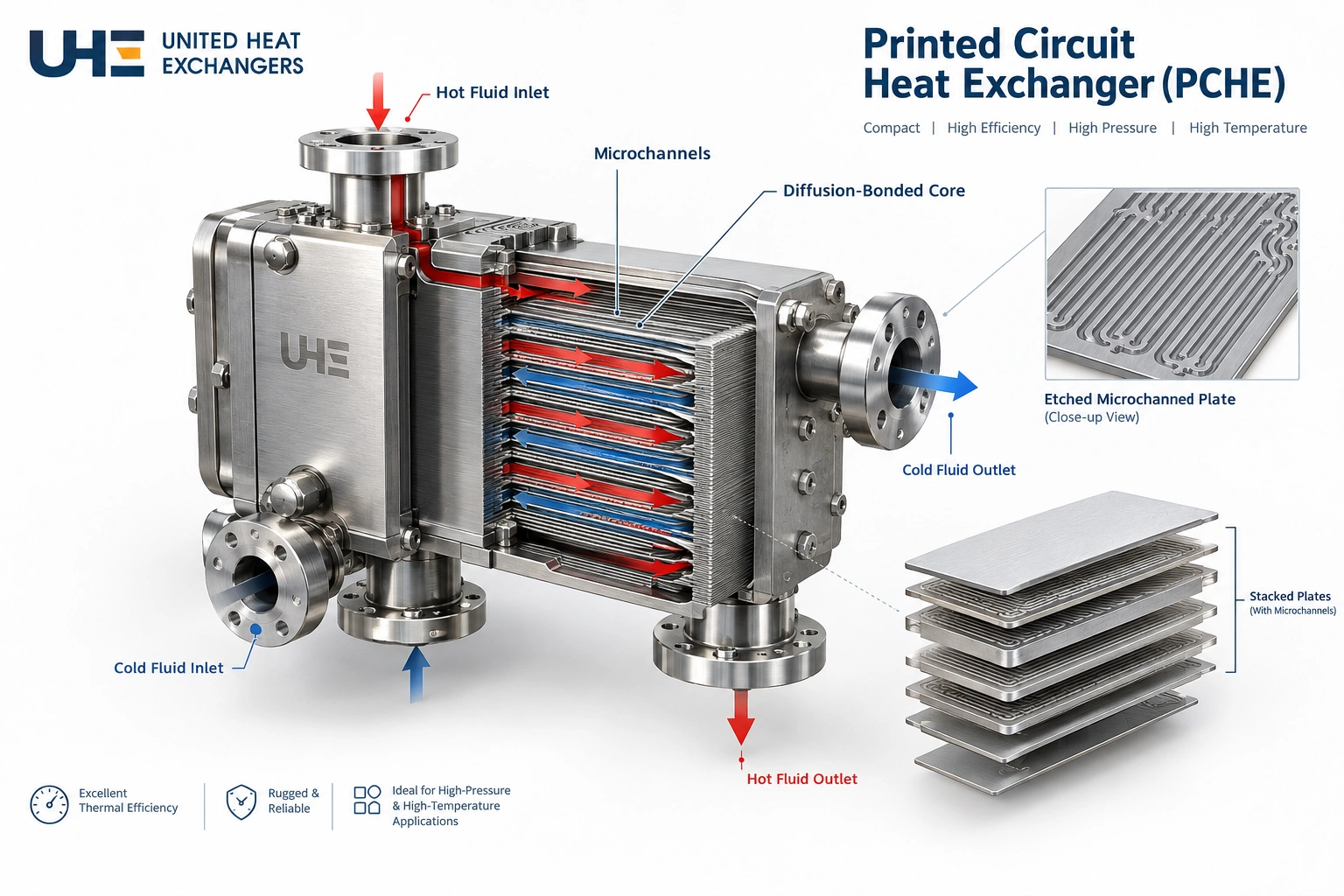
A printed circuit heat exchanger is a compact, all-metal heat exchanger built by chemically etching fluid flow channels into thin metal plates and then diffusion-bonding the plates into a single solid block. The name comes from the etching process, which resembles how circuits are etched onto a printed circuit board — the fluid channels, not any electronics, are what's "printed."Because the channels are etched at millimetre scale and the plates are fused into one solid metal mass rather than gasketed or brazed together, a PCHE can achieve heat transfer surface densities far beyond a conventional shell and tube or plate unit, while tolerating pressures and temperatures that neither can safely reach. This note is provided as an educational reference: United Heat Exchangers' own fabrication focuses on shell and tube, plate, and air cooled heat exchangers — the sections below explain the PCHE technology and where it fits, including where a conventional exchanger from our range remains the better and more cost-effective choice.
How a PCHE Is Made — Etching and Diffusion Bonding
Channel Design
Flow channel geometry — straight, zig-zag, or airfoil-fin patterns — is designed for the specific thermal-hydraulic duty.
Photochemical Etching
A photoresist mask and acid etch cut the channel pattern into each thin metal plate, typically 1–2 mm deep.
Plate Stacking
Etched plates are stacked in the required flow arrangement — counter-current, cross-flow, or multi-stream.
Diffusion Bonding
The stack is heated under pressure below the metal's melting point until the plates fuse at a grain-boundary level into one solid block.
Header and Nozzle Attachment
Inlet/outlet headers and nozzles are welded onto the finished block, and the unit is pressure-tested before dispatch.
Why Diffusion Bonding Matters: Because the bonded joint has the same parent-metal strength as the plate itself, a PCHE has no gasket, braze filler, or mechanical seal anywhere in the pressure boundary — which is what allows it to hold pressures and temperatures that would destroy a gasketed plate exchanger's seals almost immediately.
Key Advantages
Extreme Compactness
Surface area densities many times higher than shell and tube construction mean a PCHE can replace a much larger conventional unit in the same duty.
High Pressure and Temperature Capability
Solid diffusion-bonded construction routinely handles pressures and temperatures well beyond what gasketed or brazed designs can sustain.
No Gasket or Braze Failure Points
With no gasket material to degrade and no braze joint to fatigue, the pressure boundary itself carries very low leak risk over the service life.
Low Weight Relative to Duty
The dramatic size reduction also means substantially less installed weight than an equivalent-duty conventional exchanger — valuable on offshore platforms and skid-mounted packages.
Limitations to Consider
High Capital Cost
Photochemical etching and diffusion bonding are precision, capital-intensive processes — a PCHE typically costs significantly more upfront than a shell and tube unit of similar duty.
Channels Cannot Be Mechanically Cleaned
The micro-channel geometry cannot be rodded, brushed, or mechanically descaled — any fouling-prone stream is a poor fit for this construction.
Long, Specialised Lead Times
Few fabricators worldwide hold true diffusion-bonding capability, so lead times and shipping distances are often longer than for a locally sourced conventional exchanger.
Limited Field Repair Options
A damaged or corroded internal channel generally cannot be repaired on site — the unit is typically replaced rather than serviced.
PCHE vs Shell and Tube vs Plate Heat Exchanger
| Parameter | PCHE | Shell and Tube | Gasketed Plate |
|---|---|---|---|
| Relative Footprint | Smallest — up to ~85% smaller | Largest for the same duty | Compact, larger than PCHE |
| Max Practical Pressure | 600+ bar | Very high (300+ bar routinely) | Moderate, gasket-limited |
| Max Practical Temperature | 900°C+ (alloy dependent) | High, material dependent | ~180°C, gasket-limited |
| Fouling Tolerance | Poor — cannot be mechanically cleaned | Good — bundle removable for cleaning | Moderate — plates can be opened and cleaned |
| Field Serviceability | Very limited | High — retubing and repair are routine | High — gaskets and plates are replaceable |
| Relative Capital Cost | Highest | Moderate, most cost-predictable | Moderate, lower than PCHE |
Materials Used
PCHE plates are almost always built in alloys chosen for their diffusion-bonding behaviour and high-temperature strength, most commonly 316/316L stainless steel for moderate duty and nickel alloys such as Alloy 617 or Alloy 625 for the highest temperature and pressure applications — the same corrosion-driven material logic that governs any heat exchanger selection still applies, just at a more extreme end of the scale.
Typical Applications
These applications share a common thread: extreme pressure or temperature combined with a hard space or weight constraint — conditions where the PCHE's cost premium is justified because no conventional design can physically fit or survive the duty.
When to Choose PCHE vs a Conventional Exchanger
Choose PCHE When...
Plot space or weight is a hard constraint, the duty exceeds what gasketed plate construction can seal against, or the process temperature/pressure combination is beyond conventional shell and tube limits.
Choose Shell and Tube When...
The stream fouls, field cleaning or retubing needs to be routine, or the project needs the most cost-predictable, widely serviceable option — the case for the large majority of refinery, gas processing, and general industrial duty.
Choose Plate When...
The duty needs a very close approach temperature in a compact footprint, operating temperature stays under the gasket's rated limit, and periodic mechanical cleaning access is valuable.
Choose Air Cooled When...
Water availability or discharge permitting is the binding constraint, and the site has room to trade water savings for a larger footprint.
Not Sure Which Configuration Fits Your Duty?
Send us your process conditions, space constraints, and fluid properties. We'll size the right configuration from our shell and tube, plate, and air cooled range — and tell you plainly if your duty genuinely needs a PCHE-class specialist instead.
Talk to Our Engineering Team →Frequently Asked Questions
Does United Heat Exchangers manufacture printed circuit heat exchangers?
No — our fabrication capability covers shell and tube, plate, and air cooled heat exchangers. This guide is provided as an educational reference on PCHE technology, and where relevant we'll advise if your duty is better served by a specialist PCHE fabricator or by one of our own product lines.
Why is a PCHE so much more expensive than a shell and tube exchanger?
Photochemical etching and diffusion bonding are slow, precision, capital-equipment-intensive processes compared with rolling and welding a tube bundle, and only a small number of fabricators worldwide hold the capability — both factors push the price up significantly for the same thermal duty.
Can a PCHE be cleaned or repaired if it fouls?
Generally no. The micro-channel geometry cannot be mechanically rodded or brushed, and there's no way to open the solid diffusion-bonded block for internal access — fouling-prone streams are a poor fit for this construction, and damaged units are usually replaced rather than repaired.
What industries actually need a PCHE instead of a conventional exchanger?
LNG liquefaction, supercritical CO₂ power cycles, offshore/subsea processing, hydrogen refuelling, and advanced nuclear systems are the main users — applications where extreme pressure or temperature combines with a hard space or weight limit that no conventional exchanger can meet.
Is a PCHE always the "better" heat exchanger?
No — for the large majority of refinery, gas processing, HVAC, and general industrial duty, a shell and tube or plate exchanger is more cost-effective, easier to maintain, and just as reliable. PCHE only wins where its specific pressure, temperature, or footprint advantage is actually required by the application.
Author: Senthil Kumar, Technical Director — United Heat Exchangers Pvt. Ltd. | Last Updated: September 2026