Author: Senthil Kumar, Technical Director | Updated: May 2026
Table of Contents
- What Is a Stainless Steel Heat Exchanger?
- Why Stainless Steel — The Engineering Case
- Complete Grade Guide — SS 304 to Super Duplex 2507
- Grade Selection Decision Table
- Types of Stainless Steel Heat Exchangers
- The Three Failure Modes of Stainless Steel — How to Prevent Each
- Stainless Steel Heat Exchangers for Pharmaceutical and Food Grade Service
- Design Specifications and ASTM / ASME Standards
- Industries and Applications
- Stainless Steel vs Carbon Steel vs Titanium Heat Exchangers
- How to Select the Right Grade and Type
- Maintenance and Service Life Guide
- Why United Heat Exchangers
- Delivery and What's Included
- Frequently Asked Questions

What Is a Stainless Steel Heat Exchanger?
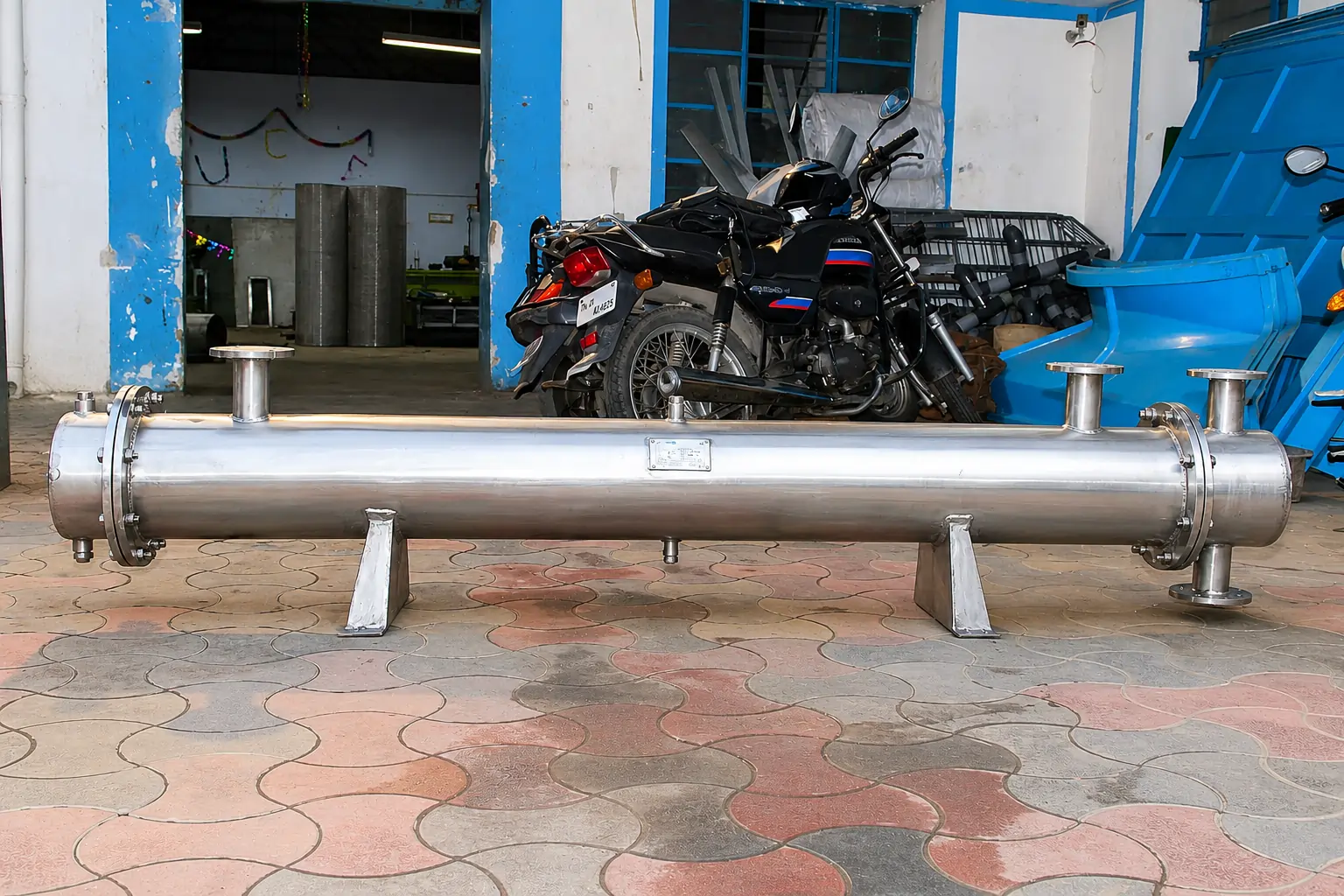
A stainless steel heat exchanger is a heat exchanger in which the tubes, shell, plates, and pressure-containing components are fabricated from stainless steel alloys. The stainless steel construction provides corrosion resistance, hygienic surfaces, and long service life in environments where carbon steel would corrode, contaminate the process fluid, or fail regulatory inspection.
Stainless steel alloys resist corrosion through a passive chromium-oxide film on their surface — invisible, self-repairing, and continuously maintained as long as the steel is exposed to oxygen. This passive layer is what makes stainless steel viable across an enormous range of corrosive fluid services where carbon steel would require frequent replacement.
As a leading stainless steel heat exchanger manufacturer in India, United Heat Exchangers designs and fabricates shell and tube, plate, brazed plate, and air cooled heat exchangers in SS 304, 316L, 321, 347, 904L, duplex 2205, and super duplex 2507 — ASME U-Stamp certified, HTRI thermal rated, with written performance guarantees on every unit.
Why Stainless Steel — The Engineering Case
Carbon steel corrodes in water, acids, chlorides, and many process chemicals at rates that make it unsuitable for heat exchanger service in corrosive industries. The failure mode is straightforward: carbon steel loses wall thickness progressively through corrosion until the tube wall perforates — causing cross-contamination between process circuits, unplanned shutdown, and expensive repair.
Stainless steel resists this failure mode through its passive oxide layer — a thin, dense chromium-oxide film that forms spontaneously when chromium content exceeds 10.5% and oxygen is present. This layer regenerates immediately after mechanical damage, providing continuous corrosion protection across the exchanger's operating life without any external coating or treatment.
Beyond corrosion resistance, stainless steel brings three additional properties that define its use in pharmaceutical, food and beverage, and high-temperature process service: hygienic surface finish capability to Ra 0.8 micron or better; oxidation resistance at elevated temperatures up to 925°C in 310S grade; and full compliance with ASTM, ASME, and FDA material requirements.
💡 Stainless is not one material — it is a family of twelve families. SS 304 and SS 316L are the most commonly specified grades, but they cover only two of the eight stainless grades that United Heat Exchangers routinely manufactures. Specifying the wrong grade costs more in replacement cost than the price difference between correct and incorrect grade at the time of order. Every UHE stainless steel heat exchanger proposal includes a written grade selection rationale.
Complete Grade Guide — SS 304 to Super Duplex 2507
Stainless steel grades are defined by their alloy composition — primarily chromium, nickel, and molybdenum content. Each combination delivers a different balance of corrosion resistance, strength, temperature capability, and cost. The following profiles cover every grade United Heat Exchangers routinely fabricates.
SS 304 / 304L
Standard austenitic — clean water, steam, mild chemicals| Chromium / Nickel | 18% Cr / 8% Ni |
| Carbon (L grade) | Max 0.03% — prevents weld sensitisation |
| Max Temperature | 870°C oxidation resistance (intermittent) |
| Corrosion Resistance | Excellent in mild aqueous, steam, dilute acids, clean process water |
| Chloride Limit | Not suitable above trace chlorides — SCC risk above 50 ppm at elevated temp |
| ASTM Standard | A213 TP304 / TP304L (tubes), A240 (plates), A312 (pipe) |
| Best For | Condensate, steam, freshwater cooling, food grade, HVAC, mild chemical service |
SS 316L / 316
Molybdenum-enhanced — chloride and acid resistant| Chromium / Nickel / Mo | 16–18% Cr / 10–14% Ni / 2–3% Mo |
| Carbon (L grade) | Max 0.03% — mandatory for welded construction |
| Max Temperature | 870°C oxidation (intermittent); 316H for continuous high-temp |
| Corrosion Resistance | Superior chloride pitting and crevice resistance; resistant to sulphuric, phosphoric, and acetic acids |
| Chloride Limit | Up to 200–400 ppm Cl⁻ at moderate temperatures — above this, consider duplex |
| ASTM Standard | A213 TP316L (tubes), A240 (plates), A270 (sanitary tubes) |
| Best For | Pharmaceutical, food grade, chemical process, mild seawater, amine units, acidic process fluids |
SS 321 / 321H
Titanium-stabilized — high temperature, no sensitization| Chromium / Nickel / Ti | 17–19% Cr / 9–12% Ni / Ti min 5×C |
| Stabilizing Element | Titanium forms TiC preferentially — prevents chromium carbide precipitation at weld zones |
| Max Temperature | 870°C continuous; 321H to 900°C |
| Corrosion Resistance | Similar to 304 at room temperature; superior sensitization resistance after high-temperature weld cycles |
| Key Advantage | Does not sensitize in the 425–870°C range — safe for heat exchangers thermally cycled through this range |
| ASTM Standard | A213 TP321 / TP321H (tubes), A240 (plates) |
| Best For | Refinery furnace tubes, high-temperature process exchangers, steam super heaters, thermally cycled services above 425°C |
SS 347 / 347H
Niobium-stabilized — high temp, chemical and refinery service| Chromium / Nickel / Nb | 17–19% Cr / 9–13% Ni / Nb min 10×C |
| Stabilizing Element | Niobium (columbium) — stronger carbide former than titanium; more stable at extreme temperatures |
| Max Temperature | 900°C continuous; 347H rated higher still in ASME pressure vessel code |
| Corrosion Resistance | Excellent sensitization resistance at temperatures even higher than 321 can manage |
| Key Advantage | Preferred over 321 for very high temperature or sigma phase formation risk services |
| ASTM Standard | A213 TP347 / TP347H (tubes), A240 (plates) |
| Best For | High-temperature refinery exchangers, chemical plant at 850°C+, continuous high-temperature cycling services |
904L (UNS N08904)
High alloy austenitic — strong acids, mixed corrosive environments| Composition | 20% Cr / 25% Ni / 4.5% Mo / 1.5% Cu — high-alloy austenitic |
| Carbon | Max 0.02% ultra-low carbon |
| Max Temperature | 400°C with excellent corrosion resistance |
| Corrosion Resistance | Outstanding resistance to Sulphur acid at all concentrations, phosphoric acid, seawater, and mixed acid environments; significantly better than 316L in aggressive environments |
| PREN | ~34 — significantly higher than 316L (~26); good pitting resistance in warm seawater |
| ASTM Standard | A213 N08904, A240 N08904 |
| Best For | Sulphur acid coolers, phosphoric acid service, seawater with elevated temperatures, aggressive chemical plant |
Duplex 2205 (UNS S31803 / S32205)
Dual-phase — twice the strength, superior SCC resistance| Composition | 22% Cr / 5% Ni / 3% Mo / 0.18% N — duplex austenitic-ferritic |
| Microstructure | ~50% austenite / 50% ferrite — duplex structure delivers superior performance vs either phase alone |
| Yield Strength | 450–480 MPa — approximately 2× higher than 316L; allows thinner walls at equivalent pressure rating |
| PREN | ~35 — reliable in seawater to 25°C; borderline above 30°C |
| SCC Resistance | Highly resistant to chloride stress corrosion cracking — the primary failure mode of 316L in warm chloride service |
| ASTM Standard | A789 S31803 / S32205 (tubes), A240 (plates) |
| Best For | Seawater cooling, offshore and marine service, chloride process streams, produced water, high-pressure heat exchangers |
Super Duplex 2507 (UNS S32750)
Highest pitting resistance — aggressive seawater and brine| Composition | 25% Cr / 7% Ni / 4% Mo / 0.28% N — super duplex |
| PREN | >40 — the recognized threshold for reliable seawater service at all operating temperatures |
| Yield Strength | 550 MPa — 2.5× higher than 316L |
| Corrosion Resistance | Excellent resistance to seawater pitting, crevice corrosion, and stress corrosion cracking; superior to duplex 2205 in aggressive high-temperature brine |
| Limitations | Requires careful heat treatment — intermetallic phase precipitation if held 700–900°C; specified weld procedure essential |
| ASTM Standard | A789 S32750, A240 S32750 |
| Best For | Offshore produced water coolers, desalination heat exchangers, aggressive brine, high-chloride chemical services |
310S / 253MA
High-temperature oxidation resistant — furnace and fired heater service| 310S Composition | 25% Cr / 20% Ni — high chromium and nickel for oxidation resistance |
| 253MA Composition | 21% Cr / 11% Ni / Ce (cerium) — micro alloyed for oxidation and creep resistance |
| Max Temperature | 310S to 1100°C; 253MA to 1100°C with superior creep resistance |
| Corrosion Resistance | Outstanding oxidation and carburization resistance at extreme temperatures |
| Best For | Fired heater tubes, furnace outlet manifolds, very high temperature process exchangers above 800°C, thermal oxidizer heat recovery |
| Not For | Aqueous corrosive service — not designed for chloride or acid resistance; high alloy cost limits to extreme temperature applications |
Stainless Steel Grade Selection — Decision Table
This table maps the most common stainless steel heat exchanger service conditions to the correct grade. Reading this table correctly before specifying saves the replacement cost of a failed heat exchanger.
| Service Condition | Recommended Grade | Reason |
|---|---|---|
| Clean fresh water, condensate, steam | SS 304L | Cost-effective for non-corrosive aqueous service; passive layer adequate; no chloride risk |
| Mild chemical service, amine units, general process | SS 316L | Molybdenum addition resists pitting and crevice corrosion in mildly acidic and low-chloride environments |
| Pharmaceutical product contact (FDA / GMP) | SS 316L electropolished | 316L is FDA requirement for product-contact wetted surfaces; electropolish to Ra ≤ 0.8 micron for hygienic compliance |
| Food grade — direct contact with food or beverage | SS 316L (3-A sanitary compliant) | 316L resists organic acids in food fluids; 3-A sanitary standards specify 316L minimum for hygienic heat exchanger design |
| High temperature above 425°C — thermally cycled | SS 321 or SS 347 | Stabilized grades prevent chromium carbide sensitization in the 425–870°C range that renders 304/316 susceptible to intergranular attack |
| Very high temperature above 800°C continuously | SS 310S or 253MA | Standard austenitic grades oxidize rapidly above 870°C; 310S and 253MA provide the chromium content needed for oxidation resistance at extreme temperature |
| Seawater cooling up to 25°C | Duplex 2205 | PREN ~35 — adequate for seawater at moderate temperature; significantly better SCC and pitting resistance than 316L in chloride |
| Seawater above 25°C or aggressive brine | Super Duplex 2507 | PREN >40 — the recognized threshold for reliable seawater pitting resistance; necessary when duplex 2205 approaches its chloride limit |
| Sulphur acid cooling or phosphoric acid service | 904L | Outstanding sulphuric acid resistance at all concentrations; performs significantly better than 316L in aggressive acid service |
| Chloride above 400 ppm at moderate temperature | Duplex 2205 minimum | 316L SCC risk becomes unacceptably high above ~200 ppm Cl⁻ at elevated temperatures; duplex microstructure resists SCC by design |
| Offshore produced water, high-pressure saline process | Super Duplex 2507 | High pressure + seawater + elevated temperature combination exceeds duplex 2205 PREN safely — super duplex provides the required margin |
| Budget-sensitive general industrial cooling water | SS 304L | Where chloride risk is low and budget is constrained — 304L provides adequate corrosion resistance at the lowest stainless grade cost |
⚠ The Most Costly Stainless Steel Heat Exchanger Mistake: Specifying SS 304 or 316L for seawater cooling or chloride-containing process fluids without checking the actual chloride concentration and operating temperature. Chloride stress corrosion cracking of austenitic stainless steel in warm chloride environments is the most common cause of stainless steel heat exchanger premature failure — and it is completely preventable by specifying duplex or super duplex when chloride levels warrant it. United Heat Exchangers confirms chloride content and temperature before recommending any stainless grade.
Types of Stainless Steel Heat Exchangers
Stainless Steel Shell and Tube Heat Exchanger
TEMA-R/B/C compliant — full pressure rangeThe most versatile stainless steel heat exchanger configuration — suitable for the widest range of pressures, temperatures, fouling services, and fluid chemistries. Tubes in the specified stainless grade run through a shell of matching or different stainless grade. Shell and tube sheet materials selected independently for each circuit.
- Fixed tube sheet, U-tube, or floating head configurations — all in stainless
- Operating pressure to 350 bar; temperature to 650°C with 321 or 347
- Full TEMA-R, B, or C compliance; ASME Section VIII U-Stamp
- Independent material selection for shell, tubes, tube sheets, and headers
- Tube bundle extractable for inspection and mechanical cleaning
Stainless Steel Gasketed Plate Heat Exchanger
316L plates — compact, disassemblable, food and pharma standardCorrugated stainless steel plates in a bolted frame. Fully disassemblable for plate cleaning and inspection. The standard specification for food and beverage, pharmaceutical, and general chemical process service where compact footprint and cleanability are both required.
- 316L standard plate; titanium or duplex available for aggressive fluids
- Electropolished plate option for pharmaceutical and food-grade hygienic compliance
- Operating pressure to 25 bar; capacity scalable by adding plates
- 3-A sanitary compliant designs for dairy, beverage, and food contact service
- CIP (clean-in-place) compatible without plate removal
Stainless Steel Brazed Plate Heat Exchanger
316L plates, copper or nickel brazed — sealed, compactStainless steel corrugated plates vacuum-brazed with copper or nickel filler — no gaskets, no frame. The most compact stainless steel heat exchanger per unit of thermal duty. Nickel brazed for ammonia, drinking water, or high-temperature service. Copper brazed for general HVAC, refrigeration, and oil cooling.
- 316L plates with copper brazing (standard) or nickel brazing (ammonia/high-temp)
- Operating pressure: 30–50 bar depending on brazing type
- 90% smaller footprint than equivalent shell-and-tube
- Not field-disassemblable — CIP chemical cleaning only
- HVAC, refrigeration, heat pumps, and industrial oil cooling
Stainless Steel Air Cooled Heat Exchanger
SS tubes with fins — corrosive vapor serviceStainless steel tube bundles with aluminum or stainless fins, cooled by ambient air flow from axial fans. Used where the process vapor or liquid inside the tubes is corrosive to carbon steel — chemical plant overhead condensers, pharmaceutical process coolers, and acid vapor condensers.
- 316L tubes standard; 321, 347, or duplex for aggressive fluid services
- Aluminum fins standard; stainless steel fins for corrosive atmospheres
- No cooling water required — ambient air is the cooling medium
- API 661 design standard for petroleum and chemical service
- Offshore and marine installations: C5-M coating on structural steel
Sanitary / Hygienic Stainless Steel Heat Exchanger
316L electropolished — pharmaceutical, dairy, food gradeShell and tube or plate heat exchangers fabricated to sanitary standards — electropolished 316L wetted surfaces, tri-clamp or DIN sanitary connections, dead-leg-free design, full drain capability, and CIP system compatibility. Qualify to 3-A, FDA, EHEDG, and GMP standards for regulated food and pharmaceutical service.
- Electropolished Ra ≤ 0.8 micron — prevents bacterial adhesion on tube and plate surfaces
- Dead-leg-free piping layout — no stagnant zones where biofilm can form
- Tri-clamp or Varivent sanitary nozzle connections
- Full drain design — no pooling of process fluid during shutdown
- 3-A, FDA, EHEDG, EU 1935/2004 compliance documentation available
Stainless Steel Double Pipe Heat Exchanger
Tube-in-tube — high viscosity, small flow, close approachInner tube carrying one fluid, annular space carrying the other, in a hairpin or straight configuration — all in stainless steel. The simplest stainless heat exchanger geometry. True counter-current flow achieves the closest temperature approaches of any stainless heat exchanger configuration.
- 316L or higher alloy for both inner tube and outer pipe
- Handles highly viscous fluids — full tube bore allows high-viscosity flow
- Very high pressure capability — simple tube geometry withstands extreme pressures
- Easily dismantled for tube cleaning and inspection
- Suitable for small-flow pharmaceutical, specialty chemical, and laboratory service
The Three Failure Modes of Stainless Steel — How to Prevent Each
Most stainless steel heat exchanger failures are preventable. They occur because the wrong grade was specified for the operating conditions — not because stainless steel as a family of materials is inadequate. Understanding the three failure mechanisms allows the right grade and design to be specified from the outset.
Chloride Stress Corrosion Cracking (SCC)
The most common stainless steel heat exchanger failure. Austenitic grades (304, 316L) crack in warm chloride environments — typically above 60°C with Cl⁻ above 50–100 ppm. The cracks are nearly invisible until through-wall, causing sudden tube leakage. Prevention: specify duplex 2205 or super duplex 2507 where chloride and temperature both exceed the austenitic limit. Duplex microstructure is inherently resistant to SCC.
Sensitization — Intergranular Corrosion at Weld Zones
Standard 304 and 316 (non-L grades) heated in the range 425–870°C — during welding — precipitate chromium carbides at grain boundaries, depleting the surrounding chromium and destroying the passive layer. The sensitized zone corrodes rapidly in acidic service. Prevention: always specify the L (low carbon) grade for welded stainless heat exchangers — 304L, 316L. For service continuously above 425°C, specify titanium-stabilized 321 or niobium-stabilized 347.
Pitting Corrosion — Chloride Attack on Passive Layer
Chloride ions locally penetrate the passive film, especially at surface defects, crevices under gaskets, and tube-to-tube-sheet joints. A pit forms and propagates rapidly through the tube wall — often invisible until through-wall perforation causes tube leak. Prevention: specify a grade whose PREN (Pitting Resistance Equivalent Number) exceeds the threshold for the service chloride concentration and temperature. PREN of 304 = ~18; 316L = ~26; duplex 2205 = ~35; super duplex 2507 = >40. Match PREN to your service conditions.
💡 PREN — The Number That Prevents Failures: Pitting Resistance Equivalent Number is calculated as Cr + 3.3 × Mo + 16 × N. The higher the number, the more resistant the grade to chloride pitting. For warm seawater service, specify a grade with PREN above 40 — super duplex 2507. For moderate chloride process service, PREN above 34 (duplex 2205) is the safe minimum. United Heat Exchangers calculates PREN for every stainless grade before confirming material selection on any corrosive service enquiry.
Stainless Steel Heat Exchangers for Pharmaceutical and Food Grade Service
Pharmaceutical and food grade stainless steel heat exchangers are not simply standard units made from 316L — they are engineered systems where every design decision reflects regulatory requirements and hygienic principles. The differences are specific and significant.
316L Wetted Surfaces — No Exceptions
Every surface contacting the product fluid must be SS 316L. FDA 21 CFR and EU GMP guidelines specify 316L as the minimum stainless grade for drug product and food product contact surfaces.
Electropolished Finish
Internal wetted surfaces electropolished to Ra ≤ 0.8 micron (0.4 micron for injectable drug service). Smooth surface prevents bacterial adhesion and biofilm formation — a regulatory requirement, not an aesthetic preference.
Dead-Leg-Free Design
No stagnant zones where fluid pools between CIP cycles. Nozzle L/D ratios and piping layouts specified to eliminate any section of tube or channel that does not clear completely during CIP.
Full Drain Capability
The heat exchanger and all connected nozzles drain completely by gravity — no residual fluid retention during shutdown. Required to prevent microbial growth during idle periods between production batches.
Full Material Traceability
Mill test reports with heat number for every wetted component — traceable from the raw material certificate to the finished exchanger. Required for GMP qualification, validation dossiers, and regulatory audits.
💡 3-A Sanitary Standards: The 3-A standards define construction requirements for sanitary heat exchangers in dairy, food, and beverage service — surface finish, dead-leg elimination, drain design, and material specifications. EHEDG guidelines apply equivalent requirements for European food processing. United Heat Exchangers issues 3-A compliance documentation with every sanitary stainless steel heat exchanger order where this certification is specified.
Design Specifications and ASTM / ASME Standards
| Specification | Details |
|---|---|
| Tube Material Standards | ASTM A213 (seamless), ASTM A249 (welded) — covering TP304, TP304L, TP316L, TP321, TP347, S31803 (duplex), S32750 (super duplex) |
| Plate Material Standard | ASTM A240 — stainless plate for shell, tube sheets, and channel components |
| Sanitary Tube Standard | ASTM A270 — welded and drawn sanitary stainless steel tubing for food, beverage, and pharmaceutical service |
| Pressure Vessel Code | ASME BPVC Section VIII Division 1 and Division 2 — all pressure-rated stainless steel heat exchangers; ASME U-Stamp MDR issued |
| Welding Standard | ASME Section IX — all pressure welds performed to qualified WPS and PQR; weld procedures qualified for the specific stainless grade and service category |
| TEMA Class | TEMA-R (refinery), TEMA-B (chemical), TEMA-C (commercial) — all classes available for stainless shell-and-tube designs |
| Design Pressure | Full vacuum to 350 bar depending on configuration; stainless plate designs: up to 100 bar welded plate, 25 bar gasketed plate |
| Design Temperature | -196°C (cryogenic stainless) to +900°C (310S/253MA high temperature grade) |
| Surface Finish Standards | 2B mill finish (standard industrial), No.4 brushed (general service), electropolished Ra ≤ 0.8 µm (pharmaceutical), Ra ≤ 0.4 µm (injectable drug grade) |
| PMI (Positive Material Identification) | XRF-based PMI testing performed on all pressure-containing stainless components before assembly — confirms alloy grade matches MTR and specification |
| NDE | Radiography (spot or 100%), UT, liquid penetrant testing (standard for stainless), hydrostatic pressure test — per code class and inspection plan |
| Hygienic Compliance | 3-A sanitary standards, EHEDG, FDA 21 CFR, EU GMP — issued with documentation package for food, beverage, dairy, and pharmaceutical service |
Industries and Applications
Pharmaceutical Manufacturing
SS 316L electropolished — GMP / FDA compliantFood and Beverage Processing
SS 316L 3-A sanitary — dairy, juice, beer, saucesChemical Processing
316L to 904L — acid coolers, solvent exchangersOil and Gas — Upstream and Refining
316L, 321, duplex — high temperature, sour gasPower Generation
304, 316L, 321 — condensate, steam, boiler feedwaterMarine and Offshore
Duplex 2205, super duplex 2507 — seawater serviceHVAC and Building Services
SS 316L — chilled water, district coolingWater Treatment
316L, duplex — potable water, desalinationStainless Steel Heat Exchangers — SS 304 to Super Duplex 2507
From pharmaceutical-grade 316L electropolished units to offshore super duplex seawater coolers — ASME U-Stamp certified, written HTRI thermal guarantee, PMI on every component. Free quote in 48 hours.
Request My Free Quote →Stainless Steel vs Carbon Steel vs Titanium Heat Exchangers
| Criterion | Stainless Steel (316L) | Carbon Steel | Titanium Grade 2 |
|---|---|---|---|
| Chloride Corrosion Resistance | ⚠ Moderate — SCC risk above 200 ppm Cl⁻ at elevated temp; specify duplex above this | Poor — rapid uniform corrosion in aqueous service; requires coating or sacrificial anode | Excellent — immune to chloride pitting and SCC at all marine operating temperatures |
| Hygienic Surface Finish | Electropolish able to Ra ≤ 0.4 micron — pharmaceutical and food grade standard | Not suitable — corrodes and introduces iron contamination in food and pharma service | Smooth passive surface — suitable for hygienic service; rarely specified over SS for cost reasons |
| Capital Cost | ⚠ Moderate — 2–4× higher than carbon steel for the same geometry | Lowest — standard industrial material; widest availability | ⚠ Highest — titanium plate and tube material commands significant premium over stainless |
| High Temperature Service | 321/347 to 900°C; 310S to 1100°C — broad temperature range | ⚠ Limited — low-alloy steel to ~550°C; above this, creep and scaling become limiting | Limited to 315°C maximum — titanium loses strength and becomes reactive above this temperature |
| Regulatory Compliance (Food / Pharma) | FDA, GMP, 3-A, EHEDG compliant in 316L — all widely specified and accepted | Not compliant for direct food or drug product contact | FDA listed — sometimes specified for very aggressive pharmaceutical process fluids |
| Seawater Cooling | ⚠ 316L not suitable for direct seawater; duplex or super duplex required | Corrodes rapidly in seawater even with coatings and cathodic protection | The definitive seawater material — essentially immune to seawater corrosion |
| Service Life | 20–30 years — correctly specified and maintained | ⚠ 10–15 years in corrosive service; replacement driven by wall thickness loss | 30+ years in seawater — corrosion rate near zero in clean marine service |
| Best Application | Food, pharma, chemical, moderate-chloride process, high-temperature refinery, general industrial with corrosive fluids | Non-corrosive hydrocarbons, clean steam, freshwater cooling where corrosion allowance is adequate and contamination is not a concern | Seawater, wet chlorine, aggressive brine, weight-critical marine applications where no other material is adequate |
How to Select the Right Stainless Steel Heat Exchanger
Identify Fluid Chemistry on Both Sides
The most critical step. Document chloride concentration, pH, acid type and concentration, and whether the fluid is oxidizing or reducing. Chloride content and temperature together determine whether 316L is adequate or whether duplex or super duplex is required. Acid type determines whether 316L or 904L is the right specification.
Confirm Operating Temperature Range
Below 200°C — 304L, 316L, or duplex grades are all thermally adequate. 200°C–425°C — standard grades remain suitable but confirm chloride limits carefully. Above 425°C — specify 321 or 347 to prevent sensitization. Above 800°C — specify 310S or 253MA. Temperature and chloride always assessed together.
Check Regulatory Requirements
Pharmaceutical service — 316L minimum, electropolished, full material traceability required. Food and beverage — 316L with 3-A or EHEDG compliance. Potable water — 316L compliant with national drinking water standards. Oil and gas — NACE MR0175 sour service compliance where H₂S is present in the process fluid.
Select Heat Exchanger Type
Clean fluids, compact space, food or pharma — stainless plate. Fouling fluids, high pressure, or thermally cycled — stainless shell and tube. Refrigeration, HVAC, oil cooling — stainless brazed plate. High-viscosity small flow — stainless double pipe. Corrosive vapor to be condensed — stainless air cooled.
Specify the Surface Finish
Standard industrial service — 2B mill finish is adequate. General chemical or marine service — 2B or No.4 brushed. Pharmaceutical product contact — electropolished Ra ≤ 0.8 micron. Injectable drug or sterile product — electropolished Ra ≤ 0.4 micron. Specifying higher surface finish than required adds cost without benefit.
Confirm PMI and Documentation Requirements
For pharmaceutical, nuclear, and oil and gas applications — PMI (positive material identification) by XRF testing on all pressure-containing stainless components is standard. Confirm whether full material traceability to heat and lot number is required for the project quality plan. United Heat Exchangers performs PMI as a standard scope item on all stainless steel heat exchanger orders.
Maintenance and Service Life Guide
A stainless steel heat exchanger correctly specified for its service conditions requires minimal maintenance compared to carbon steel — no corrosion allowance consumption, no coating inspection, no sacrificial anode replacement. The maintenance focus shifts to performance monitoring and system chemistry control.
| Task | Frequency | Action |
|---|---|---|
| Cooling Water Chemistry Check | Weekly | Monitor chloride concentration, pH, and inhibitor levels in cooling water circuits. Chloride above 200 ppm at elevated temperature triggers SCC risk in 316L — act immediately by increasing blowdown rate or switching to a different cooling water source |
| Thermal Performance Monitoring | Monthly — log approach ΔT | Track outlet temperatures against commissioning baseline. Rising approach temperature at constant flow indicates fouling — initiate CIP cleaning before performance loss affects the downstream process |
| External Visual Inspection | Monthly | Check all nozzle flanges and gaskets for weeping, staining, or corrosion. Stainless steel staining — brown rust streaks — typically indicates iron contamination from upstream carbon steel components, not stainless corrosion. Confirm source and address |
| Tube Wall Thickness — UT Inspection | Every 3–5 years or at scheduled turnaround | Ultrasonic tube wall thickness measurement confirms wall thickness remaining. In stainless steel correctly specified for the service fluid, wall loss is near zero — UT confirms this and provides regulatory documentation. Accelerated thinning signals incorrect grade specification or unexpected fluid chemistry change |
| Weld Zone Inspection | Every 5 years or at turnaround | Liquid penetrant testing of tube-to-tube-sheet welds and shell nozzle welds confirms weld integrity. Stainless LPT is more sensitive than MPI for surface-breaking cracks — essential for detecting early SCC at weld heat-affected zones before through-wall failure |
| CIP Cleaning — Plate Exchangers | When approach ΔT rises 15% above baseline | Circulate dilute nitric acid (1–3%) for mineral scale; dilute caustic (1–2%) for organic or protein fouling. Confirm chemicals are compatible with stainless grade — hydrochloric acid must never be used on stainless steel; chloride-containing cleaners cause pitting on 316L even at ambient temperature |
| Pharmaceutical Surface Audit | Annual — per GMP validation protocol | Confirm electropolished surface Ra values have not degraded due to chemical attack or abrasive cleaning. Re-electropolish if Ra rises above the validated limit. Document results in the equipment qualification file |
| PMI Spot Check at Maintenance | At major turnaround — confirm any replaced components | Any replacement tubes, gaskets, or nozzle spools installed during turnaround should be PMI-tested before installation to confirm the correct stainless grade. This prevents accidental installation of a lower-grade or carbon steel component in a stainless heat exchanger |
⚠ Never use hydrochloric acid to clean stainless steel heat exchangers. Hydrochloric acid — including dilute HCl-containing descales and cleaning agents — aggressively attacks the passive layer of all stainless steel grades including 316L, 904L, and duplex. Even brief contact causes pitting that permanently damages tube and plate surfaces. For scale removal on stainless, use dilute nitric acid (1–5%) or phosphoric acid-based cleaners. Always confirm cleaner compatibility with the stainless grade before applying.
Why United Heat Exchangers for Stainless Steel Heat Exchangers
The most common cause of stainless steel heat exchanger failure is not poor fabrication — it is wrong grade selection by a manufacturer who did not assess the actual service fluid chemistry before recommending a material. United Heat Exchangers assesses every enquiry before the quote, not after the failure.
35+ Years Stainless Steel Fabrication
Established 1989. Stainless steel heat exchangers across 8 grades are a core product line — not an occasional special job. All welding procedures are ASME Section IX qualified specifically for each stainless grade.
Grade Selection — Written Rationale on Every Order
We assess chloride content, pH, temperature, and regulatory requirements before recommending a grade. Our grade selection rationale is included in the proposal — not stated verbally and then forgotten.
ASME U-Stamp + PMI on Every Unit
All pressure-rated stainless heat exchangers are ASME Section VIII certified. XRF-based PMI confirms every pressure-containing stainless component matches the specified grade before assembly — non-negotiable on every order.
Pharmaceutical Grade Capability
Electropolishing, 3-A sanitary compliance, dead-leg-free design, full GMP documentation — all in-house. We supply pharmaceutical stainless heat exchangers with complete validation-ready documentation packages.
HTRI Thermal Design — Written Guarantee
Every stainless heat exchanger is thermally rated using HTRI Xchanger Suite. Written performance guarantee issued with every unit — applicable to the grade and configuration specified, at your stated operating conditions.
Global Export — ASME and PED Accepted
Stainless steel heat exchangers supplied to pharmaceutical plants, chemical facilities, and offshore platforms across the Middle East, Europe, Southeast Asia, and Australia. ASME and PED documentation satisfies local registration in all major markets.
Delivery and What's Included
What's Included with Every Stainless Steel Heat Exchanger Order
- Written stainless grade selection rationale — confirms the recommended grade and the technical basis for the selection relative to your specific fluid chemistry and temperature
- Written HTRI thermal performance guarantee — outlet temperatures and heat duty confirmed at your stated fluid conditions and fouling resistances
- ASME U-Stamp Manufacturer's Data Report — signed by Authorized Inspector; covering all pressure-containing components on both circuits
- PMI certificates — XRF-based positive material identification for all stainless tubes, tube sheets, shell, channel, and nozzle components; heat number traceability confirmed
- Material certifications (MTRs) — mill test reports traceable to heat and lot number for all stainless components; confirms actual alloy composition against ASTM minimum requirements
- Weld procedure qualification records (WPS / PQR) — ASME Section IX qualified for the specific stainless grade; covering tube-to-tube-sheet welds, shell seam welds, and nozzle welds
- Hydrostatic test certificate — tube side and shell side each tested to 1.5× design pressure; third-party witness available
- Surface finish certificate — Ra measurement records for electropolished units; confirms compliance with specified pharmaceutical or food-grade surface finish requirement
- Hygienic compliance documentation (where applicable) — 3-A sanitary, EHEDG, FDA 21 CFR, or GMP qualification documentation for pharmaceutical and food-grade units
- Operation and maintenance manual — stainless-specific cleaning chemical compatibility guide, CIP procedure, thermal performance monitoring guidance, and prohibited cleaning agents list
- Lifetime technical support — grade suitability review for process changes, re-rating for new service, and performance troubleshooting throughout service life
Get a Free Stainless Steel Heat Exchanger Quote in 48 Hours
Share your process fluid type and chemistry, flow rates, inlet and outlet temperatures, design pressure, chloride content, operating temperature, and any pharmaceutical, food grade, or sanitary compliance requirements. Our engineering team selects the correct grade, sizes the unit, and delivers a technical proposal within 48 hours.
Request My Free Quote →Frequently Asked Questions — Stainless Steel Heat Exchangers
What is a stainless steel heat exchanger?
A stainless steel heat exchanger is a heat exchanger in which the tubes, shell, plates, and pressure-containing components are fabricated from stainless steel alloys. The stainless construction provides corrosion resistance through the chromium-oxide passive layer, hygienic surfaces for food and pharmaceutical compliance, and long service life where carbon steel would corrode, contaminate the process fluid, or fail regulatory inspection.
What is the difference between SS 304 and SS 316L heat exchangers?
SS 304 is the standard 18% Cr / 8% Ni austenitic grade — excellent for clean water, steam, condensate, and mild chemical service at moderate temperatures. SS 316L adds 2–3% molybdenum to the 304 composition — this addition dramatically improves resistance to chloride pitting and crevice corrosion, and to sulphuric, phosphoric, and acetic acids. Always specify 316L for welded construction in chemical, pharmaceutical, or marine service — the L (low carbon) designation is mandatory to prevent weld sensitization.
Which stainless steel grade is required for pharmaceutical heat exchangers?
SS 316L is the minimum grade for all wetted surfaces in pharmaceutical heat exchangers — required by FDA 21 CFR guidelines and EU GMP standards for product-contact surfaces. Internal wetted surfaces must be electropolished to Ra ≤ 0.8 micron (Ra ≤ 0.4 micron for injectable drug service). Full material traceability with certified MTRs is mandatory for GMP qualification and regulatory audit. United Heat Exchangers issues the complete pharmaceutical documentation package with every GMP stainless heat exchanger order.
When should I specify duplex 2205 instead of 316L stainless steel?
Specify duplex 2205 when the service fluid contains chloride concentrations above approximately 200 ppm at temperatures above 60°C, when seawater is the cooling medium, or when previous 316L heat exchangers have failed through stress corrosion cracking. Duplex 2205 has twice the yield strength of 316L and significantly higher resistance to chloride SCC — the primary failure mode of austenitic stainless steel in warm chloride environments. For seawater above 25°C or aggressive brine, specify super duplex 2507 (PREN >40).
What is sensitization and why does it matter in stainless steel heat exchangers?
Sensitization occurs when standard 304 or 316 (non-L grade) stainless steel is heated in the range 425–870°C — typically during welding. Chromium combines with carbon to form chromium carbides at grain boundaries, depleting the adjacent metal of chromium and destroying the passive layer. The sensitized zones corrode rapidly in acidic or chloride service — causing intergranular cracking along weld heat-affected zones. Prevention is simple: always specify the L (low carbon) grade for welded construction, or specify titanium-stabilized 321 / niobium-stabilized 347 for service that continuously operates above 425°C.
Can stainless steel heat exchangers be used in seawater cooling service?
Not with 316L — seawater chloride (approximately 19,000 ppm Cl⁻) far exceeds the safe chloride limit for austenitic stainless steel. 316L suffers rapid pitting and crevice corrosion in direct seawater contact. For seawater cooling, specify duplex 2205 for moderate service (seawater up to 25°C) or super duplex 2507 (PREN >40) for seawater at higher temperatures or more aggressive conditions. Titanium Grade 2 is an alternative when budget allows and maximum seawater corrosion resistance is the design priority.
Why should hydrochloric acid never be used to clean a stainless steel heat exchanger?
Hydrochloric acid aggressively attacks the passive chromium-oxide layer on all stainless steel grades — including 316L, duplex, and super duplex. Even dilute HCl causes pitting that permanently damages tube and plate surfaces, removing the passive layer protection and accelerating subsequent corrosion. For scale descaling on stainless heat exchangers, use dilute nitric acid (1–5%) or citric acid — both are effective and safe on stainless. Always confirm cleaning agent compatibility with the stainless grade before any chemical cleaning operation.
What is the service life of a stainless steel heat exchanger?
With correct grade selection, proper cooling water chemical treatment, and routine inspection, a stainless steel heat exchanger typically delivers 20–30 years of service. The three most common causes of premature failure — all preventable — are: incorrect grade for the fluid chemistry (316L in high-chloride service); sensitization from non-L grade material in welded construction; and chloride stress corrosion cracking from cooling water chloride above the grade's safe limit. United Heat Exchangers confirms grade suitability against your actual fluid chemistry before accepting any stainless heat exchanger order.
What is the delivery time for a stainless steel heat exchanger from United Heat Exchangers?
Standard 316L and 304L shell-and-tube and plate heat exchangers deliver in 4–8 weeks from order confirmation and approved drawings. Duplex, super duplex, 321, 347, and 904L designs deliver in 8–16 weeks. Pharmaceutical-grade electropolished units and 3-A sanitary designs add approximately 2 weeks for electropolishing and compliance documentation. Expedited schedules for turnaround and replacement projects are available on request.
Author: Senthil Kumar, Technical Director — United Heat Exchangers Pvt. Ltd. | Last Updated: May 2026