Extreme High Temperatures. Zero High-Pressure Hazards.
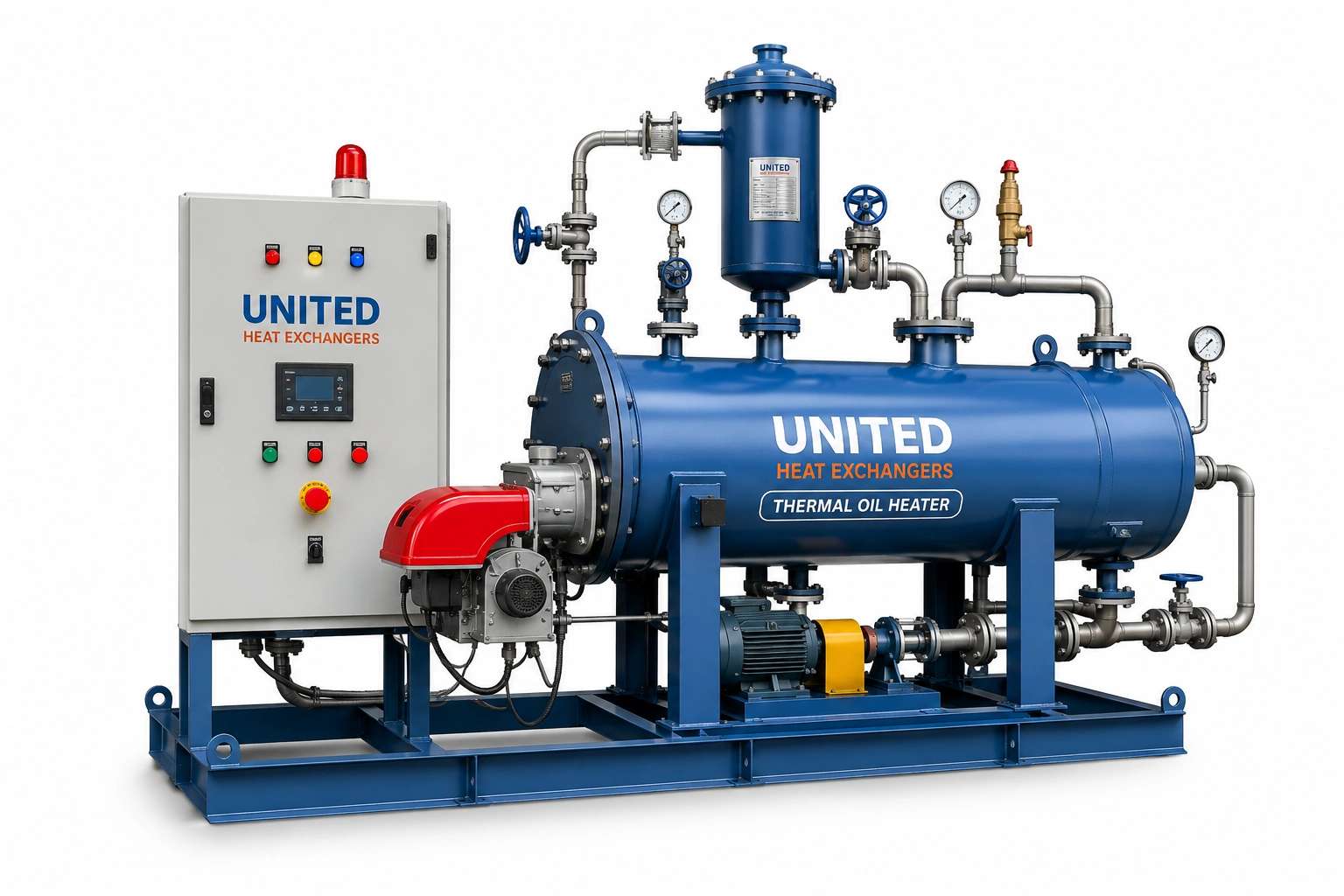
When your industrial process requires extreme heat, traditional steam boilers become dangerously highly pressurized and expensive to maintain. United Heat Exchangers engineers heavy-duty Thermal Oil Heaters (Thermic Fluid Systems) designed to deliver process temperatures up to 400°C (750°F) while operating at safe, near-atmospheric pressures. Eliminate the cost of water treatment, banish internal scaling, and achieve pinpoint thermal accuracy.
Request a Custom Quote in 48 Hours →The Thermic Fluid Advantage over Steam
Thermal oil heat exchangers form a closed-loop system where specialized synthetic or mineral oils are heated and circulated through process vessels. This provides massive operational advantages over water/steam-based heating.
- Low-Pressure Safety: To achieve 300°C with steam, your system must withstand a highly dangerous 85 bar of pressure. Thermal oil can operate at temperatures up to 300°C while maintaining pressures of only 2–3 bar, significantly lowering explosion hazards and eliminating the need for excessively thick-walled pressure vessels.
- Zero Corrosion & Scaling: Because the heat-transfer medium is oil, it also provides natural lubrication throughout the system, helping reduce friction and wear on internal components. There is no rust, no calcium scaling, no steam traps to fail, and no costly chemical water-treatment plants required.
- No Freezing Hazards: Unlike water, high-quality thermic fluids have exceptionally low freezing points, eliminating the need for complex winterization and freeze-protection tracing on your pipework.
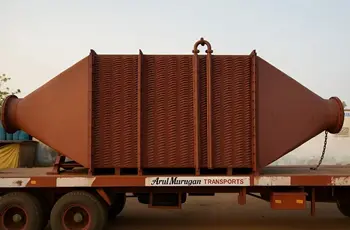
- Waste Heat Recovery (WHRU): We engineer custom thermal oil economizers and coils designed to capture exhaust heat from gas turbines or furnaces, transferring that "free" energy into your thermic fluid loop to drastically slash fuel consumption.
- Precision Control: Because thermal oil remains in a liquid phase without fluctuating steam pressures, it delivers incredibly uniform and predictable heat transfer, making it the premier choice for heat-sensitive reactor jackets.
Technical Specifications
| Parameter | Specification Capability |
|---|---|
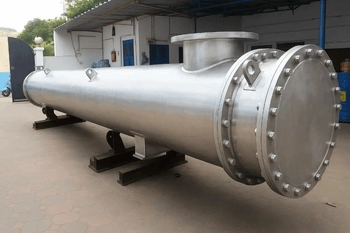
| System Configurations | Shell & Tube Exchangers, Waste Heat Recovery Coils, Fired Heater Coils |
| Operating Temperatures | Up to 400°C (750°F) using high-grade synthetic thermal fluids |
| Operating Pressures | Typically 2 to 10 Bar (Pump circulation pressure) |
| Material of Construction (Tubes) | Seamless Carbon Steel (SA-106 Gr.B), Alloy Steel (P11/P22), Stainless Steel |
| Material of Construction (Shell) | Carbon Steel (SA-516 / SA-515), SS 304/316L |
| Design Codes & Standards | ASME Sec VIII Div 1 & 2 (U-Stamp), TEMA, API 530/660, PED/CE, IBR |
| Fluid Compatibility | Dowtherm™, Therminol®, Mobiltherm™, and all standard mineral/synthetic oils |
Primary Industrial Applications

Chemical Reactors
Providing precision, high-temperature jacket heating for polymerization and synthetic resins.

Bitumen & Asphalt
Keeping heavy tank farms, asphalt terminals, and highly viscous petroleum products flowing.

Food & Edible Oils
High-temperature deodorization and precise thermal processing for industrial food manufacturing.

Waste Heat Recovery
Absorbing high-temperature exhaust gas from turbines directly into process thermal oil loops.
Upgrade Your Process Heating Today
Stop paying for massive high-pressure steam maintenance. With over 25 years of specialized fabrication experience, United Heat Exchangers delivers safe, highly efficient thermal oil heat exchangers. Send us your thermal duty requirements today.
Request a Budgetary Quote in 48 Hours →📄 Download BrochureAuthor: Senthil Kumar, Technical Director — United Heat Exchangers Pvt. Ltd | Published: August 2026 | Category: Heat Exchangers | Last Updated: August 2026