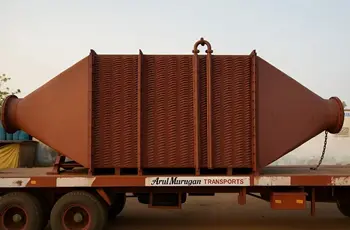
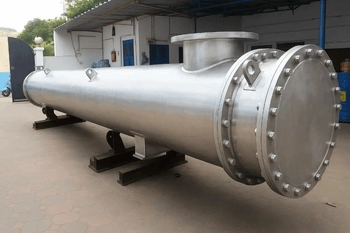
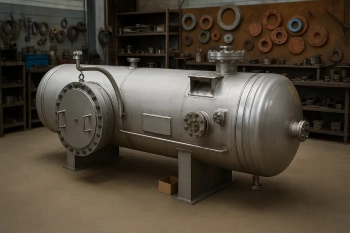
United Heat Exchangers is a trusted manufacturer and supplier of tube bundle heat exchangers, built for high performance, reliability, and long service life. Our tube bundles are used across power generation, oil and gas, chemical processing, HVAC, marine, and other industries, custom-designed for efficient heat transfer under demanding pressure and temperature conditions — with easy maintenance and cost-effective operation built into every unit.
On This Page
- What Is a Tube Bundle Heat Exchanger?
- Design and Construction
- Working Principle
- Types of Tube Bundles
- Materials of Construction
- Applications
- Advantages
- Performance Factors
- Installation Guidelines
- Maintenance & Cleaning
- Troubleshooting
- Comparison with Other Types
- How to Select the Right Bundle
- Tube Bundle Replacement Service
- Frequently Asked Questions
What Is a Tube Bundle Heat Exchanger?
A tube bundle heat exchanger is the internal heat transfer component of a shell and tube heat exchanger — multiple tubes arranged in a bundle and enclosed within a shell, with one fluid flowing through the tubes and a second fluid flowing over them outside the tubes to transfer heat between the two without mixing.
The bundle can be fixed or removable for cleaning, inspection, and maintenance, and configured as straight, U-tube, or finned depending on the application and the access required for servicing it.
Design and Construction
Tube Bundle
Multiple tubes arranged in a triangular or square pitch pattern, straight or U-shaped. Material options include copper, stainless steel, carbon steel, titanium, and alloys based on the application.
Tube Sheets
Thick plates that secure the tubes at both ends and separate the shell-side fluid from the tube-side fluid.
Baffles
Placed within the shell to direct shell-side flow across the bundle, increasing turbulence, improving heat transfer, and mechanically supporting the tubes.
End Channels / Heads
Allow fluid entry and exit on the tube side, with removable head options for easy access to the bundle.
Shell
Encloses the tube bundle and provides the flow space for the shell-side fluid.
Working Principle
The tube bundle heat exchanger operates on the principles of conduction and convection.
Hot Fluid Enters
Flows through the tubes, or around the tubes in the shell, depending on configuration.
Cold Fluid Counterflows
Enters from the opposite direction — counterflow gives the most efficient heat transfer.
Heat Transfers Through Tube Walls
Heat passes from hot to cold fluid through the tube walls without the two fluids mixing.
Baffles Add Turbulence
Directing shell-side flow across the bundle to improve the transfer rate.
Types of Tube Bundle Heat Exchangers
Fixed Tube Sheet
Permanently attached to the shellCost-effective and suited to clean fluids with minimal fouling, though harder to clean since the bundle cannot be withdrawn.
U-Tube Bundle
U-shaped tubes, removableAllows for thermal expansion and is removable for maintenance — well suited where high temperature differentials are present.
Floating Head
One end free to moveOne end of the tube stack can move to accommodate thermal expansion. Easy to clean and inspect — ideal for dirty fluids or high thermal stress.
Finned Tube Bundle
Extended surface areaTubes fitted with fins to increase surface area — used in air-cooled applications or wherever additional heat transfer is needed.
Materials of Construction
| Component | Material Options |
|---|---|
| Tubes | Copper, stainless steel, titanium, brass, carbon steel |
| Tube Sheets | Stainless steel, carbon steel, alloy steel |
| Shell | Mild steel, carbon steel, stainless steel |
| Baffles | Mild steel, stainless steel |
Material selection depends on operating temperature, pressure, fluid properties, and corrosion potential.
Applications
Power Plants
Boiler feedwater heaters, steam condensers, and heat recovery systems.
Oil & Gas
Crude oil heating, gas cooling and condensing, and refinery heat recovery.
Chemical & Petrochemical
Process heating and cooling, reactor temperature control, and solvent recovery.
HVAC Systems
Chillers, air conditioning plants, and district cooling.
Marine
Engine cooling, oil cooling, and freshwater generation.
Food & Beverage
Pasteurization, sterilization, and heat recovery systems.
Pharmaceuticals
Heating and cooling of process fluids and clean-in-place (CIP) systems.
Advantages of Tube Bundle Heat Exchangers
High Heat Transfer Efficiency
Large surface area allows effective heat exchange between fluids.
Versatility
Works with many different fluid types and duties.
High Pressure & Temperature Handling
Designed for extreme industrial operating conditions.
Easy Maintenance
U-tube and floating head designs allow easy cleaning and tube replacement.
Customizable
Designed for specific duties, capacities, and applications.
Energy Efficient
Reduces energy consumption by recovering heat from waste streams.
Performance Factors
What Drives Heat Transfer Performance
Installation Guidelines
Site Preparation
Ensure proper foundation support and clearance for maintenance and bundle removal.
Orientation
Install horizontally or vertically depending on the application.
Piping Connections
Correctly align tube-side and shell-side piping; install thermal expansion joints if needed.
Instrumentation
Fit temperature sensors, pressure gauges, flow meters, and safety valves.
Testing
Perform hydrostatic and pneumatic tests before commissioning.
Maintenance and Cleaning Tips
- Regular inspection for leaks, corrosion, and tube damage
- Chemical cleaning for fouling; mechanical cleaning with brushes or hydro jetting for heavier deposits
- Prompt replacement of damaged tubes to avoid system failure
- Periodic gasket inspection and replacement to prevent leaks
- Protective coatings or sacrificial anodes for corrosion protection
Troubleshooting Common Issues
| Issue | Cause | Solution |
|---|---|---|
| Reduced heat transfer | Fouling or scaling | Clean tubes and shell |
| Tube leakage | Corrosion, vibration | Replace affected tubes |
| High pressure drop | Blockage or improper design | Check and modify system |
| Cross-contamination | Tube failure | Replace affected tubes |
Comparison with Other Heat Exchangers
| Feature | Tube Bundle | Plate | Air Cooled |
|---|---|---|---|
| Efficiency | High | Very high | Moderate |
| Maintenance | Easy (removable bundle) | Moderate | Easy |
| Cost | Medium | Low to medium | High for large capacities |
| Pressure handling | High | Medium | Low to medium |
| Typical use | Heavy-duty industries | HVAC, food | Outdoor cooling |
How to Select the Right Tube Bundle Heat Exchanger
- Type of fluids — corrosive, non-corrosive, fouling tendency
- Temperature and pressure conditions
- Flow rates and heat load requirements
- Available space and orientation
- Maintenance accessibility
- Budget and lifecycle cost
Consulting with an experienced manufacturer ensures you get a solution customized to your process, not a generic catalogue fit.
Tube Bundle Replacement Service
Need a replacement for an existing shell? We design tube bundles for straightforward replacement when the original wears out, fouls beyond economical cleaning, or your process conditions change — as an exact duplicate of your existing bundle or a custom-built upgrade, with fast delivery to minimize downtime.
Industry outlook: demand for tube bundle heat exchangers continues to grow alongside oil and gas expansion, energy-efficiency mandates, and waste heat recovery initiatives across the chemical, pharmaceutical, and food industries.
Why Choose United Heat Exchangers?
High-Quality Products
Manufactured with premium materials for durability and performance.
Custom Solutions
Engineered to meet your specific industrial needs and applications.
Experienced Engineers
Backed by skilled engineers with years of heat exchanger design and manufacturing expertise.
Competitive Prices
Options that balance affordability with quality.
Global Exporter
Delivering to industries across Asia, Africa, the Middle East, Europe, and the Americas.
On-Time Delivery
Committed to timely production and delivery to minimize your downtime.
Frequently Asked Questions
What is a tube bundle heat exchanger?
A tube bundle heat exchanger is the internal component of a shell and tube heat exchanger — multiple tubes bundled inside a shell that transfer heat between two fluids without mixing them.
What are the types of tube bundle heat exchangers?
The common types are Fixed Tube Sheet, U-Tube Bundle, Floating Head, and Finned Tube Bundle, each suited to different fouling, thermal expansion, and maintenance requirements.
What materials are used in tube bundles?
Copper, stainless steel, titanium, carbon steel, and brass, selected based on corrosion resistance, temperature, and pressure conditions.
How do I choose the right tube bundle heat exchanger?
Consider fluid type, temperature, pressure, heat load, fouling tendency, and maintenance access — see the selection checklist above.
What industries use tube bundle heat exchangers?
Oil and gas, power plants, chemical processing, marine, HVAC, food processing, and pharmaceuticals.
How often should a tube bundle heat exchanger be cleaned?
It depends on operating conditions — in services prone to scaling or fouling, cleaning every 6–12 months is typical.
Can the tube bundle be replaced separately?
Yes. Tube bundles can be replaced without changing the entire heat exchanger shell, reducing both cost and downtime.
What are the benefits of a tube bundle heat exchanger?
High heat transfer efficiency, durability, easy maintenance on removable designs, and the ability to handle high temperatures and pressures.
How do I prevent fouling in a tube bundle heat exchanger?
Proper upstream filtration, chemical treatment where needed, and a regular cleaning schedule minimize fouling and keep efficiency close to design.
Why choose United Heat Exchangers for a tube bundle heat exchanger?
Custom-engineered solutions in durable materials, TEMA/ASME/API 660 compliant design, competitive pricing, and export support across Asia, Africa, the Middle East, Europe, and the Americas.
Need a Custom Tube Bundle or Replacement?
Share your shell dimensions, fluids, and operating conditions — as an exact duplicate or a custom upgrade — and our engineering team will get back to you with a technical proposal.
Request a Quote →