Author: Senthil Kumar, Technical Director | Updated: September 2026
Table of Contents
- What Is a Duplex Stainless Steel Heat Exchanger?
- The Duplex Microstructure — Why It Works
- Duplex Grades — 2205, 2507 and Lean Duplex
- Types of Duplex Heat Exchangers
- Key Components and Construction
- Engineering Advantages
- Design Standards — ASME, ASTM and TEMA
- Industries and Applications
- Duplex vs 316L vs Super Duplex
- Why United Heat Exchangers
- Delivery
- Frequently Asked Questions
What Is a Duplex Stainless Steel Heat Exchanger?
A duplex stainless steel heat exchanger uses tubes and plates built from a two-phase austenitic-ferritic stainless alloy — combining roughly equal proportions of austenite and ferrite in one microstructure to deliver both the pitting resistance of high-alloy stainless and mechanical strength that 316L cannot match.Duplex grades were developed specifically to close the gap between standard austenitic stainless steel, which is affordable but chloride-limited, and exotic alloys like titanium or Hastelloy, which resist chlorides completely but at a much higher material cost. In brackish water, seawater-adjacent, and moderately sour or chloride-bearing process duties, duplex offers the best balance of corrosion resistance, strength, and cost per unit of resistance. United Heat Exchangers designs and fabricates duplex shell-and-tube and duplex plate heat exchangers to ASME Section VIII and TEMA for offshore, desalination, and chemical process clients across India and 30+ export markets.
The Duplex Microstructure — Why It Works
Duplex stainless steel is not a compromise between two properties — it is an engineered microstructure that captures the best characteristic of each phase present. Understanding how the two phases work together explains why duplex outperforms either pure austenitic or pure ferritic stainless steel on its own.
Austenite Phase
Roughly 50% of the microstructure — contributes toughness, ductility, and general corrosion resistance.
Ferrite Phase
The remaining ~50% — contributes high yield strength and resistance to chloride stress corrosion cracking.
Chromium and Molybdenum
Elevated alloying content in both phases raises the Pitting Resistance Equivalent Number well above standard 316L.
Nitrogen Addition
Controlled nitrogen content stabilises the phase balance and further boosts localised corrosion resistance.
Balanced Result
A tube material with near-double the yield strength of 316L and pitting resistance approaching 6Mo super-austenitic grades.
Engineering Insight — Why the Phase Balance Matters: The roughly 50/50 austenite-ferrite ratio is deliberately controlled through composition and heat treatment. Too much ferrite reduces toughness and increases risk of embrittlement at elevated temperature; too much austenite sacrifices the strength and stress-corrosion resistance that make duplex attractive in the first place. Correct solution annealing and rapid quenching after welding are essential to preserve this balance at every joint — a step United Heat Exchangers controls and documents on every duplex fabrication.
Duplex Grades — 2205, 2507 and Lean Duplex
"Duplex" spans a range of grades from lean duplex through standard duplex to super duplex, each formulated for a different balance of cost and chloride resistance.
| Grade | UNS / EN | PREN | Typical Duty |
|---|---|---|---|
| Lean Duplex | UNS S32101 / 1.4162 | ~26 | Cost-effective upgrade from 316L where moderate chloride resistance and higher strength are the goal |
| Standard Duplex 2205 | UNS S32205 / 1.4462 | ~35 | The default duplex grade — brackish and coastal seawater, most offshore and desalination duties |
| Super Duplex 2507 | UNS S32750 / 1.4410 | ~42 | Ambient to warm seawater, high-chloride process streams, offshore gas export coolers |
Specification Tip: PREN (Pitting Resistance Equivalent Number) is calculated from chromium, molybdenum, and nitrogen content and gives a quick comparative ranking of pitting resistance between grades — but actual service performance still depends on chloride concentration, temperature, oxygen level, and crevice geometry in your specific design. United Heat Exchangers reviews the full duty before recommending a grade.
Types of Duplex Heat Exchangers
United Heat Exchangers builds duplex into the same core exchanger configurations offered in 316L and titanium, with mechanical design and welding procedures controlled specifically for duplex phase-balance preservation.
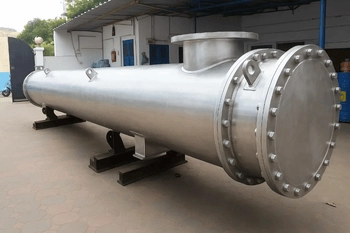
Duplex Shell and Tube Heat Exchanger
Duplex tubes with a carbon steel or duplex shellDuplex tubes are the most common configuration — the shell may remain carbon steel with a duplex tubesheet, or the entire pressure boundary can be built in duplex for full-service corrosion resistance.
- Fixed tubesheet, U-tube, or floating head per TEMA type
- Duplex or duplex-clad tubesheets to prevent galvanic attack at the joint
- Standard for brackish and coastal seawater cooling duties
- Lower material cost than titanium at comparable pitting resistance
Duplex Plate Heat Exchanger
Thin duplex plates for compact, high-efficiency dutiesCorrugated duplex plates gasketed or fully welded into a compact frame give very high heat transfer coefficients in a fraction of the footprint of an equivalent shell-and-tube unit.
- EPDM or Viton gaskets rated for the process temperature and chemistry
- Fully welded construction for high-pressure or leak-critical duties
- Preferred where plot space is limited — offshore skid packages
- Plates easily added or removed to adjust duty without a new exchanger
Duplex-Clad Construction
Duplex-clad tubesheet, channel and shell interiorTubesheets, channel covers, and shell interiors are explosion-bonded or weld-overlay clad with duplex over a carbon steel or low-alloy backing plate — used where full-scale solid duplex construction is not cost-justified.
- Corrosion protection on wetted pressure boundary at lower material cost
- Carbon steel backing retains structural strength
- Used in produced water coolers and large-diameter process vessels
- Cladding qualified per ASME Section IX procedure and bond-strength testing
Solid Duplex Construction
All pressure parts in duplex — maximum strength and corrosion marginTubes, tubesheets, channel, and shell are all fabricated in duplex where high pressure rating combined with chloride resistance is required, or where a thinner, lighter pressure vessel is the design driver.
- No dissimilar-metal joints — eliminates galvanic corrosion risk entirely
- Standard for offshore gas export coolers and high-pressure seawater duties
- Higher yield strength allows thinner wall sections than 316L at equal MAWP
- Available in Lean, 2205, or 2507 super duplex to match the exact process chemistry
Key Components and Construction
Duplex Tubes
Seamless or welded tubes to ASTM A789, typically Grade 2205 as the industry default, selected for the balance of strength, formability during tube expansion, and pitting resistance in the design duty.
Duplex or Clad Tubesheet
Solid duplex, weld-overlay clad, or explosion-bonded clad tubesheets to ASTM A182 forged plate stock. The tube-to-tubesheet joint is roller expanded, welded, or both, depending on pressure class and vibration exposure.
Channel and Shell
Solid duplex to ASTM A790 pipe, or carbon steel with a duplex clad liner on the wetted face — sized and designed to ASME Section VIII Division 1 as an independent pressure vessel.
Baffles and Tie Rods
Duplex or coated carbon steel baffles direct shell-side flow across the tube bundle and support the tubes against flow-induced vibration — material selected based on shell-side fluid corrosivity.
Phase-Balanced Weld Procedures
Matched duplex filler metal with over-alloyed nickel content and controlled interpass temperature preserve the austenite-ferrite balance at every welded joint — qualified per ASME Section IX with ferrite content verification.
Isolation Gaskets and Fasteners
Non-metallic isolation gaskets or coatings prevent direct contact between duplex and carbon steel flanges, and duplex or coated fasteners are used at any joint exposed to the process stream to prevent galvanic attack.
Engineering Advantages of Duplex Heat Exchangers
High Strength Reduces Wall Thickness
Roughly double the yield strength of 316L allows thinner tube and shell walls at the same pressure rating — lowering material weight and cost for a given design duty.
Strong Chloride Pitting Resistance
PREN values above 35 for standard duplex and above 40 for super duplex give reliable service in brackish and coastal seawater duties well beyond 316L's practical chloride limit.
Excellent Stress Corrosion Cracking Resistance
The ferrite phase gives duplex grades markedly better resistance to chloride stress corrosion cracking than austenitic stainless steel at elevated temperature.
Better Value Than Titanium in Moderate Chloride Duty
Where full seawater-grade immunity is not required, duplex delivers most of the corrosion benefit of titanium at a materially lower cost per kilogram.
Good Resistance to Erosion-Corrosion
Higher hardness and strength than austenitic stainless steel give duplex better tolerance of high-velocity flow and entrained solids than copper alloys or standard 316L.
Lower Total Life-Cycle Cost
A material cost premium over 316L is recovered through extended service life, reduced tube replacement, and the ability to use thinner sections — delivering a lower total cost in moderate-to-high chloride duties.
Design Standards — ASME, ASTM and TEMA
Every duplex stainless steel heat exchanger from United Heat Exchangers is designed, sourced, and documented to the following codes.
| Standard | Scope | Key Output |
|---|---|---|
| ASME Section VIII Div. 1 | Pressure vessel design of shell, channel, and tubesheet — wall thickness, weld NDE, and hydrostatic test at 1.3× MAWP | ASME U-Stamp; Manufacturer's Data Report (Form U-1) signed by Authorised Inspector |
| ASTM A789 / A790 | Seamless and welded duplex/super duplex tube (A789) and pipe (A790) — chemical composition, mechanical properties, and ferrite content verification | Mill test certificates; ferrite content and eddy-current or hydrostatic tube test reports |
| ASTM A182 | Forged duplex tubesheets, flanges, and fittings — mechanical and impact testing at design temperature | Traceable mill certification and impact test reports for every forged pressure part |
| TEMA Class R / C / B | Mechanical design rules for tube pitch, baffle spacing, tube-to-tubesheet joints, and bundle removal — Class R for refinery-severity service, Class C for commercial, Class B for chemical process | TEMA-compliant mechanical drawing set and tube layout |
| HTRI Xist Software | Rigorous thermal and hydraulic rating — tube-side and shell-side heat transfer, pressure drop, and vibration analysis specific to duplex tube properties | Guaranteed thermal performance certificate; vibration analysis report |
Specification Tip: Post-weld solution annealing and controlled interpass temperature are essential on duplex fabrications — uncontrolled heat input during welding can shift the phase balance toward excess ferrite, reducing toughness and corrosion resistance exactly at the joint. Confirm the fabricator's duplex welding procedure qualification before placing an order.
Industries and Applications
| Industry | Typical Duty | Process Stream | Configuration |
|---|---|---|---|
| Offshore & Marine | Gas export coolers, produced water coolers, seawater lift coolers | Seawater and produced water with moderate to high chloride content | Solid 2205 or 2507 super duplex shell-and-tube |
| Desalination | Brine circulation coolers, seawater intake heat exchangers | Brackish and coastal seawater at moderate temperature | Duplex 2205 tubes with duplex or clad tubesheet |
| Oil & Gas Processing | Gas compression inter-coolers, produced water treatment coolers | Sour gas condensate, chloride-bearing produced water | Solid or clad duplex, grade selected by H₂S/chloride partial pressure |
| Chemical Process | Process cooling where 316L is marginal but full exotic alloy is not justified | Chloride-bearing process streams below titanium/Hastelloy-mandatory thresholds | Duplex 2205 shell-and-tube or plate heat exchanger |
| Pulp & Paper | Bleach plant heat recovery, chloride-bearing liquor coolers | Chlorine dioxide and chloride-containing bleaching liquors | Duplex or super duplex plate heat exchanger |
Duplex vs 316L vs Super Duplex
| Parameter | 316L Stainless Steel | Standard Duplex 2205 | Super Duplex 2507 |
|---|---|---|---|
| PREN (Pitting Resistance) | ~24 | ~35 | ~42 |
| Yield Strength | Baseline (~170–205 MPa) | ~2× 316L (~450 MPa) | ~2.5× 316L (~550 MPa) |
| Practical Chloride Limit | Low — pitting risk above ~200–400 ppm at temperature | Moderate to high — suitable for brackish and coastal seawater | High — suitable for ambient to warm full-strength seawater |
| Relative Material Cost | Lowest of the three | Moderate premium over 316L | Higher premium, still well below titanium or Hastelloy |
| Typical Application Fit | Fresh water and low-chloride process cooling | Brackish/coastal seawater, offshore, moderate sour service | High-chloride offshore gas export, warm seawater duties |
When to Choose Duplex: Duplex is the right choice when 316L's chloride and strength limits are exceeded but full seawater-grade immunity from titanium is not required — a common position for offshore, brackish water, and moderately aggressive chemical process duties. Where the service is continuous full-strength seawater at warm temperature, titanium or super duplex 2507 becomes the safer specification. United Heat Exchangers reviews your specific chloride, temperature, and pressure requirements before recommending a grade.
Why United Heat Exchangers
Duplex Fabrication Specialist
Qualified welding procedures with ferrite content verification at every joint, controlled interpass temperature, and post-weld solution annealing to preserve the phase balance that gives duplex its corrosion resistance.
HTRI Xist Thermal Guarantee
Bundle geometry, baffle spacing, and tube layout optimized in HTRI Xist for duplex thermal and vibration properties. We issue a guaranteed thermal performance certificate with every order.
ASME U-Stamp Certified
Pressure parts carry the ASME U-Stamp with full Manufacturer's Data Reports, alongside traceable ASTM A789/A790/A182 mill certification and ferrite content reports for every duplex component sourced.
30+ Countries — Full In-House Engineering
From process datasheet to certified fabrication drawing — grade selection, thermal design, and export documentation — entirely in-house, no subcontracting. Delivered to offshore and desalination clients across 30+ countries.
Get a Free Duplex Heat Exchanger Quote in 48 Hours
Send your process duty, chloride concentration, temperature range, pressure rating, and site location. We return an HTRI-sized thermal proposal, grade recommendation, and budgetary quote within 48 hours.
Request My Free Quote →Delivery and What's Included
- HTRI Xist thermal and vibration analysis — tube-side and shell-side heat transfer, pressure drop, and flow-induced vibration check specific to duplex tube properties
- ASME U-Stamp and Manufacturer's Data Report (Form U-1) — for all pressure parts, signed by Authorised Inspector; MAWP and design temperature stamped on nameplate
- ASTM A789 / A790 / A182 mill certification — full material traceability for every duplex tube, pipe, and forged component used in the exchanger
- Ferrite content verification reports — magnetic or metallographic ferrite measurement confirming correct phase balance at base metal and welds
- Weld procedure qualification records — matched duplex filler metal and interpass temperature control procedures, qualified per ASME Section IX
- Operations and maintenance manual — tube cleaning procedure, inspection intervals, and 2-year spare parts list
Frequently Asked Questions — Duplex Stainless Steel Heat Exchanger
What is a duplex stainless steel heat exchanger used for?
A duplex heat exchanger uses a two-phase austenitic-ferritic stainless alloy for tubes and plates wherever the process or cooling stream has chloride levels or pressure requirements that exceed 316L stainless steel's practical limits, but full seawater-grade titanium is not cost-justified. It is standard for offshore, brackish and coastal seawater cooling, and moderately aggressive chemical process duty.
What is the difference between duplex and 316L stainless steel?
Duplex combines roughly equal austenite and ferrite phases, giving it nearly double the yield strength of 316L and a Pitting Resistance Equivalent Number (PREN) of around 35 versus 316L's roughly 24. This makes duplex suitable for higher-pressure designs with thinner walls and more chloride-resistant service than 316L can reliably provide.
Which duplex grade should I choose — 2205 or 2507?
2205 (standard duplex) is the default choice for brackish and coastal seawater and moderate sour service. 2507 (super duplex) is specified for continuous full-strength or warm seawater, high-chloride offshore gas export, and other duties where 2205's resistance margin is insufficient. The correct grade depends on chloride concentration, temperature, and oxygen level in the specific duty.
Is duplex stronger than titanium?
Yes — duplex has notably higher yield strength than commercially pure titanium, allowing thinner-walled, higher-pressure designs. Titanium's advantage is chloride immunity at essentially any concentration; duplex has strong but not unlimited chloride resistance. The choice depends on whether strength or absolute chloride immunity is the more critical design driver.
Why is welding duplex stainless steel more demanding than 316L?
Welding must preserve the roughly 50/50 austenite-ferrite phase balance. Excess heat input or the wrong filler metal can shift the joint toward excess ferrite, reducing toughness and corrosion resistance exactly where it matters most. Duplex welding requires matched over-alloyed filler metal, controlled interpass temperature, and ferrite content verification — procedures qualified separately from standard stainless steel welding.
What is the lead time for a duplex heat exchanger from India?
Standard duplex 2205-tube shell-and-tube exchangers with standard header types deliver in 7–10 weeks. Solid duplex or super duplex 2507, clad construction, or ASME U-Stamp units take 12–18 weeks depending on complexity. Expedited delivery is available for plant shutdowns and offshore project deadlines — contact us with your timeline.
Author: Senthil Kumar, Technical Director — United Heat Exchangers Pvt. Ltd. | Last Updated: September 2026