Table of Contents — Jump to Any Section
- What Is a Plate and Shell Heat Exchanger? (Core Definition)
- The Ultimate Hybrid: Why PSHE Technology Was Invented
- The Physics: Marrying Turbulence with Pressure Containment
- Fully Welded vs. Removable Core Designs Explained
- PSHE vs. Shell & Tube vs. Gasketed Plate Exchangers
- Industrial Applications: From Offshore FPSOs to Cryogenics
- Material Selection for Extreme Thermal Stress
- Efficiency: Understanding PSHE U-Values
- Expert Guide: When to Specify a Plate and Shell Unit
- Design Codes: ASME and High-Pressure Certification
- Frequently Asked Questions (FAQs)
- Why Choose United Heat Exchangers?
What Is a Plate and Shell Heat Exchanger?
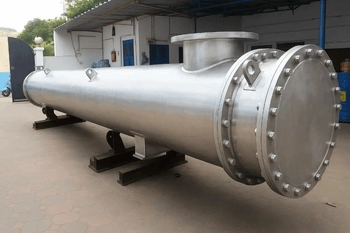
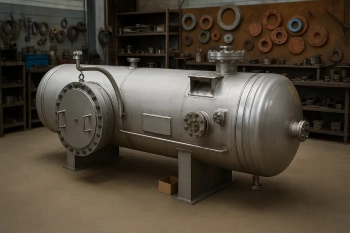
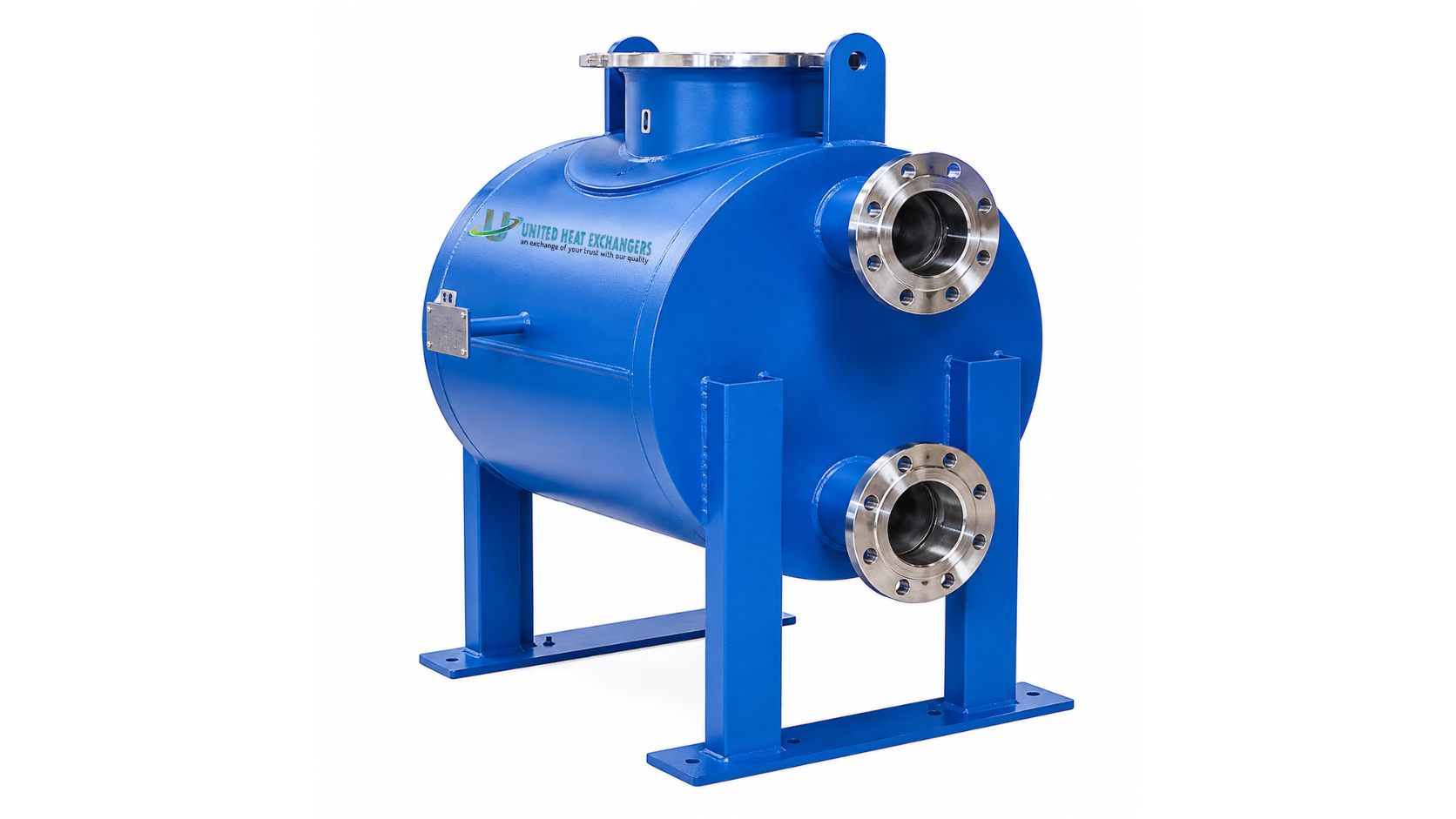
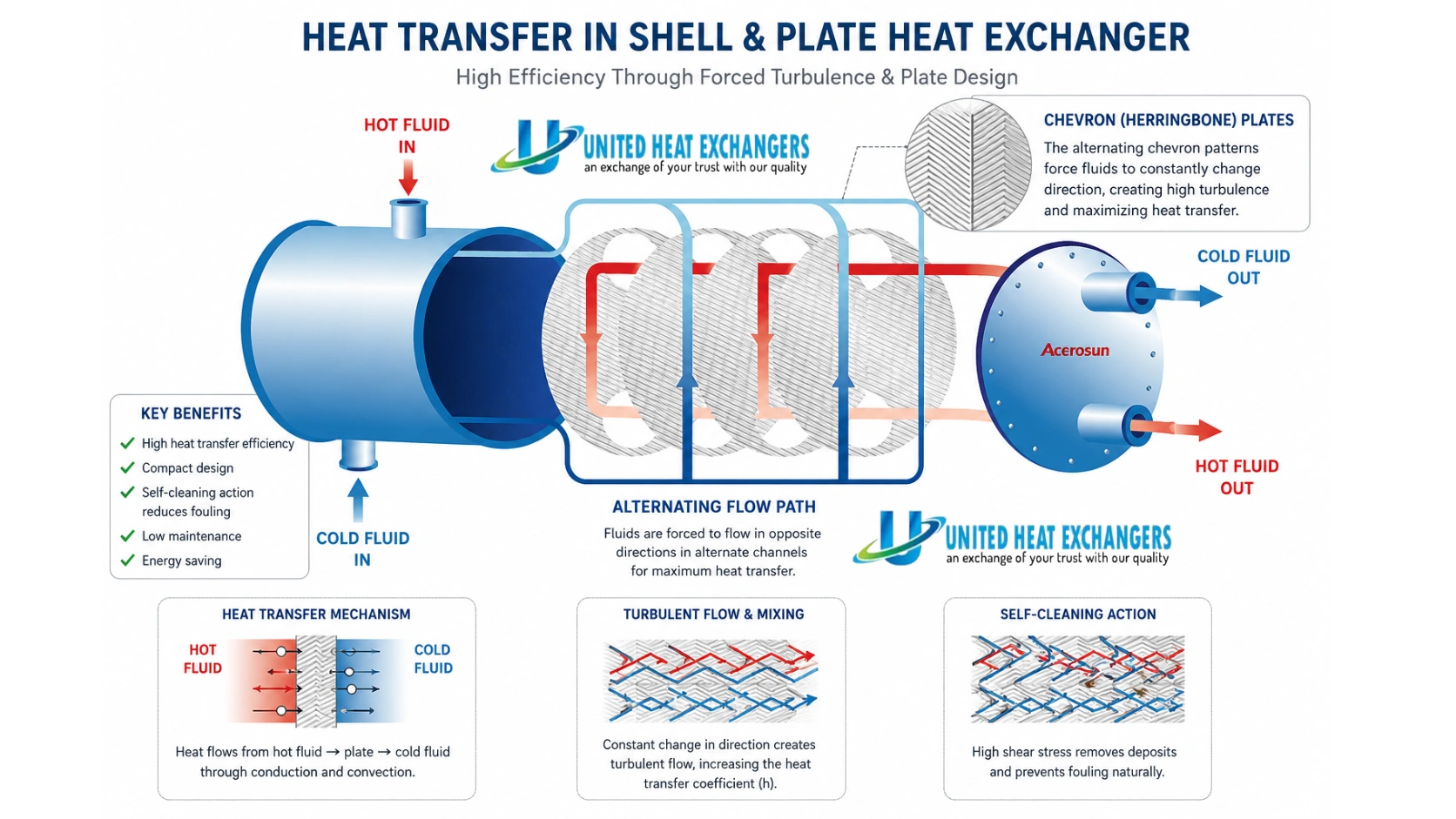
A plate and shell heat exchanger (PSHE) is an advanced thermal transfer device that combines the best characteristics of a traditional shell-and-tube exchanger with a plate heat exchanger. It consists of a fully welded, circular plate pack inserted into a cylindrical outer pressure shell.
By eliminating rubber gaskets entirely, the PSHE can handle extreme temperatures and pressures (the hallmark of a shell-and-tube) while delivering the ultra-high thermal efficiency and compact footprint created by corrugated metal plates.
💡 The simplest way to picture it: Imagine taking the highly efficient, rippled metal plates of a standard plate heat exchanger, cutting them into perfect circles, laser-welding them together into a solid accordion-like stack, and sliding that stack inside a heavy-duty steel pipe. You now have a heat exchanger that transfers heat 3x faster than a shell-and-tube, but won't leak under 100 bar of pressure.
The Ultimate Hybrid: Why PSHE Technology Was Invented
For decades, industrial thermal engineers faced a frustrating dilemma. They had to choose between two imperfect technologies for high-pressure applications:
- The Shell & Tube Problem: While they are strong enough to withstand massive pressures, their smooth internal tubes make heat transfer highly inefficient. To get the required heat duty, they have to be massive, heavy, and require massive amounts of floor space.
- The Gasketed Plate (PHE) Problem: They transfer heat incredibly efficiently and save space. However, the rubber gaskets that seal the plates will melt at high temperatures, turn brittle in cryogenics, or blow out under high pressure.
- The PSHE Solution: Developed in the late 1980s, the Plate and Shell Heat Exchanger fused the two. The heavy cylindrical shell acts as the pressure containment vessel, while the laser-welded corrugated plate pack delivers massive turbulence and high U-values without relying on vulnerable gaskets.
📌 Engineering Fact: Because a PSHE requires only 30% of the space and weight of a traditional shell-and-tube, it has become the gold standard for offshore oil rigs (FPSOs) and naval applications, where every square meter of deck space and kilogram of weight costs millions of dollars.
The Physics: Marrying Turbulence with Pressure Containment
The thermal superiority of the Plate and Shell Heat Exchanger comes down to flow dynamics. Smooth tubes create "laminar flow," where fluid travels in straight lines, creating insulating boundary layers. PSHEs destroy these boundary layers.
📈 Flow Dynamics: Chevron Corrugations
Stress Distribution
Why are the plates circular? In a rectangular welded plate exchanger, pressure creates severe stress concentrations at the 90-degree corners, leading to fatigue cracking. A circular plate distributes pressure and thermal expansion perfectly evenly across its circumference, allowing it to easily handle severe thermal shocks and cyclic fatigue.
Fully Welded vs. Removable Core Designs
While the internal plate pack is permanently welded, you can choose between two outer shell designs based on your maintenance needs.
The circular plate pack is permanently welded inside a fully enclosed steel pipe shell. There are no flanges to unbolt. This provides the absolute highest pressure and temperature ratings and is completely leak-proof.
▶ Best for: Lethal service, high-pressure gas, clean cryogenic fluids.
The shell features a massive flanged cover. By unbolting the flange, the entire welded plate pack can be pulled out of the shell. This allows operators to mechanically clean the shell-side of the plate pack if the fluid is dirty.
▶ Best for: Fouling applications, refinery bottoms, heavy cooling water.
PSHE vs. Shell & Tube vs. Gasketed Plate Exchangers
Understanding when to step up to a Plate and Shell Heat Exchanger requires looking at the technical limitations of its predecessors.
| Parameter | Plate & Shell (PSHE) | Shell & Tube (S&T) | Gasketed Plate (PHE) |
|---|---|---|---|
| Max Temperature | Up to 600°C | Up to 800°C+ | Limited to ~200°C (Gaskets fail) |
| Max Pressure | Up to 100+ bar | Extreme (300+ bar) | Limited to ~30 bar (Gasket blowout) |
| Thermal Efficiency (U-Value) | Very High | Low to Moderate | Very High |
| Physical Footprint | Ultra-Compact | Massive (Requires 2x length to pull tubes) | Very Compact |
| Maintenance / Cleaning | Chemical CIP / Shell-side mechanical | Individual tube hydro-blasting | Easy (Fully dismantleable) |
✅ The Golden Rule of Selection: If your application pressure or temperature exceeds the limits of rubber gaskets, but you do not have the physical floor space (or the budget) for a massive Shell & Tube, the Plate and Shell is your exact solution.
Industrial Applications: From Offshore FPSOs to Cryogenics
Because they are hermetically sealed and highly efficient, Plate and Shell Heat Exchangers are rapidly replacing traditional tubular units in high-stakes industries.

Marine & Offshore (FPSO)
Crude oil heating, gas dehydration, and seawater cooling where weight and space dictate design.

Refining & Petrochemical
Column overhead condensers, reboilers, and high-temperature amine/solvent recovery.
Industrial Refrigeration
Ammonia condensers, CO2 cascades, and evaporators. The gasket-free design prevents toxic refrigerant leaks.

Energy & District Heating
High-pressure steam-to-water heating stations and geothermal power plant heat recovery.

Cryogenics & LNG
Liquid nitrogen (LIN) vaporization and Liquefied Natural Gas (LNG) processing down to -196°C.
Material Selection for Extreme Thermal Stress
In a Plate and Shell Heat Exchanger, the plate pack is doing 100% of the thermal work, while the outer shell simply acts as a pressure containment vessel. This allows for incredibly cost-effective material combinations.
- The Plate Pack (High Grade): Because the plates are only 0.8mm to 1.2mm thick, they can be stamped from premium, highly corrosion-resistant exotic alloys without breaking the budget. Standard plates are Stainless Steel 316L, but Titanium Grade 2 (for seawater) and Hastelloy C-276 (for harsh acids) are common.
- The Outer Shell (Cost Effective): If the shell-side fluid is non-corrosive (like steam, cooling water, or clean oil), the heavy outer pressure shell can be constructed from standard Carbon Steel, saving massive amounts of money compared to a full stainless shell-and-tube unit.
Efficiency: Understanding PSHE U-Values
The Overall Heat Transfer Coefficient (U-value) of a Plate and Shell is comparable to a gasketed plate exchanger—and vastly superior to a shell-and-tube.
U-Value Comparison (W/m²·K) for Liquid-to-Liquid Duty
| Plate & Shell Heat Exchanger (PSHE) | 3,000–6,000 | |
| Gasketed Plate Exchanger (PHE) | 3,500–7,000 | |
| Shell & Tube Heat Exchanger (S&T) | 1,000–2,500 |
This massive increase in U-value means a Plate and Shell exchanger requires 60–70% less surface area to perform the exact same job as a shell-and-tube, drastically reducing the physical footprint and total equipment weight.
Expert Guide: When to Specify a Plate and Shell Unit
Not sure if a PSHE is right for your process? Our thermal engineers use this simple checklist:
Check the Pressure
Does your process exceed 25-30 bar? If yes, standard gasketed plate exchangers will fail. You must step up to a PSHE or Shell & Tube.
Check the Temperature
Does the fluid exceed 200°C, or involves deep cryogenics (-50°C)? Elastomer gaskets will melt or shatter. A welded PSHE is required.
Evaluate Space Constraints
If you passed steps 1 and 2, but do not have the physical room for a massive 6-meter-long Shell & Tube exchanger, the PSHE is your only viable solution.
Assess Fouling Potential
If one fluid is dirty, route it through the shell side of a "Removable Core" PSHE for easy hydro-blasting. Route the clean fluid through the permanently welded plate side.
Design Codes: ASME and High-Pressure Certification
Because Plate and Shell Heat Exchangers operate at extreme pressures (often handling lethal gases, high-pressure steam, or volatile hydrocarbons), the outer shell is legally classified as a severe-duty pressure vessel.
⚠ Regulatory Compliance: Any PSHE operating at industrial pressures must be designed, welded, and inspected according to strict codes. At United Heat Exchangers, our units are rigorously stamped according to ASME Section VIII Div 1 (U-Stamp), the European PED 2014/68/EU (CE Mark), or the Indian IS 2825 depending on global installation requirements.
Frequently Asked Questions (FAQs)
1. Can a Plate and Shell heat exchanger be cleaned?
Yes. The inside of the plate pack (Plate side) is typically cleaned chemically using Clean-in-Place (CIP) circulation. If you purchase a "Removable Core" design, the entire plate bundle can be extracted from the shell, allowing the outside of the plates (Shell side) to be mechanically cleaned with high-pressure water jets.
2. Does a PSHE have any rubber gaskets?
No. The entire heat transfer core is laser-welded or TIG-welded. The only "gasket" is a high-pressure metallic or graphite ring joint used to seal the outer shell cover on removable-core models.
3. How does it handle thermal expansion?
Because the plates are circular, they expand and contract radially in a perfectly uniform manner. Additionally, the welded plate pack acts like an accordion (bellows), easily absorbing severe thermal shocks without cracking the welds.
4. Is a Plate and Shell exchanger more expensive than a Shell and Tube?
Usually, no. While the laser welding technology is advanced, a PSHE requires up to 70% less material (steel/titanium) to achieve the same heat duty as a Shell and Tube. When exotic alloys are required, the PSHE is almost always significantly cheaper.
Why Choose United Heat Exchangers?
United Heat Exchangers Pvt. Ltd is India's leading authority in advanced thermal solutions. For over 25 years, we have successfully replaced massive, failing tubular units with highly compact Plate and Shell systems for offshore operators, refineries, and power plants worldwide.
- ASME U-Stamp Certified: Every pressure vessel we build undergoes rigorous, independent code inspection to guarantee safety at extreme pressures.
- Exotic Material Mastery: In-house expertise in precision-welding Titanium, Hastelloy, and Duplex steel plate packs.
- ISO 9001:2015 Quality: Flawless fabrication management spanning procurement, automated welding, and non-destructive testing (NDT).
- In-House Thermal Design: Leveraging industry-leading ASPEN EDR software to model complex phase-changes, boiling, and condensing applications.
- Rapid 48-Hour Engineering Quotes: We don't keep your projects waiting. Our thermal engineers deliver preliminary designs and budgetary pricing fast.
Upgrade Your High-Pressure Heat Transfer
Stop replacing blown gaskets and stop allocating massive floor space to outdated technology. Share your high-pressure process conditions with us today and receive a comprehensive Plate & Shell engineering recommendation and quote within 48 hours.
Request My Free Engineering Quote →📄 Read More Technical GuidesAuthor: Senthil Kumar, Technical Director — United Heat Exchangers Pvt. Ltd | Published: August 2026 | Category: Heat Exchangers | Last Updated: August 2026