Table of Contents — Jump to Any Section
- What Is a Regenerative Heat Exchanger? (Core Definition)
- Why Heavy Industry Relies on Thermal Regeneration
- The Physics: Heat Storage and the Thermal Matrix
- Rotary vs. Fixed Bed: The 2 Main Types Explained
- Regenerative vs. Recuperative Heat Exchangers
- Industrial Applications: Power, Steel, and HVAC
- Matrix Materials: From Corrugated Steel to Ceramics
- The Disadvantage: Managing Cross-Contamination
- Thermal Effectiveness vs. U-Value
- Expert Guide: When to Specify a Regenerator
- Frequently Asked Questions (FAQs)
- Why Choose United Heat Exchangers?
What Is a Regenerative Heat Exchanger?
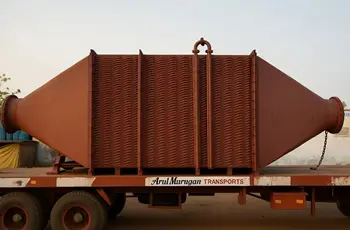
A regenerative heat exchanger (often simply called a regenerator) is a type of heat transfer equipment where a hot fluid and a cold fluid flow through the exact same physical space—but at different times. Instead of transferring heat instantly across a solid wall, a regenerator uses a high-capacity "thermal mass" (the matrix) to temporarily store thermal energy from the hot stream, which is later released into the cold stream.
Regenerative heat exchangers pass fluids through the same flow channels one after another, creating an exceptionally high surface-area-to-volume ratio. This design makes them one of the most efficient solutions for recovering heat between gas streams.
💡 The simplest way to picture it: Imagine blowing hot exhaust air through a dense pile of bricks. The bricks heat up (storing thermal energy). Once the bricks are glowing hot, you stop the exhaust and blow cold, fresh air through the same pile of bricks. The cold air absorbs the heat from the bricks, exiting as hot air. You have just transferred heat without the two air streams ever physically mixing at the same time.
Why Heavy Industry Relies on Thermal Regeneration
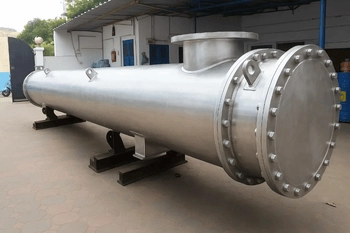
Gas-to-gas heat transfer is notoriously difficult. Because gases have extremely low density and poor thermal conductivity, traditional shell-and-tube heat exchangers require enormous, prohibitively expensive surface areas to transfer heat between two gas streams.
Regenerators solve this by utilizing a porous matrix (often corrugated metal or ceramic honeycombs). This matrix packs thousands of square meters of heat transfer area into a very small footprint. Without regenerative air preheaters, modern coal-fired power plants, glass melting furnaces, and blast furnaces would burn exponentially more fuel, making their operation economically and environmentally unsustainable.
📌 Engineering Fact: In utility-scale power generation, every 20°C drop in flue gas temperature achieved by a regenerative air preheater increases the boiler's overall thermal efficiency by approximately 1%. Over the 40-year lifespan of a power plant, this translates to hundreds of millions of dollars in saved fuel and drastically reduced carbon emissions.
The Physics: Heat Storage and the Thermal Matrix
Unlike recuperative exchangers (where heat flows constantly across a dividing wall), regenerative heat transfer is fundamentally a transient, time-dependent process. It relies on the heat capacity (Cp) of the solid matrix material.
The Critical Role of the Matrix
The efficiency of a regenerator depends entirely on the matrix. It must possess high thermal mass (to store a lot of energy), excellent thermal shock resistance (to survive rapid heating and cooling cycles), and low pressure drop (to avoid straining large industrial fans).
Rotary vs. Fixed Bed: The 2 Main Types Explained
There are two primary ways to achieve the alternating flow of a regenerative system: by moving the matrix, or by moving the fluid paths via valves.
The thermal matrix is built into a massive, slowly rotating cylinder (1–3 RPM). The cylinder rotates continuously through two separate gas ducts (one hot, one cold). As the wheel spins, the matrix continually absorbs heat in the hot sector and releases it in the cold sector.
▶ Best for: Power plant air preheaters, HVAC energy recovery ventilators (ERV).
The matrix remains stationary inside two parallel towers. Hot exhaust is piped into Tower A to heat it up, while cold air is piped into Tower B to absorb previously stored heat. After a set time (e.g., 20 minutes), massive butterfly valves switch the flows, reversing the roles of the two towers.
▶ Best for: Blast furnaces, glass melters, extreme temperatures (>1,000°C).
Regenerative vs. Recuperative Heat Exchangers
In thermal engineering, gas-to-gas heat recovery generally comes down to choosing between a regenerator or a traditional recuperator (like a shell-and-tube or plate heat exchanger).
| Feature | Regenerative (Thermal Wheel/Bed) | Recuperative (Shell & Tube / Plate) |
|---|---|---|
| Heat Transfer Mechanism | Transient storage in a solid matrix. | Steady-state transfer across a solid wall. |
| Fluid Mixing (Leakage) | Yes (1% - 5%) due to carryover and seal leakage. | Zero (Fluids are physically separated). |
| Size & Footprint | Extremely compact for high gas volumes. | Massive footprint required for gas-to-gas duties. |
| Thermal Efficiency | Very High (up to 95%). | Moderate (Requires huge surface area for >80%). |
| Maintenance Needs | High (Moving parts, seals, alternating valves). | Low (No moving parts, static equipment). |
✅ The Golden Rule of Selection: If absolutely zero cross-contamination is allowed (e.g., toxic gases mixing with breathable air), you MUST use a recuperative heat exchanger. If 2-5% leakage is acceptable, a regenerative heat exchanger will save massive amounts of capital cost and space.
Industrial Applications: Where Regenerators Dominate
Regenerative heat exchangers are exclusively used for gas-to-gas heat transfer. Here are the primary industries that rely on them:
Utility Power Plants
Rotary Ljungström air preheaters recover exhaust heat to preheat boiler combustion air.

Commercial HVAC
Thermal wheels (ERV/HRV) recover heat and humidity from exhaust air in office buildings.

Glass Manufacturing
Fixed-bed checker brick regenerators handle the extreme 1,500°C exhaust of glass melters.

Steel Production
"Cowper Stoves" are massive fixed-bed regenerators used to blast 1,200°C air into iron furnaces.
Environmental Control
Regenerative Thermal Oxidizers (RTOs) use ceramic beds to cleanly burn off VOC emissions.
The Disadvantage: Managing Cross-Contamination
The single greatest operational challenge of a regenerative heat exchanger is leakage and carryover. Because both gas streams share the exact same matrix channels (just at different times), a small amount of mixing is unavoidable.
- Carryover Leakage: In a rotary wheel, as the matrix spins from the exhaust side to the fresh air side, the physical voids in the matrix are still filled with exhaust gas. This gas is carried over into the fresh air stream.
- Seal Leakage: Rotary wheels require mechanical seals to separate the hot and cold ducts along the spinning face of the wheel. Due to thermal expansion and wear, these seals are never 100% tight, allowing high-pressure gas to bleed into the low-pressure side.
⚠ Design Mitigation: Engineers mitigate carryover by implementing "purge sectors"—a small slice of the wheel where clean, high-pressure air forcefully blows out the remaining exhaust gas just before the matrix enters the clean air stream.
Thermal Effectiveness vs. U-Value
Unlike shell-and-tube heat exchangers, which are rated by a U-value (Overall Heat Transfer Coefficient), regenerative heat exchangers are typically rated by their Thermal Effectiveness (ε) using the NTU method. Effectiveness is a percentage representing how much actual heat was transferred compared to the maximum theoretically possible heat transfer.
Typical Thermal Effectiveness (%) by Technology
| Fixed-Bed Ceramic (RTO / Blast Furnace) | 90–95% | |
| HVAC Desiccant Thermal Wheel (ERV) | 75–85% | |
| Power Plant Rotary Air Preheater | 70–80% | |
| Gas-to-Gas Shell & Tube (Recuperative) | 40–60% |
Notice that gas-to-gas shell-and-tube models max out around 60% effectiveness before becoming too massive to build economically. Regenerators easily push past 80%, recovering millions of BTUs that would otherwise be lost up the chimney.
Expert Guide: When to Specify a Regenerator
Not every gas-to-gas application should use a regenerative heat exchanger. Here is how professional thermal engineers decide when to deploy them.
Confirm Fluid Phase
Regenerators are strictly for gas-to-gas or vapor-to-gas duties. If you are dealing with liquids, immediately pivot to plate, spiral, or shell-and-tube designs.
Determine Leakage Tolerance
Can the clean air stream tolerate 2-5% contamination from the exhaust stream? If yes, proceed. If no, you must use a recuperative heat exchanger.
Analyze Temperature
For temperatures under 500°C, use corrugated metallic rotary wheels. For extreme temperatures (up to 1,500°C), you must use fixed-bed ceramic checker-brick towers.
Evaluate Footprint vs. Duty
If you are processing massive volumes of air (like a 500 MW power plant) and require high thermal efficiency, a regenerator is the only technology that will fit on-site economically.
Frequently Asked Questions (FAQs)
1. What is a Ljungström Air Preheater?
Invented by Fredrik Ljungström in 1920, it is the most famous type of rotary regenerative heat exchanger. It is used almost universally in large thermal power plants to recover heat from boiler exhaust gases to preheat the incoming combustion air.
2. Can a regenerative heat exchanger handle liquids?
No. Liquids have high density and viscosity, making the alternating storage-and-release mechanism highly inefficient and prone to severe cross-contamination. They are engineered strictly for gas-to-gas operations.
3. What materials are used for the thermal matrix?
In HVAC systems, thin corrugated aluminum is common. In heavy industry and power plants, corrugated carbon or stainless steel sheets are used. In extreme temperature applications like glass melting and blast furnaces, the matrix is constructed from refractory ceramic bricks.
4. How do you clean a rotary heat exchanger?
Because the channels are tiny, rotary wheels are highly susceptible to soot and particulate fouling. They are typically equipped with automated "soot blowers"—lances that blast high-pressure steam or compressed air through the spinning matrix to dislodge debris without stopping the machine.
Why Choose United Heat Exchangers?
United Heat Exchangers Pvt. Ltd brings over 25 years of thermodynamic mastery to the industrial sector. While our heritage is rooted in extreme-pressure shell-and-tube and spiral equipment, our engineering team brings deep theoretical and practical expertise to optimizing complex gas-to-gas heat recovery systems.
- Unbiased Technology Selection: Because we engineer multiple types of exchangers, we won't force a regenerative system if a recuperative design is safer for your contamination limits.
- Advanced Thermal Modeling: We utilize industry-standard ASPEN EDR and HTRI software to model complex gas properties, ensuring guaranteed thermal effectiveness.
- ISO 9001:2015 & ASME Certified: Flawless engineering management, ensuring any pressure-retaining components meet the strictest global safety codes.
- Total System Diagnostics: Upgrading your heavy industrial plant? We assess pressure drops, fan limitations, and thermal loads to ensure your entire system balances perfectly.
- Rapid 48-Hour Engineering Quotes: Stop waiting weeks for technical responses. Our thermal engineers deliver preliminary designs and budgetary pricing fast.
Maximize Your Plant's Thermal Efficiency
Stop sending valuable thermal energy out the exhaust stack. Whether you need a massive air preheater evaluation or are replacing gas-to-gas recuperators, our team is ready to help. Share your gas flow data today for a comprehensive engineering assessment and quote within 48 hours.
Request My Free Engineering Quote →📄 Read More Technical GuidesAuthor: Senthil Kumar, Technical Director — United Heat Exchangers Pvt. Ltd | Published: August 2026 | Category: Heat Exchangers | Last Updated: August 2026