Author: Senthil Kumar, Technical Director | Updated: March 2026
Table of Contents
- What Is a Steam Condenser?
- How Does a Steam Condenser Work?
- Functions and Benefits of a Steam Condenser
- Types of Steam Condensers — Complete Guide
- Types Comparison Table
- Design and Construction
- Vacuum System and Air Removal
- Materials and Construction Standards
- Industrial Applications
- How to Select the Right Steam Condenser
- Performance, Losses & Troubleshooting
- Maintenance Best Practices
- Standards and Codes
- Why Choose United Heat Exchangers?
- Frequently Asked Questions
- Get a Free Quote in 48 Hours
What Is a Steam Condenser?
Steam condensers are heat exchangers that transform exhaust steam discharged from a turbine, engine, or industrial process into liquid water (condensate) by removing its latent heat of vaporization and transferring that heat to a cooling medium — typically cooling water or ambient air.
The condensation process does two things simultaneously: it recovers the condensate as high-quality demineralized water for reuse as boiler feedwater — saving both water and chemical treatment costs — and it creates a low-pressure vacuum at the turbine exhaust, which allows the turbine to extract significantly more work from each kilogram of steam. This vacuum effect is the single most important performance contribution a condenser makes to a power plant's thermal efficiency.
💡 Why vacuum matters so much: A steam turbine exhausting against a vacuum of 0.07 bar absolute (instead of atmospheric pressure at 1.013 bar) produces roughly 20–30% more power from the same steam flow. The condenser is not just a heat sink — it is an active power amplifier for every turbine it serves.
Steam condensers are installed in thermal power plants, nuclear power stations, cogeneration systems, industrial steam turbines, geothermal plants, solar thermal plants, and any industrial process that generates exhaust steam that must be condensed for recovery, disposal, or heat rejection.
How Does a Steam Condenser Work?
The operating principle of a steam condenser is built on a single thermodynamic law: when steam releases its latent heat, it converts to liquid water at a temperature and pressure determined by the saturation curve. By removing that latent heat rapidly and continuously, the condenser maintains a stable low-pressure (vacuum) environment at the turbine exhaust.
Exhaust Steam Enters
Low-pressure exhaust steam from the turbine last stage enters the condenser shell through a large-bore inlet nozzle, distributed evenly across the tube bundle by an internal steam distribution structure.
Latent Heat Removed
Steam contacts the outer surface of water-cooled tubes. Latent heat of vaporization transfers through the tube wall to the circulating cooling water inside the tubes. Steam condenses to liquid droplets on the tube surface.
Vacuum Is Created & Maintained
As steam condenses, its specific volume drops by a factor of approximately 1,700. This enormous volume collapse creates and sustains the sub-atmospheric pressure (vacuum) that the turbine exhausts against — maximizing turbine efficiency.
Condensate Collected
Liquid condensate drains to the hotwell at the base of the condenser. A condensate extraction pump (CEP) returns it to the boiler feedwater system — closing the steam-water cycle with minimal losses.
Non-Condensable Vented
Air and non-condensable gases that would degrade vacuum are continuously extracted by steam jet ejectors or liquid-ring vacuum pumps and discharged to atmosphere or a vent condenser.
Cooling Water Returns
Heated cooling water exits the tube side and returns to the cooling tower, river, sea, or other heat sink to reject the absorbed heat — completing the cooling water circuit ready for the next pass.
Functions and Benefits of a Steam Condenser
A steam condenser performs multiple simultaneous functions — each of which contributes directly to plant efficiency, economics, and reliability.
| Function | How It Works | Benefit to Plant |
|---|---|---|
| Create Turbine Back Pressure Vacuum | Condensation reduces steam volume by ~1,700×, maintaining sub-atmospheric pressure at turbine exhaust | 20–30% increase in turbine power output and thermal efficiency |
| Recover High-Quality Condensate | Surface condensers keep steam and cooling water separated — condensate exits as pure demineralized water | Saves 90–98% of boiler feedwater; eliminates cost of demineralization and chemical treatment for makeup water |
| Reject Cycle Heat | Transfers latent heat of exhaust steam to the cooling medium and ultimately to the environment | Closes the thermodynamic cycle; heat not recovered as work is discharged safely without atmospheric venting |
| Remove Non-Condensable Gases | Vent condenser and ejector/vacuum pump system continuously remove dissolved and infiltrating air and CO₂ | Maintains deep vacuum; prevents air blanketing of tubes that degrades heat transfer by up to 50% |
| Serve as Deaerator / Polisher | Condensate polishing equipment can be integrated in the hotwell loop to remove dissolved oxygen and ionic impurities | Produces boiler-quality feedwater, protecting boiler tubes and steam drums from corrosion |
| Act as Emergency Steam Dump | In many plants the condenser also receives bypass steam during turbine trips or load rejections via dump / bypass lines | Provides a safe thermal disposal route for excess steam without atmospheric venting or pressure relief discharge |
Types of Steam Condensers — Complete Guide
Steam condensers are classified by their method of heat transfer and by whether the steam and cooling medium are kept separate or mixed. Each type has a distinct operating principle, set of advantages, limitations, and ideal application range. Below is a complete explanation of every type.
▿ Surface Condenser (Shell & Tube Type)
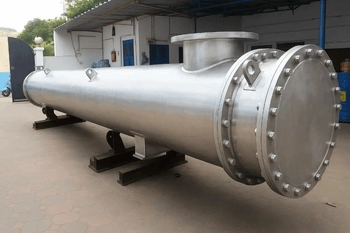
The surface condenser is the most widely used steam condenser in the world — found in virtually every large thermal power plant, nuclear power station, geothermal plant, and industrial steam turbine installation. It is a shell-and-tube heat exchanger, where cooling water flows through the tube side (inside the tubes) and exhaust steam condenses on the shell side (outside the tubes). The two fluid streams never mix — steam and condensate remain entirely separate from the cooling water circuit.
How it works in detail:
Exhaust steam enters the large-bore top or side inlet nozzle and is distributed across the tube bundle by a steam dome or distribution plate. The tubes are typically arranged in a circular bundle supported by transverse support plates to prevent vibration and maintain tube spacing. As steam contacts the cooled outer tube surface, latent heat is removed, and condensate film forms and drains by gravity to the hotwell at the shell base. Cooling water flows in a single or multi-pass arrangement through the tube interiors, entering cold and exiting heated by typically 8–15°C. The entire shell is maintained at vacuum (typically 0.05–0.15 bar absolute) by a steam jet ejector or liquid-ring vacuum pump system.
- Condensate quality: Produces pure demineralized condensate — directly reusable as boiler feedwater with no contamination from cooling water
- Vacuum capability: Can achieve and maintain very deep vacuum — down to 0.05 bar absolute — maximizing turbine efficiency
- Capacity range: From small 1 MW industrial turbines to 1,000+ MW utility power units — the design scales across the full range
- Orientation: Predominantly horizontal for large power plant service; vertical designs used in space-constrained installations
- Air removal: Dedicated air cooling sections (ACZ) in the tube bundle concentrate non-condensable gases for efficient extraction by the vacuum system
- Standards: Designed to HEI Standards for Steam Surface Condensers, ASME Section VIII, and TEMA — the most comprehensively governed condenser type
▿ Jet Condenser (Mixing / Contact Type)
A jet condenser — also called a contact condenser or mixing condenser — condenses exhaust steam by bringing it into direct physical contact with a jet or spray of subcooled cooling water injected into the condenser vessel. There is no separating surface between steam and water — the two mix in the same chamber. Condensation occurs by direct mass and heat transfer between the steam and the water spray droplets, making it extremely rapid and efficient from a thermal contact standpoint.
How it works in detail:
Exhaust steam enters the condenser body from the turbine exhaust. Inside the condenser, cooling water is injected through spray nozzles or a perforated pipe header, creating a fine curtain of water droplets that the steam must pass through. The steam condenses almost instantaneously on contact with the subcooled water droplets. The resulting mixture of condensate and cooling water collects at the base and is extracted by a pump. Because steam and cooling water mix, the condensate cannot be reused directly as boiler feedwater unless extensive treatment is applied.
- Parallel flow type: Steam and cooling water travel in the same direction — simpler design but slightly lower thermal efficiency
- Counter flow type: Steam and water travel in opposite directions — higher contact efficiency and better heat transfer
- Jet and flood type: Uses both water jets and a flooding mechanism to maximize steam-water contact at peak loads
- Low capital cost: No tube bundle, no tube sheets, no baffle system — vessel is simple and inexpensive to fabricate
- Condensate contamination: Mixed condensate and cooling water cannot be returned directly to the boiler — the primary disadvantage versus surface type
- Applications: Small industrial steam engines, geothermal power plants (where brine-contaminated steam already precludes reuse), sugar mills, pulp and paper plants, and any application where condensate recovery is not required
▿ Barometric Condenser
A barometric condenser is a specialized jet-type condenser in which the mixed condensate and cooling water drain by gravity through a tall vertical pipe (the barometric leg or tailpipe) to a hot well located at ground level, eliminating the need for a condensate extraction pump. The operating principle exploits the atmospheric pressure — water can be supported in a column up to approximately 10.3 meters by atmospheric pressure acting on the hotwell surface, which is open to atmosphere. The condenser body is elevated to this height or above, allowing vacuum in the condenser shell to be balanced by the water column in the leg below it.
How it works in detail:
Cooling water is injected into the barometric condenser vessel at elevation through spray nozzles, contacting and condensing the inlet steam. The mixture of condensate and cooling water flows downward through the barometric leg (typically 10–11 meters long) to the hotwell at the base. The vacuum in the condenser shell is maintained partly by the condensation process and partly by the hydraulic head of the water column in the leg — which acts like a water-sealed vacuum trap. No pump is needed to extract water from the condenser shell because the water falls under gravity.
- Self-draining by gravity: No condensate extraction pump required inside the vacuum zone — eliminates a critical piece of rotating equipment operating under vacuum
- Structural requirement: The condenser vessel must be elevated 10–11 meters above the hotwell — requires a substantial steel support structure or building height
- Vacuum limitation: Back pressure is limited by the length of the barometric leg and coolant temperature — typically 0.08 to 0.15 bar absolute
- Condensate not reusable: Steam and cooling water mix — condensate cannot be directly returned to the boiler feedwater system
- Applications: Sugar refineries, evaporation systems, chemical process vacuum evaporators, paper mills, and industries where steam exhaust is already contaminated and condensate recovery is not required
▿ Evaporative Condenser
An evaporative condenser combines the functions of a condenser and a cooling tower in a single unit. Steam (or hot process fluid) flows through a coil or tube bundle, and a spray of water is applied over the outside of the tubes while a fan draws or forces ambient air across the wetted surface. Heat is removed from the steam primarily by the evaporation of the spray water — the latent heat of evaporation of water (approximately 2,450 kJ/kg) does the cooling work, rather than a temperature rise of the cooling water as in a conventional surface condenser.
How it works in detail:
Steam enters the internal tube bundle. Spray nozzles uniformly wet the tube exterior surfaces with a film of recirculated water. A fan system passes ambient air upward or downward across the wetted tube surfaces. Water evaporating from the tube surface absorbs latent heat and carries it away in the air stream — cooling the tube outer surface and thereby condensing steam inside the tubes. The small fraction of spray water that evaporates is replenished from a makeup water supply. The condensate (from inside the tubes) and the recirculated spray water (outside) remain separate circuits — so condensate quality is maintained.
- Water efficiency: Uses approximately 75–80% less make-up water than a conventional cooling-tower-plus-surface-condenser arrangement for the same heat rejection duty
- Compact footprint: Condenser and cooling tower functions combined in one unit — significantly reduces plot area versus separate equipment
- Condensate purity maintained: Steam and spray water remain separated by the tube wall — condensate quality is not compromised
- Capacity limitation: Most practical for small-to-medium steam loads; large power plant duties (100+ MW) are typically served more economically by conventional cooling towers
- Wet bulb dependent: Performance is sensitive to ambient wet-bulb temperature — must be sized for summer peak conditions
- Applications: Refrigeration plants, small industrial steam turbines, process cooling in water-scarce regions, ammonia condensers, chemical plant steam condensing duties up to approximately 5–20 MW thermal
▿ Air-Cooled Steam Condenser (ACC)
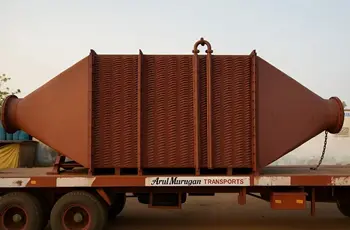
An air-cooled condenser (ACC) eliminates cooling water entirely — using ambient air drawn by large axial fans across finned tube bundles through which exhaust steam flows directly. Steam from the turbine exhaust is piped to an overhead duct system that distributes it into the individual finned tube bundles (typically arranged in an A-frame or delta configuration), where it condenses and drains as condensate back to the hotwell at ground level.
How it works in detail:
Exhaust steam travels from the turbine through a large-bore steam duct to the top distribution header of the ACC structure. Steam flows down through the finned tubes of each cell, transferring its latent heat through the finned tube wall to ambient air blown upward (or drawn through) by the fans mounted below each cell. Condensate drains by gravity to a collection header and then to the hotwell. Each ACC cell consists of one or more fans (typically 7–9 meters diameter), a heat exchanger bundle of finned tubes, and structural framework. A large power plant ACC may have 50–150 individual fan cells arranged in multiple rows.
- Zero cooling water consumption: No cooling tower, no circulating water system, no water treatment — eliminates the largest operational water consumer at a thermal power plant
- Ideal for arid and water-scarce locations: Enables power plant siting in deserts, mountains, and regions without access to sufficient cooling water
- Condensate recovery: Full condensate recovery — the water balance of the plant is not affected by the cooling medium
- Higher back pressure than water-cooled: Limited by ambient air temperature — cannot achieve the deep vacuum of a water-cooled surface condenser; back pressure rises significantly in summer
- Large plot area: ACC structures are very large — a 600 MW plant ACC may cover 10,000–20,000 m²
- Designed to API 661 for petroleum and petrochemical applications; power plant ACCs to IEC/ISO standards
- Applications: Coal, gas, and nuclear power plants in water-stressed regions; mine-mouth power stations; remote power generation; concentrated solar power (CSP) plants; geothermal plants
▿ Plate-Type Steam Condenser
A plate-type steam condenser uses a stack of corrugated metal plates — identical in construction to a plate heat exchanger — to condense steam on alternating plate channels while cooling water flows in the intermediate channels on the opposing side. The corrugated plate geometry creates highly turbulent flow conditions, delivering heat transfer coefficients 3–5 times higher than equivalent shell-and-tube designs — in a fraction of the footprint.
How it works in detail:
Steam enters the plate pack through a dedicated port and is distributed into alternating channels between the plates. Cooling water flows counter-currently in the adjacent channels. The high turbulence induced by the corrugated plate geometry dramatically thins the condensate film on the steam side and increases the convective coefficient on the water side, producing an overall heat transfer coefficient significantly higher than shell-and-tube designs. Condensate drains from the bottom of the plate pack and is collected in a sump or returned to the condensate system.
- Compact size: 3–5× smaller footprint than an equivalent shell-and-tube condenser — ideal for retrofits, space-constrained plants, and modular installations
- High efficiency: Excellent heat transfer performance; close temperature approaches achievable due to counter-current arrangement
- Easily expandable: Capacity can be increased by adding plates to the existing frame — no new unit required
- Pressure limitations: Gasketed plate designs typically limited to <25 bar and <180°C — not suitable for high-pressure steam applications
- Gasket compatibility: Gasket material must be selected for compatibility with steam and condensate — EPDM or PTFE typically specified for steam service
- Applications: Small industrial steam turbines, district heating condensers, process steam condensing in pharmaceutical and food plants, cogeneration systems, geothermal binary cycle condensers
▿ Steam Jet Ejector Condenser (Inter-Condenser / After-Condenser)
A steam jet ejector condenser — also called an inter-condenser or after-condenser — is a specialized condenser installed within the vacuum system itself, not on the turbine exhaust. In a multi-stage steam jet ejector system (used to create and maintain the main condenser vacuum), small shell-and-tube condensers are placed between ejector stages (inter-condensers) and after the final stage (after-condenser) to condense the motive steam used by each ejector. This recovers the ejector steam as condensate and dramatically reduces the quantity of steam — and therefore energy — that the ejector system consumes overall.
How it works in detail:
Each ejector stage uses high-pressure motive steam to entrain and compress the non-condensable gases extracted from the main condenser. After each stage, the mixed stream of motive steam and gases enters the inter-condenser shell side. Cooling water flowing through the tube side condenses the motive steam, leaving only the non-condensable gases (plus a small amount of vapor at the new, higher pressure) to pass on to the next ejector stage. By removing the bulk of the motive steam between stages, each subsequent ejector stage handles a much smaller volumetric flow — reducing total steam consumption by 60–75% compared to a system with no inter-condensers.
- Energy recovery: Condensing motive steam between ejector stages reduces overall vacuum system steam consumption by 60–75%
- Compact design: Small shell-and-tube units designed specifically for the lower duty of inter-stage condensing
- Critical to vacuum performance: Fouled or undersized inter-condensers directly degrade vacuum system performance — a common and overlooked cause of vacuum loss in ageing plants
- Condensate quality: Inter-condenser and after-condenser condensate is of high purity — typically returned directly to the main condenser hotwell or deaerator
- Applications: All surface condenser vacuum systems using steam jet ejectors — power plants, refineries, pharmaceutical plants, chemical process vacuum systems, paper mills, and any process maintaining vacuum with steam ejectors
Need a Steam Condenser for Your Plant?
From surface condensers for large power plants to compact plate-type units for cogeneration systems — United Heat Exchangers designs and fabricates every type to ASME, HEI, TEMA, and API standards. Share your steam flow and site conditions and we will size the right unit in 48 hours.
Request My Free Quote →Steam Condenser Types — Side-by-Side Comparison
Use this reference table to quickly identify which condenser type best matches your operating requirements, site constraints, and condensate recovery needs.
| Type | Steam-Coolant Contact | Condensate Recovery | Vacuum Achievable | Water Consumption | Capital Cost | Best Application |
|---|---|---|---|---|---|---|
| Surface (Shell & Tube) | Separated — tube wall | Yes — full purity | Very deep (0.05 bar abs) | High (cooling water) | High | Power plants, industrial turbines |
| Jet (Mixing) | Direct mixing | No — mixed with cooling water | Moderate (0.08–0.15 bar abs) | High (injection water) | Low | Geothermal, sugar mills, small engines |
| Barometric | Direct mixing | No — mixed | Moderate (0.08–0.15 bar abs) | High (injection water) | Low–Medium | Sugar refineries, evaporators, paper mills |
| Evaporative | Separated — tube wall | Yes — pure | Moderate (0.10–0.20 bar abs) | Very low (evaporation only) | Medium | Water-scarce sites, small-medium loads |
| Air-Cooled (ACC) | Separated — tube wall | Yes — pure | Low–Moderate (0.10–0.40 bar abs) | Zero | Very High | Arid regions, zero-liquid-discharge plants |
| Plate-Type | Separated — plate wall | Yes — pure | Moderate (limited by gasket pressure) | Moderate (cooling water) | Medium | Small turbines, cogeneration, retrofits |
| Ejector Inter/After-Condenser | Separated — tube wall | Yes — high purity | N/A — supports main vacuum system | Low (small cooling duty) | Low | Steam ejector vacuum systems in all industries |
Design and Construction
The design of a steam condenser — particularly the dominant surface condenser type — involves detailed thermal, hydraulic, and mechanical engineering to ensure performance, reliability, and compliance with applicable codes over a 25–40 year service life.
Key Design Parameters
| Parameter | Typical Range | Design Significance |
|---|---|---|
| Steam inlet flow rate | 1 t/h to 5,000+ t/h | Sets the condenser heat duty and determines shell diameter and tube bundle size |
| Steam inlet pressure (back pressure) | 0.05 – 0.15 bar abs (surface condensers) | Determines the saturation temperature at which steam condenses and sets the driving temperature difference for heat transfer |
| Cooling water inlet temperature | 15 – 35°C | The single most critical external factor — sets the minimum achievable condensing temperature and therefore the minimum achievable vacuum |
| Cooling water temperature rise (ΔT) | 8 – 15°C | Determines cooling water flow rate required — larger ΔT means less water flow but higher outlet temperature |
| Terminal temperature difference (TTD) | 3 – 8°C | The difference between cooling water outlet temperature and steam saturation temperature — lower TTD means more surface area but better vacuum; specified per HEI standard |
| Tube material and gauge | 18–20 BWG (0.9–1.2 mm) | Governs heat transfer resistance, corrosion allowance, and tube life — HEI specifies minimum gauges per material and cooling water type |
| HEI cleanliness factor | 75 – 85% | Accounts for tube fouling over service life — the condenser must meet rated performance at the cleanliness factor specified, not just on clean-tube conditions |
Structural Features of a Surface Condenser
- Steam dome / inlet duct: Large-bore inlet section with internal distribution structure ensures uniform steam velocity across the full tube bundle cross-section, preventing local high-velocity impingement that causes tube erosion and vibration
- Tube bundle arrangement: Tubes arranged in concentric or rectangular arrays on support plates spaced to control unsupported tube spans and prevent flow-induced vibration — a primary cause of tube failures in condensers
- Air cooling zone (ACZ): A dedicated section of the tube bundle, baffled off from the main steam space, where non-condensable gases concentrate and are continuously extracted by the vacuum system — prevents air blanketing of the main bundle
- Hotwell: The condensate collection sump at the base of the condenser — sized to provide 1–3 minutes of storage at full load condensate flow, acting as a buffer between the condenser and the condensate extraction pump
- Expansion joints: Bellows-type expansion joints on the steam inlet duct and condenser neck accommodate differential thermal expansion between the hot turbine exhaust and the cold condenser shell operating under vacuum
- Support system: Condenser is spring-mounted under the turbine exhaust nozzle to allow free thermal expansion of both turbine and condenser without imposing large nozzle loads on either
Vacuum System and Air Removal
The vacuum system is inseparable from the steam condenser — it creates the initial vacuum during startup (hogging) and maintains it against continuous air infiltration and non-condensable gas evolution during operation (holding). Without a well-functioning vacuum system, condenser performance collapses regardless of how well the heat exchanger itself is designed.
Hogging vs. Holding Duty
Removing the large volume of air from the condenser shell at startup to establish vacuum. Requires high volumetric capacity — typically handled by a motor-driven vacuum pump or large hogging ejector. Duration: 15–30 minutes for most power plant condensers.
Continuously extracting air and non-condensable that infiltrate through seals, joints, and valve glands during normal operation. Relatively small mass flow — typically 2–5 kg/h of air per 100 MW of condenser duty. Handled by the main ejector or vacuum pump in continuous service.
Vacuum System Equipment Types
- Steam jet ejectors (SJE): Use high-pressure motive steam to entrain and compress non-condensable — no moving parts, extremely reliable, lowest maintenance; 2-stage systems with inter and after-condensers are standard for power plant service
- Liquid-ring vacuum pumps (LRVP): Motor-driven pumps using a rotating liquid ring as the compression medium; no inter-condensers required; preferred where motive steam is not available or where steam economy is critical
- Hybrid ejector-LRVP systems: A steam ejector handles the high-vacuum portion (below 0.1 bar abs) where ejectors are most efficient; an LRVP handles the moderate vacuum range where it is more economical — combining the strengths of both technologies
⚠ Critical maintenance note: Air infiltration is the most common cause of condenser vacuum loss in operating plants. A leak of only 1 kg/h of air into a condenser can raise back pressure by 2–5 mbar and reduce turbine output by 0.5–2 MW. Regular leak testing using helium leak detectors or ultrasonic instruments at every planned outage is essential to maintaining rated vacuum performance.
Materials and Construction Standards
Material selection for steam condensers is primarily driven by the cooling water type — the most corrosive stream in the system. The steam and condensate side is relatively benign (clean water and water vapor) unless oxygen, carbon dioxide, or ammonia are present. The cooling water circuit, however, can range from clean demineralized water to aggressive seawater, and the tube material must be selected accordingly.
| Component | Fresh Water Cooling | Brackish / River Water | Seawater Cooling |
|---|---|---|---|
| Tubes | Carbon steel SA-179; SS 304/316L | Admiralty brass (C44300); SS 316L | Titanium Gr. 2 (ASTM B338); Cu-Ni 90/10 (C70600) |
| Tube Sheets | Carbon steel SA-516; naval brass clad | Carbon steel with brass or SS cladding | Titanium clad steel; mounts metal; naval brass |
| Shell | Carbon steel SA-516 Gr. 70 | Carbon steel SA-516 Gr. 70 | Carbon steel SA-516 (steam side — no seawater contact) |
| Water boxes | Carbon steel, rubber-lined | Carbon steel, rubber-lined or epoxy-coated | Rubber-lined carbon steel; fiberglass (GRP); naval brass; titanium |
| Hotwell | Carbon steel, stainless steel lining optional | Carbon steel with stainless lining | Stainless steel 316L lining (steam condensate in contact) |
HEI Minimum Tube Gauge Requirements
The Heat Exchange Institute (HEI) Standards for Steam Surface Condensers specify minimum tube wall thickness (gauge) based on tube material, tube outer diameter, and the nature of the cooling water service. HEI also defines cleanliness factors, air removal system sizing, and performance test procedures — making it the definitive design reference for surface condenser construction worldwide.
Fabrication and Inspection
- ASME BPVC Section VIII Div. 1 or 2 — all pressure-containing components designed, fabricated, and U-Stamped
- ASME Section IX — all pressure weld procedures and welder qualifications
- Tube-to-tubesheet joints — roller expanded plus strength welded for maximum joint integrity and leak resistance under vacuum cycling
- Hydrostatic testing — shell side and tube side tested independently to 1.5× design pressure before shipment
- Helium leak testing — tube bundle leak tested to confirm vacuum integrity of all tube-to-tubesheet joints
- Non-destructive examination — all pressure welds examined per ASME Section V requirements; radiographic and ultrasonic testing as specified
Industrial Applications of Steam Condensers
Steam condensers are essential thermal equipment in any industry that generates, uses, or exhausts steam. Below is a full industry reference covering the primary applications and the condenser type most commonly specified.
| Industry | Application | Typical Condenser Type | Key Requirement |
|---|---|---|---|
| Thermal Power Generation | Coal, gas, and oil-fired steam turbine exhaust condensing | Surface condenser (shell & tube) | Deep vacuum (0.05–0.10 bar abs); full condensate recovery; HEI compliance |
| Nuclear Power | Low-pressure turbine exhaust condensing in secondary circuit | Large surface condenser, titanium tubes | High condensate purity; very large steam flows; nuclear-grade quality documentation |
| Concentrated Solar Power (CSP) | Steam turbine exhaust condensing in parabolic trough and tower plants | Air-cooled condenser (ACC) or surface condenser | ACC preferred — solar plants located in arid high-irradiance regions with no water availability |
| Geothermal Power | Steam turbine exhaust from geothermal brine-steam separators | Direct contact / jet condenser; surface condenser for binary cycle | Steam may contain H₂S and dissolved solids — direct contact acceptable as condensate is not reused |
| Oil & Gas Refineries | Turbine driver exhaust condensing; vacuum column overhead condensing | Surface condenser; ejector inter/after-condensers | API 660 compliance; vacuum maintenance for column operation; condensate return to boiler |
| ⚙ Cogeneration (CHP) | Back-pressure turbine or extraction-condensing turbine exhaust | Surface condenser or plate-type condenser | Condensate recovery to maximize cycle efficiency; integration with district heating or process heat |
| Sugar Industry | Multiple-effect evaporator vapor condensing; mill exhaust steam | Barometric condenser; jet condenser | Low capital cost; large vapor volumes; condensate reuse not critical in direct-injection condensers |
| Chemical Processing | Reactor vessel vent condensing; vacuum column overhead condensing; distillation reflux condensing | Surface condenser; plate-type; ejector inter-condenser | Material compatibility with overhead vapor chemistry; full condensate recovery |
| Pharmaceutical Manufacturing | Clean steam condensing; WFI (water for injection) production; solvent recovery stills | Plate-type; small surface condenser — SS 316L construction | cGMP compliance; full condensate purity; electropolished internal surfaces; FDA-approved gaskets |
| District Heating | Extraction steam condensing for network heat supply | Plate-type; surface condenser | Variable steam load following; close temperature approach to maximize heat delivery to network |
Steam Condensers for Every Industry and Every Scale
United Heat Exchangers designs and manufactures all types of steam condensers — from small pharmaceutical plate-type units to large power plant surface condensers — backed by full ASME certification, HEI compliance, and 25+ years of thermal engineering experience.
Talk to Our Engineers Today →How to Select the Right Steam Condenser
The right condenser type for your application depends on five critical factors. Work through these questions systematically to arrive at the best technical and economic choice.
Question 1 — Is Condensate Recovery Required?
- Yes — condensate must be returned to the boiler feedwater system → Surface condenser, air-cooled condenser, evaporative condenser, or plate-type condenser. All maintain separation between steam and cooling medium.
- No — condensate is discharged (geothermal, contaminated steam, once-through cooling) → Jet condenser or barometric condenser are acceptable — lower capital cost and simpler operation.
Question 2 — How Deep a Vacuum Is Required?
- Deep vacuum (0.05–0.10 bar abs) for maximum turbine efficiency → Water-cooled surface condenser with low cooling water inlet temperature — the deepest vacuum achievable in practice
- Moderate vacuum (0.10–0.20 bar abs) acceptable → Evaporative condenser, plate-type condenser, or air-cooled condenser in a temperate climate
- Vacuum only needed for process (not turbine efficiency) → Jet or barometric condenser may be adequate and most economical
Question 3 — Is Cooling Water Available?
- Ample fresh water or seawater available → Water-cooled surface condenser — lowest capital cost, deepest vacuum, best thermal performance
- Limited water availability (arid region, water cost is high) → Evaporative condenser (for small-medium loads) or air-cooled condenser (for large loads)
- No water available at all (desert, remote site) → Air-cooled condenser (ACC) — the only viable option; accept higher back pressure and corresponding turbine output reduction
Question 4 — What Is the Steam Load and Duty?
- Large power plant (50 MW+) → Horizontal shell-and-tube surface condenser — scalable, maintainable, designed to HEI standard; or ACC for water-scarce sites
- Small industrial turbine (1–20 MW) → Plate-type condenser or vertical surface condenser — compact, lower capital cost, suitable for factory or plant building installation
- Process vacuum duty (not turbine exhaust) → Ejector inter/after-condensers + jet or barometric condenser — sized for ejector system steam flows, not full turbine exhaust
Question 5 — What Are the Cooling Water Characteristics?
- Clean fresh water (river, tower) → Carbon steel or stainless steel tubes — economical and long-lived in clean water service
- Brackish or estuarine water → Admiralty brass or 316L stainless steel tubes — resists intermediate chloride levels
- Seawater cooling → Titanium Grade 2 or Cu-Ni 90/10 tubes — essential for long service life against seawater corrosion; rubber-lined water boxes standard
- High fouling cooling water → Specify removable water box covers for easy tube-end access; add 25–30% surface area fouling margin; consider automatic tube cleaning (sponge ball) system
Design tip: Always specify the condenser performance at both summer peak conditions (highest ambient or cooling water temperature) and design point conditions. A condenser correctly sized for winter operation will frequently constrain turbine output on the hottest days of the year — when electricity demand and value are often at their peak.
Performance, Losses and Troubleshooting
Condenser performance degradation directly reduces turbine power output and plant heat rate. Most problems are detectable early through careful monitoring of a small set of key parameters.
| Symptom | Most Likely Cause | How to Diagnose | Corrective Action |
|---|---|---|---|
| Vacuum rising (pressure increasing) at constant load | Air in-leakage into the vacuum system or condenser shell | Measure air extraction rate from vacuum pump/ejector; perform helium leak test on all joints, seals, valve packing | Identify and seal leaks; replace worn shaft seals and valve glands; check expansion joint integrity |
| Vacuum high but TTD increasing | Tube fouling — scale or biological deposits reducing heat transfer coefficient | Calculate current overall heat transfer coefficient U; compare to clean baseline; estimate fouling resistance Rf | Schedule tube cleaning — high-pressure water lance or chemical circulation; review cooling water treatment |
| Cooling water outlet temperature too high | Reduced cooling water flow rate — pump degradation, valve partially closed, tube blockage | Measure cooling water flow rate; compare to design; check pump performance curve | Restore cooling water flow; check for tube-side plugging or blockage at water box inlet screens |
| High dissolved oxygen (DO) in condensate | Air infiltration through hotwell, condensate pump seals, or condenser shell leaks | Trace DO peaks to specific operating conditions or equipment changes; check pump mechanical seals | Seal air ingress points; check pump seal water system; verify nitrogen blanketing of hotwell if specified |
| Tube leaks (cooling water in condensate) | Corrosion pitting, erosion-corrosion at tube inlets, vibration fatigue at support plate contacts | Monitor condensate conductivity; perform in-service eddy current test on suspect tubes; hydrostatic test of tube bundle | Plug failed tubes immediately (up to 10% without performance impact); plan retubing; review tube material specification for the cooling water chemistry |
| Ejector / vacuum pump overcapacity — can't hold vacuum | Fouled inter/after-condensers reducing ejector capacity; motive steam pressure low; vacuum pump wear | Measure inter-condenser outlet temperature and pressure; compare ejector performance to rated curves at actual motive steam conditions | Clean inter/after-condenser tubes; verify motive steam pressure and quality; service or replace vacuum pump internals |
Maintenance Best Practices
Continuous / Daily Monitoring
- Monitor condenser back pressure (absolute) and compare to baseline at current cooling water temperature — rising back pressure at constant coolant temperature is the first sign of performance degradation
- Track cooling water inlet and outlet temperature and flow rate — deviations from design directly explain changes in vacuum
- Monitor condensate dissolved oxygen (DO) level — rising DO indicates air infiltration into the vacuum system or hotwell
- Check condensate conductivity daily — any rise indicates tube leakage and cooling water contamination of feedwater
- Verify vacuum pump or ejector performance indicators — steam consumption for ejectors; power draw and discharge pressure for vacuum pumps
Scheduled Cleaning (Based on Fouling Rate)
- Clean fresh water service: Tube-side cleaning every 12–24 months; high-pressure water lance to remove scale and biological deposits
- River or brackish water service: Tube-side cleaning every 6–12 months; biocide treatment regime to control microbiological fouling between cleanings
- Seawater service: Tube-side cleaning every 3–6 months; anti-fouling treatment or automatic tube cleaning system (ATCS / sponge ball system) to minimize biofouling
- Shell-side cleaning: Remove oil and iron oxide deposits from steam side at each major outage using chemical cleaning; inspect for under-deposit corrosion
Outage / Turnaround Inspection
- Eddy current or IRIS tube inspection — full bundle or statistical sample to detect wall thinning, pitting, and cracks; replace tubes below 75–80% wall remaining
- Inspect tube sheet faces and tube-to-tubesheet joints for corrosion and joint failures; re-roll expanded joints that show signs of loosening
- Inspect steam inlet duct, expansion bellows, and steam dome for erosion and fatigue cracking
- Pressure test shell side and tube side independently before returning to service
- Perform full helium leak test of all shell nozzles, joints, and expansion bellows — document all leak points and repair before startup
- Inspect and service all vacuum pump mechanical seals, ejector nozzles and diffusers, and inter/after-condenser tubes
- Replace all gaskets at flanged joints opened during the outage — never re-use compression gaskets
Standards and Codes
United Heat Exchangers designs and fabricates steam condensers in full compliance with all applicable international and domestic codes. All certifications are current and maintained under ISO 9001:2015 quality management.
| Code / Standard | Issuing Body | Scope & Application |
|---|---|---|
| ASME BPVC Section VIII Div. 1 & 2 | ASME | All pressure vessel design, fabrication, inspection, and U-Stamp certification — mandatory for all pressure-containing condenser components |
| ASME BPVC Section IX | ASME | Welding procedure and welder performance qualification for all pressure welds |
| HEI Standards for Steam Surface Condensers | Heat Exchange Institute | Tube material and gauge selection, cleanliness factors, air removal system sizing, performance test procedures — the definitive standard for surface condenser design and rating |
| TEMA Class R / B / C | TEMA | Shell-and-tube construction tolerances, tube bundle design practices, and minimum thickness requirements for ejector inter/after-condensers and industrial surface condensers |
| API 660 | American Petroleum Institute | Enhanced specification for shell-and-tube heat exchangers (including condensers) in petroleum, petrochemical, and natural gas industries — applied over TEMA and ASME |
| API 661 | American Petroleum Institute | Air-cooled heat exchangers (including air-cooled steam condensers) for petroleum, petrochemical, and natural gas industries |
| ASME B31.1 Power Piping | ASME | Design of steam inlet ducts, turbine exhaust connections, condensate lines, and cooling water piping connected to the condenser |
| HEI Standards for Steam Jet Ejectors | Heat Exchange Institute | Sizing, performance rating, material selection, and testing of steam jet ejectors and associated inter/after-condensers used in the vacuum system |
| NACE MR0175 / ISO 15156 | NACE International / ISO | Material qualification for sour service (H₂S) environments — applies to condensers in oil refineries and gas plants where H₂S may be present in the steam or condensate |
| PED 2014/68/EU / IS 2825 | EU / Bureau of Indian Standards | European Pressure Equipment Directive and Indian Standard for pressure vessels — available for international and domestic export project compliance |
| ISO 9001:2015 | ISO | Quality management system governing all engineering, procurement, fabrication, inspection, testing, and documentation processes |
Why Choose United Heat Exchangers for Your Steam Condenser?
- 25+ years of manufacturing experience — steam condensers delivered to power plants, refineries, chemical plants, pharmaceutical facilities, cogeneration systems, and sugar mills across India and internationally
- All condenser types available: Surface (shell & tube), jet, barometric, evaporative, air-cooled, plate-type, and ejector inter/after-condensers — engineered and fabricated in-house
- ASME U-Stamp & R-Stamp certified fabrication with full code documentation package for regulatory, insurance, and owner compliance
- HEI Standards compliance — performance design and rating to the internationally recognized standard for steam surface condensers
- TEMA Class R, B, and C capability — matching the construction standard to service severity and project specification requirements
- API 660 and API 661 licensed for petroleum, petrochemical, and gas industry condenser applications
- In-house thermal and mechanical design using HTRI, HTFS, and ASPEN EDR software — complete thermal performance guarantee with every unit supplied
- Full vacuum system engineering: Steam jet ejectors, inter/after-condensers, liquid-ring vacuum pumps, and hybrid systems designed and integrated with condenser supply
- Full material range: Carbon steel, stainless steel 304/316L, duplex, admiralty brass, copper-nickel 90/10 and 70/30, titanium Grade 2 — material selection engineering included with every quote
- Fast-track delivery: Standard designs in 4–8 weeks; large engineered power plant units in 12–20 weeks
- Lifetime technical support — OEM performance documentation, vacuum leak testing support, performance monitoring guidance, and troubleshooting throughout equipment life
- Free thermal feasibility study and budgetary quote within 48 hours of receiving your steam flow and site data
Frequently Asked Questions About Steam Condensers
1. What is a steam condenser and what does it do?
A steam condenser is a heat exchanger that converts exhaust steam from a turbine or industrial process back into liquid water (condensate) by removing its latent heat of vaporization and transferring it to a cooling medium. It performs two critical simultaneous functions: it creates a low-pressure vacuum at the turbine exhaust, increasing power output by 20–30%; and it recovers the condensate as high-quality demineralized water for reuse as boiler feedwater, eliminating the cost and waste of treating makeup water.
2. What are the main types of steam condensers?
The seven main types are: (1) Surface condenser — shell-and-tube; steam and cooling water separated by tubes; recovers pure condensate; most common in power plants. (2) Jet condenser — steam and cooling water mix directly; simple and inexpensive but condensate is not recoverable. (3) Barometric condenser — jet-type with a tall gravity-drain leg eliminating the extraction pump; used in sugar mills and evaporators. (4) Evaporative condenser — cools tube bundle by evaporation of spray water; saves 75–80% of cooling water. (5) Air-cooled condenser (ACC) — uses ambient air; zero cooling water consumption; required for arid sites. (6) Plate-type condenser — compact corrugated plate design; 3–5× smaller than equivalent shell-and-tube. (7) Ejector inter/after-condenser — condenses ejector motive steam between stages; reduces vacuum system steam consumption by 60–75%.
3. Why is vacuum important in a steam condenser?
Vacuum in the condenser lowers the back pressure against which the turbine exhausts, allowing steam to expand to a much lower pressure and extract more work before it leaves the turbine. A typical steam turbine exhausting at 0.07 bar absolute (instead of 1 bar atmospheric) can produce 20–30% more power from the same steam — making the condenser vacuum one of the most impactful performance levers in the entire power cycle. Every 1 mbar rise in condenser back pressure typically costs 0.3–0.5 kW of turbine output per MW of installed capacity.
4. What is the difference between a surface condenser and a jet condenser?
In a surface condenser, steam and cooling water are completely separated by the tube wall — steam condenses on the tube outside, cooling water flows inside the tubes, and the condensate is recovered as pure water for boiler feedwater reuse. In a jet condenser, steam and cooling water mix directly in the condenser vessel — condensation is faster and the unit is mechanically simpler, but the condensate is contaminated with cooling water and cannot be returned to the boiler without full water treatment. Surface condensers are standard wherever feedwater recovery matters; jet condensers are acceptable where it does not.
5. What causes vacuum loss in a steam condenser?
The most common causes are: air in-leakage through shaft seals, flange joints, valve glands, or expansion bellows; inadequate vacuum pump or ejector capacity; rising cooling water temperature above design in summer; tube fouling reducing heat transfer; fouled inter/after-condensers degrading ejector performance; condenser flooding from high hotwell level; and air blanketing of tubes from accumulated non-condensable that the vent system cannot clear. Even a 1 kg/h air leak can raise back pressure by 2–5 mbar. Regular helium leak testing at every outage is the most effective preventive measure.
6. What tube material should I specify for a seawater-cooled condenser?
For seawater cooling, Titanium Grade 2 (ASTM B338) is the premium choice — it provides outstanding resistance to seawater corrosion and biofouling, and is specified for all critical and long-life applications. Copper-Nickel 90/10 (Cu-Ni, C70600) is the traditional seawater-cooled condenser tube and remains widely used — excellent resistance to biofouling and pitting at lower cost than titanium. Admiralty brass is only acceptable in low-velocity, low-chloride seawater applications. Water boxes for seawater service are rubber-lined or fiber-reinforced plastic (FRP/GRP) to prevent galvanic corrosion between the tube material and the water box structure.
7. What information is needed to get a steam condenser quote?
Provide: (1) Exhaust steam flow rate (kg/h or t/h), (2) Inlet steam conditions (pressure, temperature, quality or enthalpy), (3) Required back pressure or condensing temperature, (4) Cooling medium type (fresh water, seawater, air) and inlet temperature, (5) Available cooling medium flow rate or allowable temperature rise, (6) Site altitude (affects air-cooled condenser performance), (7) Condensate recovery requirement (yes / no), (8) Applicable design code and HEI class, (9) Expected number of operating cycles per year (for thermal fatigue analysis). Our engineers will complete the full thermal and mechanical design and deliver budgetary pricing within 48 hours.
8. Are United Heat Exchangers steam condensers ASME and HEI certified?
Yes. All steam condensers are designed, fabricated, inspected, and stamped per ASME Boiler & Pressure Vessel Code Section VIII Division 1 and 2. Performance design and rating comply with HEI Standards for Steam Surface Condensers. United Heat Exchangers holds current ASME U-Stamp and R-Stamp certifications and complies with TEMA, API 660 / 661, HEI steam ejector standards, NACE MR0175, PED 2014/68/EU, IS 2825, and other applicable international codes as required by each project specification.
Get Your Free Steam Condenser Quote in 48 Hours
Share your exhaust steam conditions, cooling medium, site location, and design code requirements — and our applications engineering team will recommend the right condenser type, size, material, and vacuum system configuration, backed by 25+ years of experience and full ASME and HEI certification.
Request My Free Quote →Author: Senthil Kumar, Technical Director — United Heat Exchangers Pvt. Ltd. | Last Updated: March 2026