Author: Senthil Kumar, Technical Director | Updated: September 2026
Table of Contents
- What Is a Reflux Condenser?
- The Purpose and Function of a Reflux Condenser in Distillation
- How a Reflux Condenser Works
- Reflux Condensation, Reflux Ratio and the Reflux Drum System
- Types of Reflux Condensers
- Reflux Condenser Design and Sizing
- Materials of Construction and Corrosion Resistance
- Design Standards and Codes
- Applications Across Industries
- Operation, Fouling, Maintenance and Troubleshooting
- Instrumentation, Control and Process Documentation
- Choosing a Reflux Condenser Manufacturer and Supplier
- Frequently Asked Questions
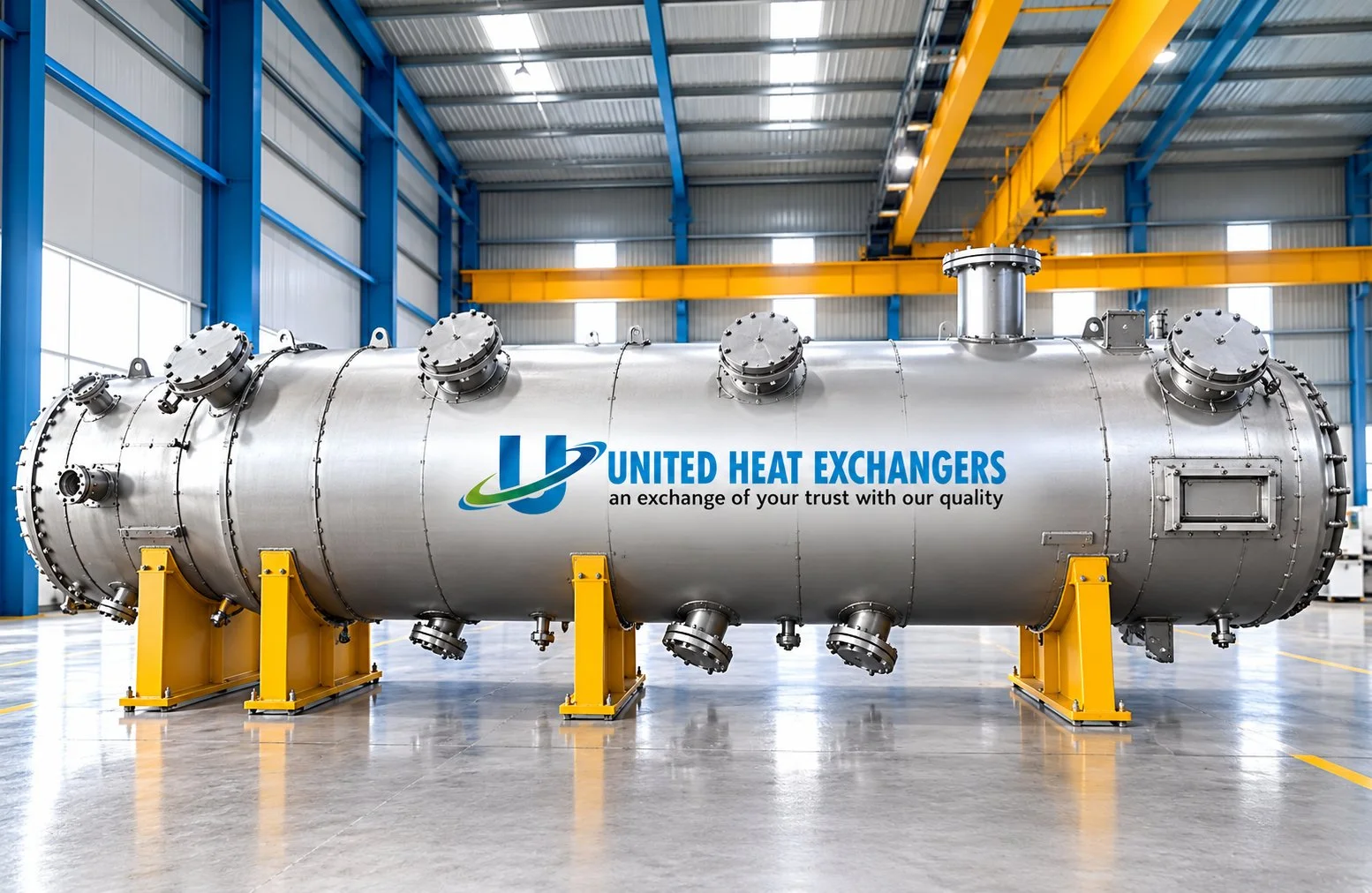
What Is a Reflux Condenser?
An industrial reflux condenser is a heat exchanger installed at the top of a distillation column that condenses vapour leaving the column back into liquid, so part of it can be returned — refluxed — to the column while the rest is withdrawn as overhead product. In a chemical plant, this is the single piece of equipment that lets a distillation column control separation purity rather than simply boiling everything off in one uncontrolled pass.What does a reflux condenser do, in practical terms? It removes exactly the amount of heat needed to condense a defined fraction of the overhead vapour, holding the column's separation efficiency steady even as feed composition or throughput drifts. United Heat Exchangers designs and manufactures reflux condensers — most commonly as shell and tube construction — to ASME Section VIII and TEMA for petrochemical, refinery, and chemical process clients across India and 30+ export markets.
The Purpose and Function of a Reflux Condenser in Distillation
The purpose of a reflux condenser goes beyond simple cooling — its real role is process control. Why is reflux important in a distillation column? Because the ratio of liquid returned to the column against product withdrawn (the reflux ratio) directly sets how sharply the column separates light and heavy components. A reflux condenser controls column reflux by adjusting how much of the overhead vapour it condenses and returns versus how much passes through as distillate.
The Difference Between Reflux and Condensation: Condensation is simply the phase change from vapour to liquid — it happens inside the exchanger tubes or plates. Reflux is what happens next: the deliberate decision to send some or all of that condensed liquid back into the column rather than drawing it off as product. A reflux condenser performs the condensation; the column's reflux ratio control system decides how the condensed liquid is split between reflux and distillate.
How a Reflux Condenser Works
The working principle of an industrial reflux condenser follows the same fundamentals as any shell and tube heat exchanger, applied to a specific overhead vapour duty.
Overhead Vapour Enters
Vapour leaves the top of the distillation column and enters the condenser shell or tube side, depending on orientation.
Cooling Medium Removes Heat
Cooling water or air flows across the heat transfer surface, absorbing the latent heat of condensation from the vapour.
Vapour Condenses to Liquid
As the vapour gives up its latent heat, it condenses — partially or totally, depending on the process design intent.
Condensate Collects in the Reflux Drum
Condensed liquid drains into a reflux drum, which acts as a surge vessel and split point for the stream.
Stream Splits — Reflux and Distillate
A pump or gravity feed returns the reflux fraction to the column top, while the remainder is drawn off as overhead product.
Reflux Condensation, Reflux Ratio and the Reflux Drum System
A complete reflux system in a distillation plant is made up of three connected parts working together: the reflux condenser itself (which performs reflux condensation — the phase change from vapour to liquid), the reflux drum (which buffers and separates the condensed stream), and the reflux ratio control loop (which sets how much liquid returns to the column versus how much leaves as distillate).
| Component | Function |
|---|---|
| Reflux Condenser | Condenses overhead vapour into liquid, removing the process heat duty |
| Reflux Drum | Buffers condensate flow and provides a stable liquid level for pump suction |
| Reflux Ratio Control | Sets the split between liquid returned to the column and liquid drawn off as product |
Design Tip: Condenser duty and reflux ratio are directly linked — increasing the reflux ratio to improve separation purity increases the vapour load the condenser must handle, which in turn increases the required heat transfer area. Reflux ratio should always be confirmed before condenser sizing begins, not treated as a variable to adjust after the unit is built.
Types of Reflux Condensers
Reflux condenser types are chosen against vapour load, available cooling medium, and plot space — not a single default configuration fits every column.
Shell and Tube Reflux Condenser
The standard configuration for process and refinery dutyVapour typically condenses on the shell side across a tube bundle carrying cooling water — the default shell and tube reflux condenser design for petrochemical and refinery overhead systems.
- Vertical or horizontal orientation depending on drainage and plot layout
- TEMA Class R or B mechanical design
Plate Reflux Condenser
Compact construction for smaller-duty columnsGasketed or welded plates give a high heat transfer coefficient in a small footprint, suited to lower-pressure, non-fouling overhead streams.
- Limited to moderate pressure and temperature versus shell and tube
- Compact alternative where plot space is constrained
Water Cooled Reflux Condenser
Highest heat transfer coefficient, requires cooling water supplyCooling water gives the closest approach temperature and smallest exchanger size for a given duty, at the cost of water consumption and treatment.
- Preferred where cooling water is available and inexpensive
- Standard choice for most refinery and petrochemical columns
Air Cooled Reflux Condenser
Zero water consumption, larger footprintFinned tube bundles reject heat directly to ambient air — the right choice for water-scarce sites, at the cost of a larger plot footprint and seasonal ambient sensitivity.
- No cooling water treatment or blowdown
- Performance varies with ambient dry-bulb temperature
Orientation is a design decision in its own right: a vertical reflux condenser drains condensate by gravity directly back toward the column, while a horizontal reflux condenser is often easier to support structurally and service in the field — the right configuration and orientation depend on your column's overhead piping layout.
Reflux Condenser Design and Sizing
Reflux condenser design and sizing calculation follows the same core heat exchanger engineering process as any shell and tube unit, with a few duty-specific checks layered on top.
Heat Duty Calculation
Reflux condenser heat duty (or heat load) is calculated from the vapour's latent heat of condensation plus any sensible desuperheating or subcooling required — this sets the total cooling capacity the unit must deliver.
LMTD and Overall U Value
The reflux condenser LMTD calculation and an assumed overall heat transfer coefficient (U value) together determine the required heat transfer area for the specified duty.
Tube Bundle and Area Sizing
Tube bundle design, tube diameter, and tube area calculation convert the required heat transfer area into an actual physical bundle layout and shell diameter.
Cooling Water Requirement
Cooling water flow rate and cooling water temperature rise are calculated from the heat duty, setting the utility demand the condenser will place on the plant's cooling water system.
Pressure Drop and Nozzle Sizing
Reflux condenser pressure drop on both the vapour and cooling-medium sides is checked against the column's available pressure budget, and nozzle size is set accordingly.
Design Pressure, Temperature and Service Rating
Design pressure and design temperature are set with appropriate margin above operating conditions, including checks for vacuum service, high-pressure service, or hazardous/hydrocarbon service classification.
Materials of Construction and Corrosion Resistance
Reflux condenser material selection follows the same logic as any heat exchanger: match the tube and shell metallurgy to the actual corrosivity of the overhead vapour and cooling medium, not a generic default.
| Material | Typical Fit |
|---|---|
| Carbon Steel Reflux Condenser | Non-corrosive hydrocarbon overhead streams and treated closed-loop cooling water |
| Stainless Steel Reflux Condenser | Corrosive or acid-bearing overhead vapour, pharmaceutical and fine chemical service |
| Duplex Stainless Steel Reflux Condenser | Chloride-bearing streams beyond standard stainless steel's practical limit |
| Titanium Reflux Condenser | Seawater-cooled condensers or highly chloride-aggressive overhead chemistry |
| Alloy Reflux Condenser (Hastelloy) | Mixed acid or highly corrosive solvent recovery overhead duty |
Design Standards and Codes
| Standard | Scope |
|---|---|
| ASME Section VIII | Pressure vessel design, wall thickness, weld NDT inspection, and hydrostatic testing for the condenser shell and tube pressure boundary |
| TEMA Class R | Refinery-severity mechanical design — tube pitch, baffle spacing, and bundle removal for demanding hydrocarbon service |
| TEMA Class B | Chemical process-severity mechanical design, applied where refinery-grade construction isn't required |
| API 660 | Complete shell and tube heat exchanger specification for refinery service, including reflux condenser applications |
Testing Note: Every reflux condenser should undergo hydrostatic testing and leak testing before dispatch, with NDT inspection (radiographic or ultrasonic) applied to pressure-boundary welds per the governing code and the specified quality inspection level.
Applications Across Industries
Reflux condensers for chemical processing, petrochemical plants, and refinery applications share the same underlying duty — controlling a distillation column's overhead — but the specific stream chemistry varies widely by sector.
A reflux condenser for solvent recovery, for example, typically runs at lower pressure and handles a different vapour composition than a refinery reflux condenser on a crude distillation overhead — which is exactly why condenser design should start from the actual process flow diagram (PFD) rather than a generic industrial condenser for reflux service.
Operation, Fouling, Maintenance and Troubleshooting
Reflux condenser performance degrades predictably over time if fouling and inspection aren't managed proactively.
Fouling and Scaling Prevention
Reflux condenser fouling — whether from cooling water scaling or process-side polymerisation — reduces the overall heat transfer coefficient and raises pressure drop over time. Cooling water treatment and periodic cleaning schedules manage this directly.
Inspection and Preventive Maintenance
Reflux condenser inspection at planned intervals catches tube leakage, corrosion, and early-stage fouling before they cause an unplanned shutdown — the core of any reliability-driven preventive maintenance programme.
Troubleshooting Low Performance
Reflux condenser troubleshooting for low performance typically starts with three checks: cooling water flow rate and temperature, fouling buildup on the heat transfer surface, and any shift in actual vapour load versus original design duty.
Tube Leakage and Failure Investigation
Reflux condenser tube failure is most often traced to corrosion at the tube-to-tubesheet joint or erosion at the vapour inlet — both are why material selection and inlet design deserve as much attention as bulk heat transfer sizing.
Instrumentation, Control and Process Documentation
A reflux condenser doesn't operate in isolation — it's tied into the column's temperature control system and pressure control system, with reflux ratio control instrumentation setting the split between reflux and distillate flow in real time. Every reflux condenser should be fully captured on the unit's PFD and P&ID (process flow diagram and piping and instrumentation diagram), with equipment specification and datasheet issued alongside the mechanical drawings so operations and maintenance teams have a single reference for the unit's design intent.
Choosing a Reflux Condenser Manufacturer and Supplier
Whether you're sourcing a custom reflux condenser for a new column or a replacement for an existing one, the same evaluation criteria apply to any reflux condenser manufacturer or reflux condenser supplier you're considering.
In-House Thermal and Mechanical Design
Reflux condenser engineering — heat duty calculation, LMTD, tube bundle design — should happen in-house, not through a subcontracted design step that can introduce errors against your process datasheet.
Code Compliance on File
Confirm ASME Section VIII and the applicable TEMA class or API 660 scope are current for the specific fabrication facility building your unit.
Replacement and Reverse-Engineering Capability
A reflux condenser replacement project often starts with only nameplate data or an old drawing — a capable fabrication company can size a like-for-like or upgraded-material unit from that alone.
Full Specification and Quotation Support
A reflux condenser specification sheet, technical datasheet, and formal quotation should be standard parts of the procurement process, not an afterthought.
Get a Free Reflux Condenser Quote
Send your column overhead vapour composition, flow rate, reflux ratio, and design pressure/temperature. We return an HTRI-sized thermal proposal and budgetary quote within 48 hours.
Request My Free Quote →Frequently Asked Questions
How do I select a reflux condenser for my distillation column?
Start from the column's overhead vapour composition, flow rate, required reflux ratio, and available cooling medium — these four inputs determine whether shell and tube or plate construction fits, and which material resists the actual stream chemistry.
How do I size a reflux condenser and calculate the required area?
Calculate the heat duty from the vapour's latent heat of condensation, determine the LMTD from the process and cooling-medium temperatures, assume or calculate an overall heat transfer coefficient, and divide duty by (U × LMTD) to get the required heat transfer area.
How do I calculate the cooling water requirement for a reflux condenser?
Divide the total heat duty by the cooling water's specific heat and the allowable temperature rise across the condenser — this gives the required mass flow rate, which then sets tube-side velocity and pressure drop.
How can I reduce fouling in a reflux condenser?
Control cooling water quality through proper treatment, maintain design velocity to discourage settling, and schedule periodic mechanical or chemical cleaning before fouling resistance meaningfully erodes the design margin.
How do I troubleshoot a reflux condenser that isn't performing?
Check cooling water flow rate and inlet temperature first, then inspect for fouling on the heat transfer surface, and finally confirm actual vapour load against the original design duty — a shift in any one of these three is the most common root cause.
What is the difference between a reflux condenser and a regular condenser?
Mechanically they can be identical heat exchangers. The distinction is functional: a reflux condenser is specifically positioned to return condensed liquid to a distillation column as reflux, rather than simply condensing a vapour stream for downstream use or disposal.
What is the typical cost of an industrial reflux condenser?
Cost depends on heat duty, material of construction, design pressure and temperature, and certification requirements — there's no fixed reflux condenser price without a real thermal design against your process datasheet. Share your specifications and we'll return a budgetary quotation.
Author: Senthil Kumar, Technical Director — United Heat Exchangers Pvt. Ltd. | Last Updated: September 2026