Author: United Heat Exchangers Engineering Team | Updated: July 2026 | Reading time: 11 min
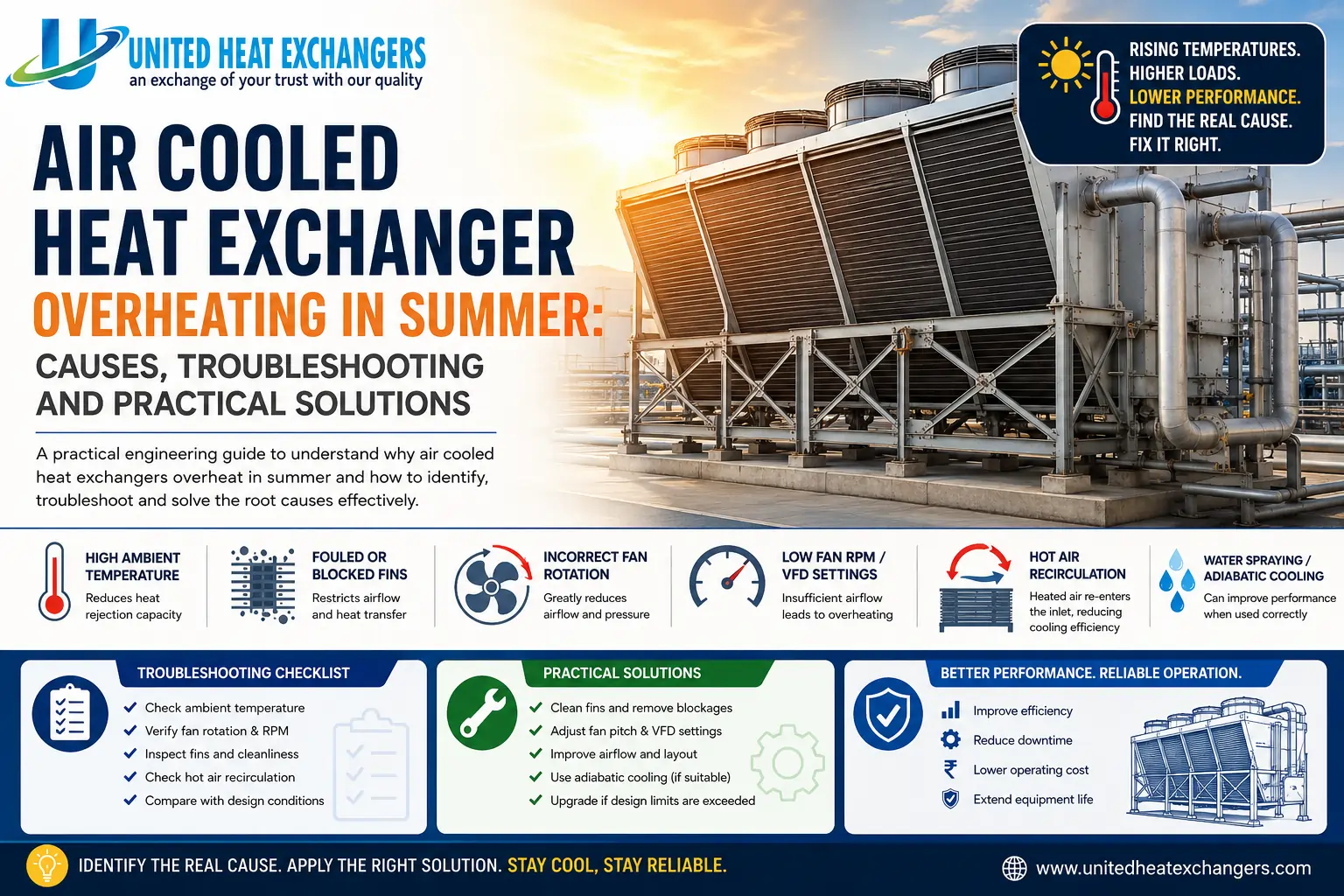
Summer is when air cooled heat exchangers earn their keep — and when they're most likely to fall short. Refineries, petrochemical plants, power facilities and chemical processing units all feel it: an ACHE that ran fine all winter suddenly can't hold the required outlet temperature once ambient temperatures climb.
An Air Cooled Heat Exchanger (ACHE) — also called a fin fan cooler or air fin cooler — rejects process heat straight to the atmosphere, which is what lets a plant avoid running a continuous cooling water supply. That convenience comes with a trade-off, though: performance depends entirely on ambient air temperature, airflow, fin cleanliness and fan condition, and all of those move against you in summer.
The instinctive reaction is usually to blame the exchanger itself — assume it's undersized, or that something inside has failed. More often, though, the real cause is something more fixable: dirty fins, a fan turning the wrong way, weak airflow, hot air recirculating back into the intake, high winds, a misconfigured VFD, or simply a process duty that's crept up over time. Finding the actual cause matters — it's the difference between a cleaning job and an unnecessary capital project.
Jump to a Section
- How ambient temperature affects an air cooled heat Exchanger
- High ambient air temperature
- Fouled or blocked fins
- Incorrect fan rotation
- Incorrect fan blade pitch
- Low fan RPM or incorrect VFD settings
- Hot air recirculation
- Water spraying and adiabatic cooling
- Can a temporary glycol chiller help?
- Is it the wrong application, not a broken exchanger?
- Troubleshooting checklist
- Maintenance best practices
- When to upgrade or replace
How ambient temperature affects an air cooled heat Exchanger
It comes down to a straightforward heat transfer relationship:
Q = heat transfer duty | U = overall heat transfer coefficient
A = available heat transfer surface area | ΔT = effective temperature difference
As ambient air heats up, ΔT is the term that takes the hit. Say a process fluid needs to come down to 50°C:
The exchanger now has to move the same amount of heat with roughly a third of the driving force it had before. If there isn't enough design margin built in to absorb that swing, the outlet temperature target simply stops being achievable — no matter how well the unit is maintained.
Key Causes of Summer Overheating
Six mechanisms account for the overwhelming majority of summer ACHE complaints — and five of them have nothing to do with the exchanger being undersized.
High Ambient Air Temperature
This is the most obvious culprit, and often the first thing worth ruling out. Since ACHEs depend entirely on atmospheric air as the cooling medium, every degree the inlet air temperature climbs eats directly into the driving force available for heat transfer. An exchanger can be mechanically perfect — no fouling, no fan issues, nothing wrong — and still miss its outlet temperature simply because the air going in is hotter than what it was designed for.
The fix starts with comparing today's conditions against the original design basis:
- What was the original design ambient temperature?
- What's the current air inlet temperature?
- Has the process heat duty increased since commissioning?
- Has the required outlet temperature changed?
- Is the exchanger running below its designed approach temperature?
If the current operating requirement turns out to be tougher than what the unit was originally sized for, the exchanger isn't broken — it's just undersized for where the plant is today.
Fouled or Blocked Fins
Fouled fins are probably the single most common reason an ACHE underperforms. Fins exist to multiply the external heat transfer surface area of the tubes, so anything that clogs the gaps between them — dust, sand, oil mist, process deposits, insects, plant debris, salt particles, fibrous material — chokes performance at the source. Once airflow resistance builds up, the fan can be running exactly as designed and still not push the required volume of air through the bundle.
The tricky part is that fouling doesn't always show up on a quick look. A clean-looking face can hide serious internal blockage, so the bundle needs inspecting from both the air inlet side and the discharge side, not just a glance from the walkway. Cleaning method depends on the fin material and what's actually fouling it — what works for dust won't necessarily shift oil residue or salt deposits. While you're in there, check for bent or damaged fins too; even a few crushed fins narrow the spacing enough to meaningfully cut airflow across that section of the bundle.
Incorrect Fan Rotation
This one catches people off guard because a fan spinning the wrong way still looks like it's working — the blades turn, air moves, nothing seems obviously wrong. It's just moving a lot less air than it should. Rotation direction commonly gets flipped after electrical maintenance, a motor swap, VFD installation, wiring changes, a shutdown, or fan replacement — basically any job that touches the electrical connections carries some risk of it.
Never assume a spinning fan is spinning correctly. The only way to know for sure is to physically verify rotation direction against the manufacturer's spec. A reversed fan still generates airflow, but both volume and static pressure drop well below design values. This is also one of the easier wins on this list — correcting the rotation can bring the outlet temperature back down almost immediately.
Incorrect Fan Blade Pitch
Blade pitch is a balancing act. Set it too shallow and the fan won't move enough air through the bundle; set it too aggressive and the motor risks overload. Both mistakes are easy to make during a blade reset after maintenance.
Worth verifying as a set: blade pitch, consistency across all blades, fan RPM, motor amperage and power, vibration, and fan tip clearance. Every blade should be set to the pitch the fan manufacturer specifies — not approximately, but exactly — because even slight inconsistency between blades throws off airflow distribution and shows up as vibration.
Low Fan RPM or Incorrect VFD Settings
VFDs are standard on most modern ACHE installations, but a misconfigured one can quietly cap performance well below what the fan is actually capable of. Start by checking the actual operating frequency against fan RPM, then work through the parameters that govern it: maximum and minimum frequency limits, motor speed, fan rotation, current limit, torque limit, and process controller output.
Measure it — don't trust the display: it's easy for a fan designed to run at full speed during peak summer load to end up throttled by a conservative VFD setting nobody revisited after commissioning. Measure the actual RPM and compare it against the design value.
Hot Air Recirculation
Hot air recirculation is one of the more insidious problems on this list, because the exchanger can be mechanically sound and still underperform badly. It's designed to draw in relatively cool ambient air, absorb process heat as that air passes through the bundle, and discharge it at a higher temperature — and ideally, that hot discharge air moves away and stays away. Under the wrong conditions, though, it loops back around to the intake instead. Now the exchanger is trying to cool the process using air it already heated once, the effective temperature difference collapses, and cooling capacity takes a serious hit.
Hot Air Recirculation in Forced Draft Fin Fan Coolers
Forced draft units are particularly exposed to this. The fan sits below the tube bundle and pushes air upward, so hot air exits from the top — and a strong enough crosswind can knock that discharge plume sideways, right back toward the intake at the bottom. Once that loop forms, it tends to persist as long as the wind does, which is why the problem shows up hardest in refineries and plants in genuinely windy locations.
Signs of Hot Air Recirculation
A few patterns tend to give it away:
- Outlet temperature running high
- Inlet air reading hotter than true ambient
- Uneven inlet temperatures across the unit
- Performance that tracks wind direction or time of day
- One bay consistently underperforming its neighbours
- Discharge air temperature elevated right near the inlet zone
The simplest way to confirm it is to walk the unit with a thermometer and measure at several points — true ambient temperature well away from the exchanger, air just below the fan inlet, air at each side of the unit, air above the tube bundle, and conditions around adjacent bays. If the air actually entering the fan runs noticeably hotter than true ambient, recirculation is worth investigating properly.
Solutions for Hot Air Recirculation
Wind Screens or Barriers
Positioned correctly, these meaningfully cut the effect of crosswinds on the discharge plume. Positioned poorly, a barrier can choke off fresh air supply and make things worse — this needs proper engineering, not a makeshift fix.
Increase Discharge Height
Getting the hot air to exit higher, further from the intake, can be enough to break the recirculation loop — usually via modifying the discharge structure or adding a discharge extension.
Improve Plenum Design
Poor plenum geometry — fan-to-bundle distance, plenum depth, internal airflow distribution — can cause uneven flow through the bundle on its own, so it's worth reviewing alongside everything else.
Modify Cooler Layout
When units sit close together, one exchanger's hot discharge can feed straight into its neighbour's intake. If recirculation only shows up under specific wind directions, the layout of the whole cooler bank deserves a look.
Consider Induced Draft
Mounting the fan above the bundle, pulling air through instead of pushing it, changes discharge characteristics in ways that can reduce recirculation. Converting an existing forced draft unit is a major structural undertaking, though — it needs a full mechanical evaluation first.
Water Spraying and Adiabatic Cooling: Temporary Fix or Long-Term Risk?
It's a tempting fix during a brutal heatwave: hose the exchanger down and watch the outlet temperature drop almost immediately, thanks to evaporative cooling. The problem is what happens after the immediate relief.
Spraying untreated plant water, firewater or seawater directly onto the bundle on a routine basis sets up: fin corrosion, tube corrosion, mineral scaling, blocked fin passages, reduced airflow, galvanic corrosion, and generally accelerated degradation of the whole unit. Mineral deposits build up between closely spaced fins, restrict airflow permanently, and often demand intensive cleaning to reverse — the short-term cooling win can end up trading for a much bigger heat transfer problem down the line.
A Better Approach: Controlled Adiabatic Cooling
If evaporative cooling genuinely is needed, the better route is a proper adiabatic system rather than an improvised hose-down. Fine atomizing nozzles installed upstream of the air inlet cool the incoming air through evaporation before it ever touches the tube bundle — the mist is meant to evaporate in the airstream, not land on the fins. Water quality matters here too; depending on the system, treated or demineralized water may be necessary to keep mineral deposits from building up. Direct wetting of the fins should stay off the table unless the exchanger and cooling system were specifically designed for wet operation.
Can a Temporary Glycol Chiller Help During Summer?
For a purely seasonal capacity shortfall, renting a temporary glycol chiller can be a genuinely practical bridge. It lets a plant test, cheaply and quickly, whether additional cooling capacity actually removes the bottleneck — useful when:
Seasonal Problem Only
The cooling shortfall only shows up during peak summer months, not year-round.
Real Production Losses
Losses are significant enough to justify the rental cost of a temporary unit.
Permanent Fix Needs Time
A permanent modification requires engineering lead time the plant doesn't have right now.
Proof Before Approval
Management wants evidence the investment is worth making before it's approved.
What it shouldn't become: a substitute for actually troubleshooting the existing exchanger. Fan performance, fin cleanliness, airflow and design conditions all still need investigating — chiller or no chiller. What it does provide is real operating data that strengthens the case for a permanent upgrade, if one turns out to be needed.
Is the Exchanger Broken, or Is the Application Wrong?
Not every disappointing result means the exchanger itself is at fault — sometimes the equipment type or system arrangement just isn't right for the thermal duty being asked of it. Take a system trying to recover heat from steam to warm ventilation air: if the steam cools rapidly while the air barely seems to change temperature, that's not automatically a failure. A few things are worth checking before jumping to that conclusion.
Steam Condensation Can Be Misleading
Steam carries a lot of latent heat, so when it hits a colder surface and condenses, its temperature can appear to fall fast — that drop looks dramatic, but it reflects the phase change, not necessarily poor exchanger performance. Meanwhile the air side can have its own issues masking what's really happening: excessive airflow diluting the temperature rise, inaccurate measurement, heat losses to the surroundings, insufficient surface area, or uneven airflow distribution. A large volume of air can absorb real, significant heat while only rising a couple of degrees, which is why temperature alone is a poor way to judge performance.
Check the Heat Balance
Q = heat transferred | ṁ = air mass flow rate
Cp = specific heat capacity of air | ΔT = air temperature rise
Because mass flow rate is part of that equation, a very high airflow can transfer substantial heat while the temperature rise stays small — heating a huge volume of air by just 2°C can actually take more energy than heating a small volume by 20°C. Looking at ΔT in isolation, without accounting for ṁ, is how a perfectly functioning system gets misdiagnosed as broken.
Select the Correct Heat Exchanger for the Duty
Equipment selection has to match the actual fluids and phase conditions involved, not just the general temperature ranges:
Sensible Heat Duty
No phase change involved- Air-to-air heat exchangers
- Shell and tube heat exchangers
- Plate heat exchangers
Steam / Condensing Duty
Involves phase change and latent heat- Steam-to-air heating coils
- Condensing heat exchangers
- Finned tube steam coils
Steam is not just hot air. A steam heating application needs to account for condensation, condensate drainage, steam pressure, latent heat and control requirements — the exchanger has to be purpose-built for steam condensation or steam-to-air transfer, not repurposed from a design meant for something else.
Air Cooled Heat Exchanger Troubleshooting Checklist
Prior to approving the replacement or redesign of an ACHE, it is advisable to conduct a methodical inspection—in order—instead of leaping right to the most likely reason.
Record Process Conditions
Measure process inlet/outlet temperature, pressure, flow rate, ambient air temperature, and air inlet/discharge temperature. Compare against the original exchanger datasheet.
Inspect the Finned Tube Bundle
Look for dust, oil contamination, salt deposits, mineral scale, bent or damaged fins, and blocked passages. Clean using a method appropriate to the exchanger's materials.
Verify Fan Rotation
Physically confirm the direction against the manufacturer's requirements — especially important right after motor, electrical or VFD work.
Measure Fan RPM
Measure actual fan speed directly and compare it to design RPM — don't take the VFD display's word for it.
Check Fan Blade Pitch
Verify blade angle, and confirm every blade on the fan is set to the same pitch.
Measure Motor Load
Record motor current, voltage, operating frequency and actual power consumption. A lightly loaded motor often means the fan isn't producing the expected aerodynamic load.
Inspect Fan and Plenum Clearances
Check fan tip clearance, fan ring condition, fan position, plenum condition, and air leakage paths. Excess clearance lets air recirculate around the fan instead of through the bundle.
Investigate Hot Air Recirculation
Measure inlet air temperature at several points and compare against true ambient. Repeat under different wind conditions where possible.
Compare Actual Performance With Design
Pull the original thermal design conditions and line them up against actual operating conditions to reveal whether the issue is mechanical, operational, or sizing-related.
Consult the Manufacturer
Hand over accurate, complete operating data so the manufacturer can properly compare actual performance against the original thermal design.
Maintenance Best Practices for Air Cooled Heat Exchangers
None of the troubleshooting above is a substitute for preventive maintenance — a well-maintained ACHE rarely needs the full checklist in the first place.
Clean Fins Regularly
Cleaning frequency should match the environment — refineries, dusty sites and coastal installations foul faster and need more frequent attention.
Inspect Fan Blades
Check for cracks, erosion, corrosion, pitch drift and general mechanical damage.
Monitor Vibration
Rising vibration usually points to blade imbalance, bearing wear, shaft misalignment, uneven pitch, or structural looseness.
Inspect Motors and Gear Drives
Where applicable: bearings, gearboxes, belts, couplings and lubrication systems.
Monitor Exchanger Performance
Track outlet temperature, ambient temperature and fan conditions over time — often the only way to catch gradual degradation before it becomes an emergency.
When Should an ACHE Be Upgraded or Replaced?
One rough summer isn't grounds for replacement on its own. That decision belongs after troubleshooting has actually confirmed the existing exchanger can't meet the required thermal duty — not before.
Persistent Capacity Limitations
The exchanger consistently misses its outlet temperature target even at the design ambient condition — not just on the hottest day of the year.
Increased Process Duty
Plant expansions and production ramp-ups have quietly pushed process flow rate or heat load well past the original design.
Severe Fin or Tube Damage
Years of untreated water exposure, a corrosive environment, or improper cleaning have permanently damaged the bundle.
Airflow System Limitations
Full replacement isn't always necessary — capacity can often be improved through better fans, blade designs, motors, VFD settings, plenums, seals or adiabatic cooling instead.
Before any fan or motor upgrade: get sign-off from the exchanger manufacturer or a qualified engineer. Pushing more airflow through a bundle changes motor load, fan stress, vibration and noise levels in ways that need to be checked, not assumed.
Final Thoughts
Summer overheating rarely means the exchanger is undersized or broken — more often, high ambient temperature is just exposing weaknesses that stayed hidden all winter. Fouled fins, reversed fan rotation, poor blade pitch, low RPM, VFD limitations and hot air recirculation account for the overwhelming majority of cases, and every one of them is fixable without a capital project.
Forced draft units in windy locations deserve particular attention to recirculation — a quick round of inlet temperature measurements around the unit will usually confirm or rule it out within an afternoon. And if the summer heat genuinely calls for extra cooling, engineered adiabatic systems or a temporary chilled glycol unit are safer bets than hosing the bundle down with untreated water and paying for it in corrosion and scaling later.
The throughline across all of this is simple: troubleshoot systematically before reaching for a redesign. Measure the process, verify the airflow, inspect the fins, check the fans, and compare what you find against the original thermal design. In such approach, replacement and significant change ought to come last rather than first.
Struggling With ACHE Performance This Summer?
Our engineering team reviews fan cooler performance data, troubleshooting results and design questions for air cooled heat exchangers in active service. Share your operating conditions and we'll respond with a technical assessment within 48 hours.
Talk to Our Engineering Team →Author: United Heat Exchangers Engineering Team | Last Updated: July 2026