Author: Senthil Kumar, Technical Director | Updated: August 2026
Engineered and manufactured in Coimbatore, India — ASME-certified pressure vessels for industrial customers, EPC contractors, and projects across India, and for export to the USA, the UAE, and beyond.
Table of Contents
- What Is a Pressure Vessel?
- Pressure Vessels Manufacturing in India — Who We Are
- What We Manufacture
- Manufacturing Standards We Follow
- Design Considerations
- Material Selection
- Industries Served
- Quality Certifications
- Why Choose United Heat Exchangers
- Delivery Timelines and Documentation
- Frequently Asked Questions
- Get a Free Quote
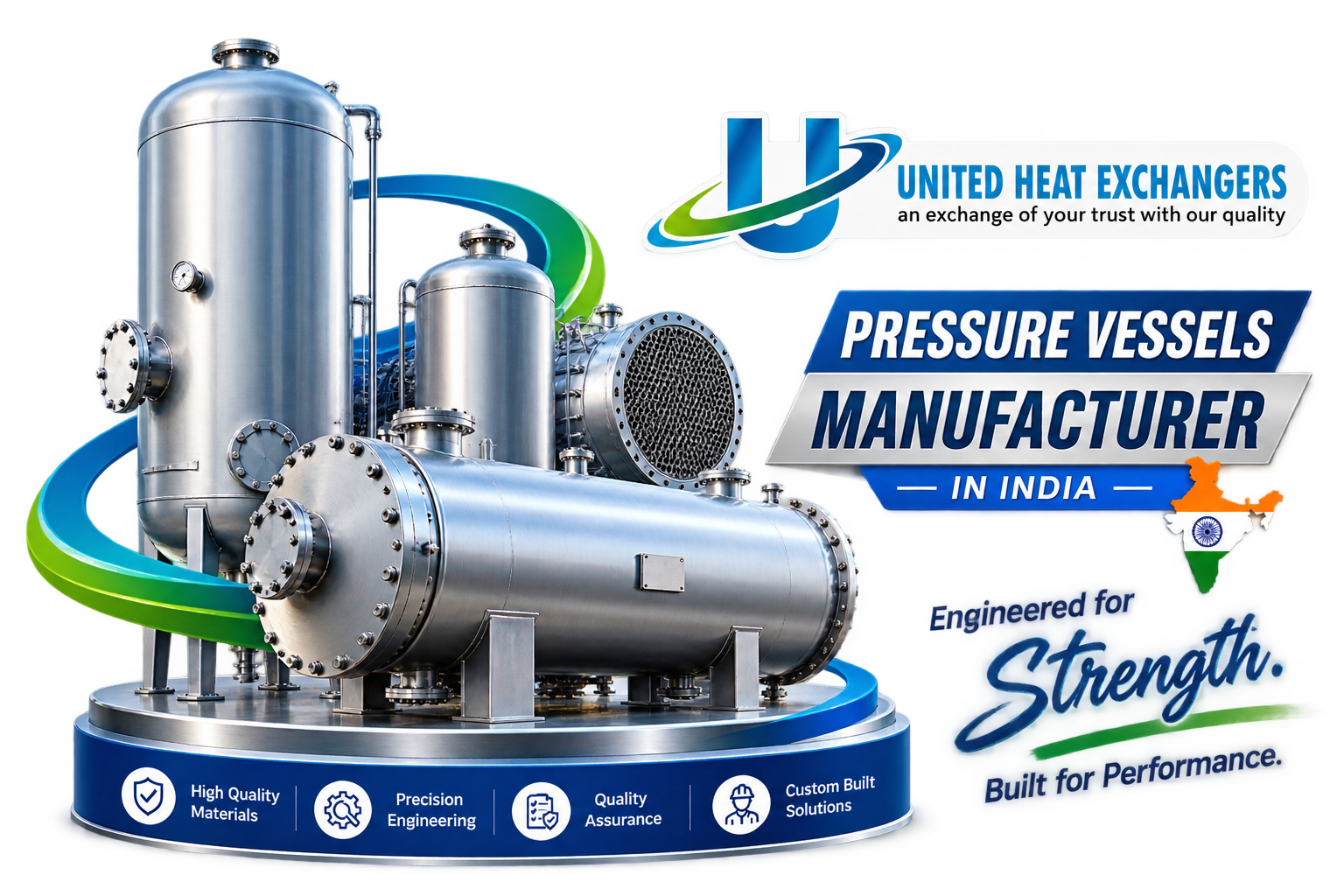
What Is a Pressure Vessel?
A pressure vessel is a sealed container engineered to hold a gas or liquid at a pressure significantly different from the surrounding atmosphere. Because a poorly designed vessel can fail catastrophically, every pressure vessel is built and inspected against a recognized design code — in most of the world, ASME Section VIII.
The category covers a wide range of equipment: heat exchangers, reactors, distillation columns, storage vessels, separators, and autoclaves are all pressure vessels, whatever their specific process function. What unites them is the underlying design math — wall thickness, design pressure, design temperature, and corrosion allowance, all calculated to a maximum allowable working pressure (MAWP).
Pressure vessels are among the most heavily regulated categories of industrial equipment for good reason: a vessel that fails under pressure can release stored energy violently, causing serious injury or major property damage. Design codes like ASME Section VIII exist specifically to prevent that failure mode through calculated, inspected, and certified construction.
💡 Quick definition: If it's a sealed vessel holding pressure above or below atmospheric, it's a pressure vessel — and it needs to be engineered to code, not just built to hold together.
Pressure Vessels Manufacturing in India — Who We Are
United Heat Exchangers is a pressure vessel manufacturer headquartered in Coimbatore, Tamil Nadu, manufacturing continuously since 1989. Every vessel we build is designed, fabricated, and tested inside our own ASME-certified works — not routed through a subcontracted workshop or trading arrangement.
Not every company advertising pressure vessels in India actually fabricates them. Some outsource pressure-boundary welding to independent job shops with no direct quality oversight. Our ASME U-Stamp, R-Stamp, and U2-Stamp are issued to our own facility — which is the detail worth confirming with any supplier before you commit.
What We Manufacture
Within the broad pressure vessel category, our manufacturing program encompasses both heat-transfer equipment and process vessels. We build pressure vessels engineered to move heat between fluids, as well as vessels designed to store, react, or separate them. Each of the following is an ASME Section VIII pressure vessel in its own right.
| Pressure Vessel Type | Configuration | Design Code |
|---|---|---|
| Shell and Tube Heat Exchanger | Fixed tube sheet, U-tube, floating head, kettle reboiler | ASME Sec. VIII, TEMA R/B/C |
| Process Reactors | Jacketed, half-pipe, limpet coil, internal heating/cooling | ASME Sec. VIII |
| Storage Vessels & Receivers | Horizontal, vertical, high-pressure bullets | ASME Sec. VIII |
| Separators & Columns | 2-phase, 3-phase, distillation and packed columns | ASME Sec. VIII |
If your project calls for a highly specialized custom configuration outside these categories, share your specification with us. Our engineering team will evaluate your requirements and provide an honest assessment of our fabrication capabilities.
Manufacturing Standards We Follow
Division 1 covers standard design rules suited to most process applications. Division 2 uses more detailed design rules that permit higher design pressures and thinner walls, at the cost of more extensive engineering analysis and non-destructive examination — we design and stamp to whichever your specification requires.
For projects executed entirely within India, IS 2825 (the Indian Standard Code for Unfired Pressure Vessels) is the commonly referenced domestic design code, alongside Indian Boiler Regulations (IBR) where a vessel qualifies as a boiler component. Let us know at the quote stage whether your project specifies IS 2825, ASME, or both, so we confirm the correct design basis upfront.
Design Considerations
Design Pressure & Temperature
Set with appropriate margin above normal operating conditions, not just equal to them, to keep the vessel safely inside its MAWP through upset conditions.
Corrosion Allowance
Added wall thickness sized to the process fluid's corrosivity and the vessel's intended service life, confirmed against your maintenance and inspection interval.
Division 1 vs. Division 2
Division 2 is worth considering when design pressure is high enough that thinner walls and lower material cost offset the added analysis and NDE.
NDE Extent
Spot or full radiography, and the joint efficiency that follows from it, are set by the service classification — lethal, hazardous, or general.
Nozzle & Flange Rating
Nozzle flanges are rated to ANSI B16.5 or the equivalent standard your piping specification calls for, confirmed before fabrication drawings are finalized.
Material Selection
Materials are specified to ASME/ASTM designations — SA-516 Grade 70 carbon steel plate, SA-240 stainless steel (304/316L/321/904L), duplex and super duplex, and nickel alloys including Hastelloy and Inconel for corrosive or high-temperature service — matched to the process fluid, not selected by default.
Positive material identification (PMI) verification and full mill traceability to the heat number are standard on every pressure-retaining component, documented and shipped with the vessel as part of the certification package.
💡 Worth checking: Ask for the mill test report before you approve materials. The ASME material designation on the MTR should match your datasheet exactly, heat number and all.
Industries Served
Pressure vessels manufactured in our Coimbatore facility are in service across refineries, petrochemical complexes, power plants, and process industries in India, alongside marine, pharmaceutical, and desalination applications supplied domestically and for export.
| Industry | Typical Application |
|---|---|
| Refineries | Preheating crude feedstocks, overhead vapor condensation, processed product cooling, and distillation tower reboiling |
| Petrochemicals | Reactor effluent cooling, monomer condensers, solvent recovery |
| Power Generation | Boiler feedwater heating systems, lubrication oil cooling units, and closed-loop cooling circuits |
| Chemical Plants | Chemical process temperature control, vapor condensation loops, and highly corrosive acid cooling |
| LNG & Gas Processing | Gas cooling, amine regeneration, glycol dehydration |
| Desalination | Brine heaters, distillate coolers, steam condensers in MED and MSF plants |
| Marine | Jacket water heat dissipation for marine engines, lubricating oil temperature reduction, and integrated central cooling networks |
| Pharma | Thermal management for active pharmaceutical ingredient (API) production, water for injection (WFI) systems, and sanitary steam processing |
Quality Certifications
For sale and operation in the United States and Canada, the ASME U-Stamp is a legal requirement, regardless of which country manufactures the vessel. For Europe, PED 2014/68/EU applies. We hold the ASME U-Stamp, R-Stamp, and U2-Stamp, alongside ISO 9001:2015 — each maintained through periodic, unannounced audits, not a one-time badge.
- ASME U-Stamp — the mandatory certification to legally install and operate pressure vessels across the United States and Canada
- ASME U2-Stamp — certified for advanced Division 2 engineering, ideal for high-pressure applications
- ASME R-Stamp — repair and alteration certification
- ISO 9001:2015 — certified quality management protocols, verified through external independent audits
- PED 2014/68/EU — required for projects routed through Europe
Why Choose United Heat Exchangers
35+ Years, One Product Category
Manufacturing pressure vessels for heat transfer service exclusively since 1989 — focus, not diversification.
Official ASME U, R, and U2 Accreditations Registered to Our Coimbatore Works
Independently audited certification issued directly to our Coimbatore facility, not borrowed through a partner workshop.
Vendor-Approved by India's Leading PSUs
ONGC, GAIL, NTPC, ISRO, and the Indian Navy have each cleared us through their own vendor-approval processes.
Complete Documentation as Standard
MDR, MTRs, radiography reports, and hydrostatic test certificates ship with every order, not as a paid add-on.
Export-Ready for the USA and UAE
ASME-stamped documentation and export packing handled in-house for international shipment, not outsourced to a freight agent.
Direct Engineering Contact
You work with the engineers who design and build your vessel, not a reseller or distributor layer.
Sourcing a Pressure Vessel in India?
Send your process data and get a technical proposal — design basis, material recommendation, and pricing — directly from the engineers who design and build your vessel.
Request My Free Quote →Delivery Timelines and Documentation
What's Included with Every Order
- ASME documentation package — Manufacturer's Data Report (MDR), material certifications (MTRs), weld records, NDE inspection reports
- Hydrostatic test certificate — tested to 1.5× design pressure; third-party witness available
- Certified Material Tracking — verifiable mill test certificates provided for all pressure-bearing parts, tracked directly to the raw material heat batch
- Lifetime technical support — direct engineering assistance for re-rating and troubleshooting
Frequently Asked Questions
What is a pressure vessel?
A pressure vessel is a sealed container engineered to hold a gas or liquid at a pressure significantly different from the surrounding atmosphere. It is designed and inspected against a recognized code — ASME Section VIII in most of the world — because a poorly designed vessel can fail catastrophically.
What’s the difference between ASME Div 1 and Div 2?
Division 1 covers standard design rules for most pressure vessel applications. Division 2 uses alternative, more detailed design rules that allow higher design pressures and thinner walls, at the cost of more extensive engineering analysis and non-destructive examination. The ASME U2-Stamp certifies Division 2 construction.
Do I need an ASME U-Stamp for a pressure vessel used in the USA or exported internationally?
Yes — for the United States and Canada the ASME U-Stamp is a legal requirement for pressure vessel sale and operation, regardless of which country manufactures it. For projects routed through Europe, PED 2014/68/EU certification applies instead or in addition.
What pressure vessel types does United Heat Exchangers manufacture?
We manufacture a diverse range of pressure vessels, including shell and tube heat exchangers (fixed tube sheet, U-tube, floating head, kettle reboiler), as well as process reactors, storage vessels, and separators. All are engineered and built to ASME Section VIII and, where applicable, TEMA standards.
What certifications should I check before selecting a pressure vessel manufacturer in India?
Confirm the ASME U-Stamp — and U2-Stamp if Division 2 construction is required — is held in the manufacturer's own name, check for ISO 9001:2015 quality certification, and ask whether design and fabrication are done in-house or subcontracted.
How do I request a quote for a pressure vessel?
Share your process fluid, design pressure and temperature, required volume or duty, material of construction, and applicable code. Our engineering team returns a technical proposal with design basis and budgetary pricing within 48 hours.
Author: Senthil Kumar, Technical Director — United Heat Exchangers Pvt. Ltd. | Last Updated: August 2026
Get a Free Pressure Vessel Quote — Engineered and Built in India
Share your process data — fluid, design pressure and temperature, volume or duty, material of construction, applicable code — and our in-house engineering team will size the right vessel and return budgetary pricing within 48 hours.
Request My Free Quote →