Author: Senthil Kumar, Technical Director | Updated: September 2026
Table of Contents
- Shell and Tube Heat Exchanger Manufacturer in Saudi Arabia
- Engineering for Saudi Process Conditions
- Construction Types Available
- Compliance — Saudi Aramco Engineering Standards, ASME and SASO
- Cities and Industrial Zones We Supply
- Sectors We Serve in the Kingdom
- Our Approach to the Saudi Market
- Shipping and Documentation to Saudi Ports
- Lead Times and Deliverables
- Frequently Asked Questions
Shell and Tube Heat Exchanger Manufacturer in Saudi Arabia
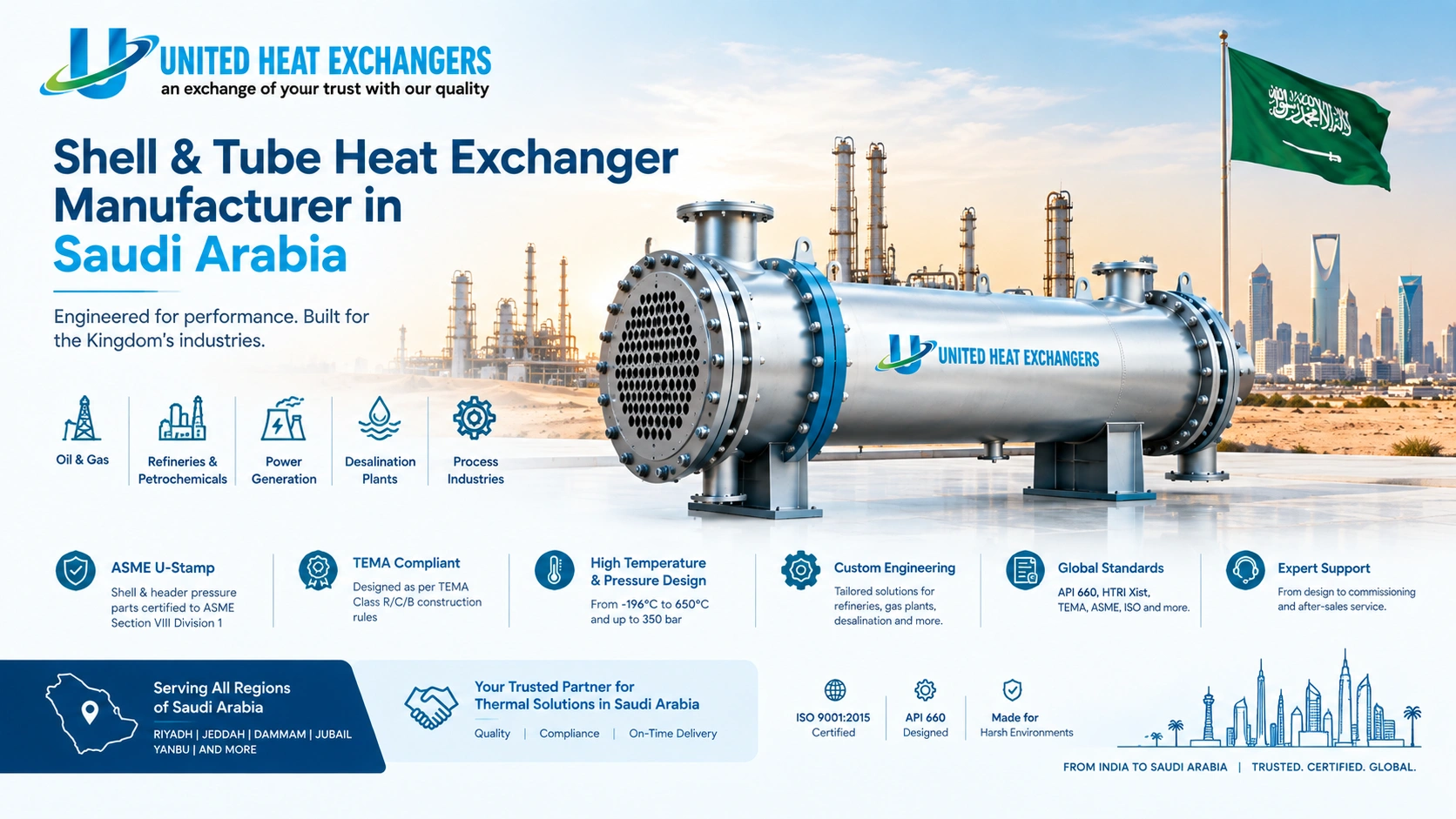
United Heat Exchangers supplies shell and tube heat exchangers into the Kingdom of Saudi Arabia from our fabrication facility in India, working with EPC contractors, licensors, and end operators across the hydrocarbon, water treatment, and industrial manufacturing sectors that anchor the Saudi economy.The scale of Saudi Arabia's process industry — from the Jubail and Yanbu industrial cities to the upstream gas and NGL facilities of the Eastern Province — means most projects specify equipment against Saudi Aramco Engineering Standards (SAES) in addition to ASME and TEMA. We build to that combined requirement as standard, not as a custom add-on, so bids and technical bid evaluations move forward without a second round of design clarification.
Engineering for Saudi Process Conditions
A heat exchanger sized against a generic international datasheet frequently under-performs once installed in the Kingdom — the combination of extreme summer ambient temperature, Gulf or Red Sea seawater cooling, and high sand/dust loading in air-cooled applications changes the real-world performance envelope.
Confirm Site Ambient
Design dry-bulb and wet-bulb temperatures are pulled from the specific project location, not a national average.
Check Cooling Water Source
Gulf coast, Red Sea coast, or inland cooling tower water each carry a different chloride and hardness profile.
Rate the Real Approach
HTRI thermal rating uses the actual elevated cooling medium temperature, so the promised outlet duty is achievable, not theoretical.
Select Fouling Margin
Higher fouling factors are applied where produced water, sour gas condensate, or high-TDS cooling water is expected.
Confirm Material Fit
Chloride content on both sides governs whether carbon steel, duplex, or titanium tubes are the correct specification.
Engineering Insight — Gulf Coast vs Red Sea Coast Duty: Cooling water drawn from the Arabian Gulf near Jubail and Dammam typically carries higher chloride and total dissolved solids than Red Sea intake water near Yanbu and Jeddah, at broadly comparable ambient temperature. This difference changes the corrosion margin, not just the thermal rating, and is one of the first things we confirm before recommending tube material for a Saudi project — assuming a single "Gulf region" default across both coasts is a common and avoidable design error.
Construction Types Available
Every core shell and tube configuration used in Saudi refining, gas processing, and petrochemical service is available from our standard design library, engineered around your specific tubesheet and header requirement.
Fixed Tubesheet
Economical construction for clean dutiesBoth tubesheets weld directly into the shell — the lowest-cost configuration where the shell-side fluid does not require mechanical bundle cleaning.
- Lowest fabrication cost of the standard configurations
- Fits utility water and closed-loop process cooling duties
- Expansion joint fitted where thermal differential requires it
U-Tube Bundle
Independent thermal expansion, removable bundleA single tubesheet carries both legs of each U-shaped tube, letting the bundle expand independently of the shell and be pulled for tube-side service.
- Handles a wide shell-to-tube temperature differential
- Common on gas plant inter-coolers and reboiler duties
- Bundle withdrawal simplifies turnaround-cycle maintenance
Floating Head
Full two-sided cleaning accessAn independently floating tubesheet lets the entire bundle come out for cleaning on both the process and cooling side — the default choice for fouling hydrocarbon streams.
- Preferred design for crude, condensate, and heavy-residue duty
- TEMA Class R detailing as standard for refinery-severity service
- Matches most Saudi Aramco refinery specification defaults
Kettle-Type Reboiler
Enlarged shell for vapour disengagementAn enlarged shell diameter above the tube bundle gives the vapour space needed for clean disengagement in reboiler and vaporiser service common across gas processing trains.
- Sized for the specific vapour load and liquid level control
- Standard for NGL fractionation and gas dehydration reboilers
- Rated in HTRI for both boiling-side and heating-medium performance
Compliance — Saudi Aramco Engineering Standards, ASME and SASO
Saudi projects typically layer three sets of requirements on a single exchanger, and our documentation package is structured to answer all three without extra correspondence during technical bid evaluation.
| Requirement | What It Covers | What We Provide |
|---|---|---|
| Saudi Aramco Engineering Standards (SAES) | Project-specific supplementary requirements layered on top of API and ASME base codes, referenced by contract number | Design and documentation cross-referenced to the applicable SAES clauses cited in your enquiry |
| API Standard 660 | Base mechanical specification for shell and tube heat exchangers in refinery and gas plant service | Completed API 660 data sheet and compliant tubesheet/baffle design |
| ASME Section VIII Division 1 | Pressure vessel design, weld NDE, and hydrostatic test requirements for all pressure-retaining parts | ASME U-Stamp and Manufacturer's Data Report (Form U-1) |
| SASO / Gulf Conformity | Saudi Standards, Metrology and Quality Organization conformity requirements for equipment entering the Kingdom | Product documentation prepared to support SASO conformity assessment where required by the importer |
| TEMA Class R | Mechanical construction detail for refinery-severity tube bundles | Standard construction class unless the enquiry specifies otherwise |
Bid Tip: If your enquiry references specific SAES document numbers, include them with the process datasheet. We cross-check the design against the cited clauses before issuing the technical proposal, rather than leaving that reconciliation for the technical bid evaluation stage.
Cities and Industrial Zones We Supply
Our Saudi enquiries concentrate around the Kingdom's established hydrocarbon and industrial corridors, though we ship anywhere in the country with an active project site.
Jubail Industrial City
The Kingdom's primary petrochemical and refining hub under the Royal Commission for Jubail and Yanbu — our highest-volume Saudi destination for API 660 and refinery-severity exchangers.
Dammam & Khobar
Upstream operator offices and supporting fabrication and logistics base for Eastern Province oil and gas fields, served with process cooling and gas compression heat exchangers.
Dhahran
Home to major upstream operations and technical centres — supplied primarily through EPC contractors executing field and gas plant projects in the surrounding area.
Yanbu Industrial City
The Kingdom's western refining and petrochemical counterpart to Jubail, with Red Sea cooling water conditions that call for a separate material and fouling review from Gulf-coast projects.
Riyadh
Head offices for major EPC contractors and industrial groups, along with district cooling and general manufacturing process cooling demand in the capital region.
Jeddah & Rabigh
Red Sea port access and the Rabigh refining and petrochemical complex, supplied with both refinery-severity units and general industrial process coolers.
Sectors We Serve in the Kingdom
| Sector | Representative Duty | Typical Material |
|---|---|---|
| Refining | Crude and vacuum unit preheat trains, product coolers, reboilers | Carbon steel and stainless steel, floating head construction |
| Petrochemical | Reactor feed/effluent exchangers, quench coolers, olefins train services | Stainless steel and duplex, per stream chemistry |
| Gas Processing & NGL | Amine and glycol coolers, compressor inter- and after-coolers, kettle reboilers | Carbon steel and 316L stainless steel |
| Water & Desalination | Brine circulation, seawater intake, and product water coolers | Titanium and duplex stainless steel |
| Mining, Minerals & Fertiliser | Process slurry coolers, ammonia and phosphate process heat exchangers | Duplex and Hastelloy per acid/chloride exposure |
Our Approach to the Saudi Market
SAES Cross-Referencing Before Quotation
When an enquiry cites specific Saudi Aramco standard clauses, we check the design against them before the proposal goes out — reducing the technical query cycle that usually follows a generic international quote.
Real-Site Thermal Rating
HTRI sizing uses the design ambient and cooling water conditions for the actual project coast — Gulf or Red Sea — rather than a single national assumption.
Documentation Built for TBE Cycles
API 660 data sheets, ASME U-1 forms, and material certification are issued in a format aligned to how Saudi EPC contractors run technical bid evaluation, cutting rounds of clarification.
In-House Engineering End to End
Thermal design, material selection, fabrication, and export documentation stay in-house through the full order — no subcontracted design step that could introduce inconsistency against the cited standards.
Request a Technical Proposal for Your Saudi Project
Share your process datasheet, any cited Saudi Aramco standard references, project location, and cooling water source. We return an HTRI-sized thermal proposal and completed API 660 data sheet within 48 hours.
Request My Free Quote →Shipping and Documentation to Saudi Ports
Deliveries to the Kingdom are handled in-house from export packing through to the documentation set the receiving project team needs for customs clearance and site handover.
- Routing to either coast — sea freight quoted to King Abdulaziz Port (Dammam) for Eastern Province projects or Jeddah Islamic Port for Red Sea and central-region projects
- Export documentation prepared directly — commercial invoice, packing list, certificate of origin, and bill of lading issued without depending on a third-party forwarder for accuracy
- Third-party inspection coordination — witness testing scheduled with your project's appointed TPI agency ahead of container loading, where specified
- Marine-grade export packing — nozzle protection, desiccant packing, and crating specified for sea transit and high-humidity coastal storage
- Complete documentation shipped with the unit — ASME U-1 forms, mill certificates, NDE reports, and the O&M manual travel with the equipment for site commissioning
Lead Times and Deliverables
- HTRI thermal performance certificate — heat transfer and pressure drop guaranteed at the project's real site conditions
- Signed API 660 data sheet — tube specification, header type, and nozzle schedule matching the as-built unit
- ASME U-Stamp and Form U-1 — issued by the Authorised Inspector for all pressure-retaining parts
- Full material traceability — mill certificates and NDE reports for every pressure part, signed by an ASNT Level II inspector
- Operations and maintenance manual — cleaning procedure, bundle withdrawal instructions, and a two-year spares list
Frequently Asked Questions — Shell and Tube Heat Exchangers in Saudi Arabia
Can you design to Saudi Aramco Engineering Standards?
Yes. Where an enquiry cites specific SAES document numbers, we review the design against those clauses before the technical proposal is issued, so the quotation already reflects the project's actual specification rather than a generic API/ASME baseline.
Do you ship to both the Eastern Province and the Red Sea coast?
Yes — sea freight is quoted to King Abdulaziz Port in Dammam for Jubail, Dammam, Khobar, and Dhahran projects, or to Jeddah Islamic Port for Yanbu, Jeddah, Rabigh, and Riyadh-area deliveries, with export documentation matched to the receiving port.
Is the cooling water chemistry different between Jubail and Yanbu?
Generally, yes — Gulf coast intake water near Jubail and Dammam tends to carry higher chloride and TDS levels than Red Sea intake near Yanbu at comparable temperature. We confirm the actual site water analysis before recommending tube material rather than assuming a single Gulf-region default.
What documentation do you provide for technical bid evaluation?
A completed API 660 data sheet, HTRI thermal performance certificate, GA and fabrication drawings, and material specification sheet accompany the technical proposal — the standard package Saudi EPC contractors require to run a TBE without a follow-up clarification round.
What is the typical lead time for delivery into the Kingdom?
Standard carbon or stainless steel units are ready ex-works in 7–11 weeks; alloy or ASME U-Stamp units in 14–22 weeks. Sea freight to Dammam or Jeddah typically adds a further 2–3 weeks. Expedited manufacturing is available where a turnaround or shutdown schedule requires it.
Can you replace an existing exchanger on an operating unit?
Yes. Send the original fabrication drawing, nameplate data, or the physical dimensions and process conditions of the unit in service, and we will engineer a like-for-like or material-upgraded replacement sized to your shutdown window.
Author: Senthil Kumar, Technical Director — United Heat Exchangers Pvt. Ltd. | Last Updated: September 2026