Table of Contents — Jump to Any Section
- What Is a Spiral Heat Exchanger? (Core Definition)
- The Problem with Slurries (And How Spirals Solve It)
- The Physics: The "Self-Cleaning" Scrubbing Effect
- The 3 Types of Spiral Heat Exchangers Explained
- Flow Arrangements: Perfect Countercurrent Design
- Spiral vs. Shell & Tube vs. Plate Heat Exchangers
- Industrial Applications: Where Spirals Dominate
- Material Selection: Fighting Extreme Corrosion
- Maintenance: The Single-Door Cleaning Advantage
- Understanding Spiral U-Values and Efficiency
- Expert Guide: Sizing Your Spiral Heat Exchanger
- Frequently Asked Questions (FAQs)
- Why Choose United Heat Exchangers?
What Is a Spiral Heat Exchanger?
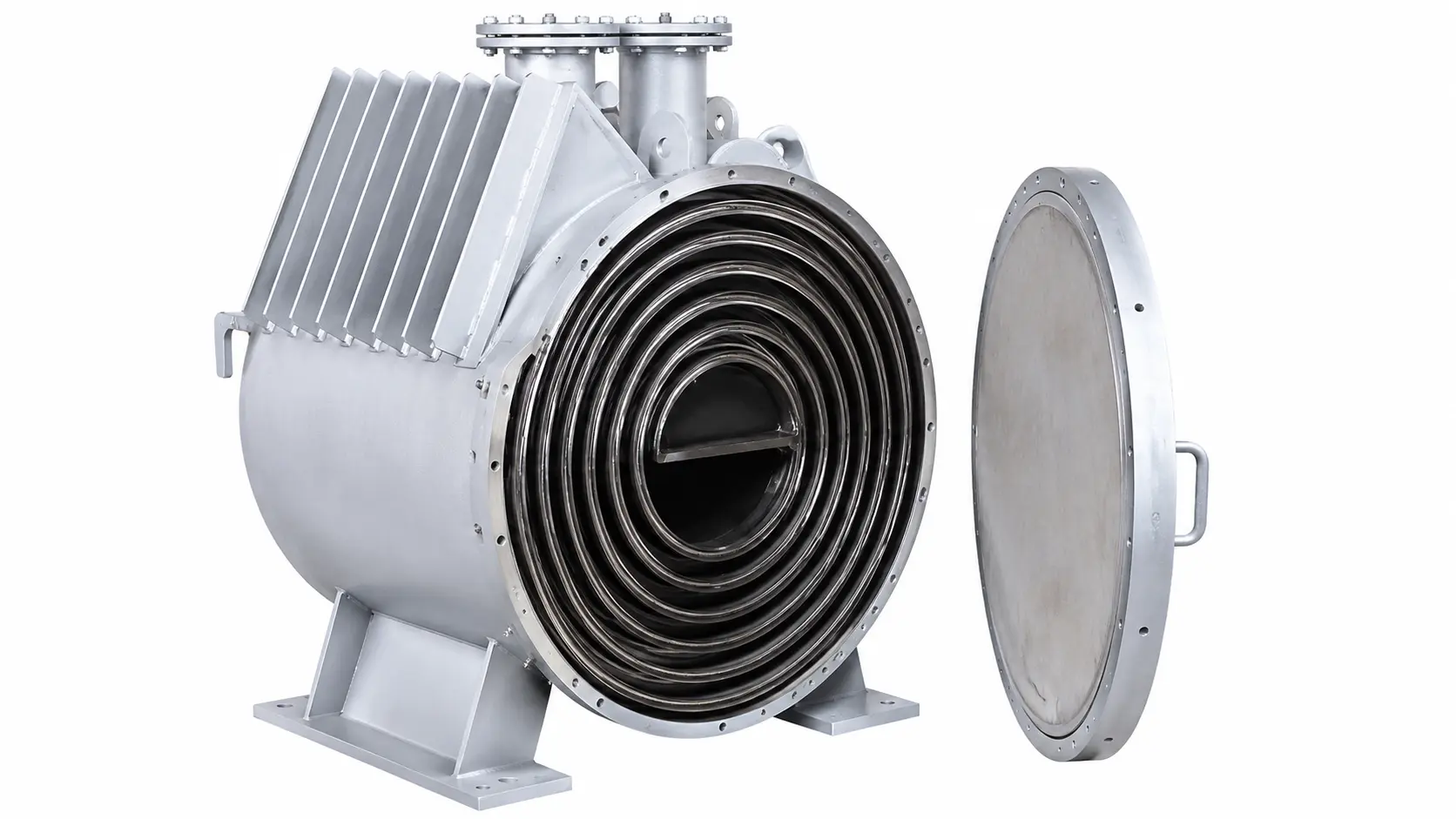
A spiral heat exchanger is a highly specialized thermal transfer device formed by rolling two flat metal plates around a central core to create two concentric, spiral-shaped channels. Unlike conventional designs that split fluids into dozens of small tubes, a spiral heat exchanger features a single, continuous flow path for each fluid.
This single-channel design is revolutionary for one specific reason: it easily processes highly viscous, dirty, or particle-laden fluids (like slurries, sludge, and heavy oils) that would instantly clog a traditional shell-and-tube or plate heat exchanger.
💡 The simplest way to picture it: Take two long metal rulers, place a slight gap between them, and roll them up tightly like a cinnamon roll. Hot fluid flows through the first gap, while cold fluid flows through the second gap. Because there is only one continuous path for the dirty fluid to take, it cannot bypass blockages—it simply accelerates and forces the blockage out.
The Problem with Slurries (And How Spirals Solve It)
In industries like wastewater treatment, palm oil processing, and chemical resin manufacturing, process fluids are rarely clean water. They are thick, sticky, and loaded with suspended solids. When these fluids enter a standard shell-and-tube heat exchanger, they face a massive problem: flow distribution.
- The Tube Blockage Cascade: In a tubular exchanger, fluid enters a header and splits into 100 different tubes. If a piece of debris blocks Tube #1, the fluid simply takes the path of least resistance and flows through the other 99 tubes.
- The Dead Zone: Tube #1 is now a "dead zone." The fluid inside it bakes onto the tube wall, hardening the blockage permanently.
- The Spiral Solution: In a spiral heat exchanger, there is only ONE channel. If scale or debris begins to build up on the wall, the channel cross-section narrows. Because the fluid volume remains constant, the local velocity of the fluid *increases* directly at the site of the blockage. This sudden surge in velocity physically scrubs the wall, washing the blockage away before it can harden.
📌 Engineering Fact: This phenomenon is known as the "Self-Cleaning Effect." It allows spiral heat exchangers to operate continuously for months—or even years—in heavy fouling applications where a shell-and-tube unit would require mechanical drilling every few weeks.
The Physics: Flow Dynamics in a Spiral Geometry
Heat transfer in a spiral exchanger benefits from the constant curvature of the channel walls. As fluid moves through the spiral curve, centrifugal forces create secondary rotational flows (known as Dean vortices) within the fluid stream.
📈 The Self-Cleaning Velocity Mechanism
As the channel narrows due to fouling, the localized fluid velocity increases exponentially, creating high shear stress that automatically scrubs the heat transfer surface clean.
Enhanced Turbulence at Lower Velocities
Because of the curved path and welded spacer studs (which maintain the gap between the plates), flow becomes highly turbulent at much lower Reynolds numbers than in straight tubes. This heightened turbulence eliminates stagnant boundary layers, drastically improving the convective heat transfer coefficient (h) even for incredibly thick, viscous fluids like molasses or heavy fuel oil.
The 3 Types of Spiral Heat Exchangers Explained
Spiral heat exchangers are categorized by how the fluid enters and navigates the channels. United Heat Exchangers engineers three distinct configurations based on your phase state (liquid or gas).
Both fluids flow in spiral paths in perfect countercurrent directions. The hot fluid enters at the center and spirals outward, while the cold fluid enters at the periphery and spirals inward. Both channels are fully closed.
▶ Best for: Slurries, wastewater, heavy oils, heat recovery.
The cooling liquid spirals normally through a closed channel. The vapor, however, flows straight down vertically in crossflow across the open spiral channel, condensing as it falls.
▶ Best for: High-vacuum condensation, top-column vapor recovery.
A hybrid design where the vapor condenses partially in crossflow, and the remaining vapor/condensate continues through a closed spiral path to sub-cool the liquid. Designed for mixed vapor/gas duties.
▶ Best for: Evaporation, reboilers, mixed gas condensing.
Spiral vs. Shell & Tube vs. Plate Heat Exchangers
How do you know if you need a spiral unit instead of a traditional design? If your fluid is clean water, a spiral is overkill. If your fluid contains 20% solids, a spiral is mandatory. Here is the engineering comparison:
| Feature | Spiral Heat Exchanger | Shell & Tube | Plate Heat Exchanger (PHE) |
|---|---|---|---|
| Fouling Resistance | Excellent (Self-cleaning) | Poor (Tubes clog rapidly) | Poor (Corrugations trap particles) |
| Viscosity Handling | Excellent (No flow distribution issues) | Moderate (Bypass issues on shell side) | Poor (High pressure drop) |
| Physical Footprint | Compact (Rolled design saves space) | Large (Requires 2x length for tube pulling) | Very Compact |
| Thermal Efficiency | High (True countercurrent flow) | Moderate (Baffles create dead zones) | Very High |
| Maintenance Access | Easy (Swing open single door) | Difficult (Requires heavy bundle extraction) | Easy (Unbolt frame) |
| Max Pressure | Moderate (~25 bar max) | Extreme (300+ bar) | Moderate (~30 bar max) |
✅ Selection Rule of Thumb: If your fluid requires you to install a strainer to protect the heat exchanger, you should probably be using a spiral heat exchanger instead.
Industrial Applications: Where Spirals Dominate
Spiral heat exchangers are the unsung heroes of dirty industries. They excel anywhere that conventional thermal transfer fails due to clogging, scaling, or burning.

Wastewater Treatment
Municipal sludge heating, anaerobic digester temp control, effluent cooling.

Palm Oil & Edible Oils
Deodorizer effluent cooling, fatty acid processing, high-viscosity organics.

Mining & Minerals
Alumina processing (Bayer process), zinc extraction, heavy mineral slurries.
Chemical & Polymers
PVC slurry cooling, latex processing, highly viscous polymer reactions.

Petrochemicals
Heavy fuel oil heating, tar processing, bitumen, and asphalt cooling.
Maintenance: The Single-Door Cleaning Advantage
Even with self-cleaning physics, extreme industrial fluids eventually require manual cleaning. This is where the mechanical design of a spiral heat exchanger drastically reduces OPEX (Operational Expenditure).
⚠ The Shell & Tube Problem: Cleaning a fouled shell-and-tube heat exchanger often requires a crane to remove the heavy tube bundle, followed by hydro-blasting each individual tube. This labor-intensive process can keep a plant offline for several days.
The Spiral Solution: A Type I spiral heat exchanger features hinged covers (doors) on both ends. To clean it, an operator simply undoes the hook bolts and swings the heavy steel door open like a bank vault. This immediately exposes the entire spiral channel for inspection and high-pressure water jetting. No cranes, no bundle pulling, and only hours of downtime instead of days.
Expert Guide: Sizing Your Spiral Heat Exchanger
Specifying a spiral unit requires exact process data to calculate the channel gap width correctly. Too wide, and you lose the self-cleaning velocity. Too narrow, and large solids will jam the entrance.
Analyze Particle Size
Identify the maximum diameter of solid particles in your fluid. The channel gap (typically 5mm to 30mm) must be sized larger than this.
Determine Viscosity Profiles
Heavy oils change viscosity drastically as they cool. Provide viscosity data at both inlet and outlet temperatures.
Select the Alloy
Because spiral plates are formed by cold-rolling, highly ductile materials like Stainless Steel 316L, Duplex 2205, or Titanium are ideal.
Apply Design Codes
Ensure the manufacturer is certified to stamp the vessel per ASME Section VIII Div 1 or regional codes like IS 2825.
Tired of Unplanned Plant Shutdowns?
Stop cleaning clogged tubes. Upgrade your worst fouling applications to a United Heat Exchangers Spiral unit. Send us your slurry or wastewater process data, and our thermal experts will provide a guaranteed thermal design.
Get Your Custom Quote in 48 Hours →Frequently Asked Questions (FAQs)
1. Can a spiral heat exchanger handle high pressures?
Due to its rolled geometric structure and flat cover plates, spiral heat exchangers are generally limited to low-to-medium pressures (up to 25 bar / 350 psi). If your process exceeds this, a high-pressure Shell & Tube or Hairpin exchanger is required.
2. How does a spiral heat exchanger achieve "self-cleaning"?
Because there is only one continuous channel per fluid, any scale or blockage reduces the channel width. This forces the fluid to accelerate rapidly through the narrowed gap, creating an intense "scrubbing" shear force that washes the scale away.
3. What is the maximum channel gap available?
Depending on the manufacturer and thermal duty, channel gaps can be engineered anywhere from 5 mm for relatively clean fluids up to 30 mm (or more) for heavy municipal sludges containing large particulate matter.
4. Are spiral heat exchangers expensive?
The initial capital expenditure (CAPEX) of a spiral heat exchanger is often higher than a basic carbon-steel shell and tube unit. However, because they eliminate constant mechanical cleaning and production downtime, the return on investment (ROI) for dirty services is usually achieved in less than 12 months.
Why Choose United Heat Exchangers?
United Heat Exchangers Pvt. Ltd is India's premier fabricator of complex thermal transfer equipment. For over 35 years, we have successfully replaced failing tubular exchangers with custom-engineered spiral solutions for global wastewater, palm oil, and chemical plants.
- Custom Channel Gaps: Precisely engineered spacing based on your exact slurry particle size to guarantee self-cleaning.
- ASME U-Stamp Certified: Every spiral pressure vessel undergoes rigorous, independent code inspection for supreme safety.
- Premium Alloy Fabrication: Expertise in rolling and welding SS316L, Duplex 2205, Hastelloy, and Titanium grades.
- ISO 9001:2015 Quality: Flawless fabrication management spanning procurement, automated welding, and final NDT testing.
- In-House Thermal Design: Leveraging industry-leading ASPEN EDR software for pinpoint thermal accuracy.
- Rapid 48-Hour Quotes: Fast, highly competitive budgetary pricing to keep your project moving.
Solve Your Fouling Problems Permanently
Don't let dirty fluids dictate your production schedule. Share your challenging process conditions with us today and receive a comprehensive spiral engineering recommendation and quote within 48 hours.
Request My Free Engineering Quote →📄 Read More Technical GuidesExplore Our Complete Product Range: Shell and Tube | Plate Heat Exchangers | Air Cooled | Finned Tube | Double Pipe | Marine Grade | Compact PCHE | Brazed Plate | Hairpin | Pressure Vessels
Author: Senthil Kumar, Technical Director — United Heat Exchangers Pvt. Ltd | Published: August 2026 | Category: Heat Exchangers | Last Updated: August 2026